

 The
following alphabetical list of operating nuclear power reactors
provides access to plant-specific actions related to the Japan Nuclear
Accident at Fukushima Dai-ichi. Specifically, these actions include
Orders and Requests for Information (RFIs) issued by the U.S. Nuclear
Regulatory Commission (NRC), as well as the related responses submitted
by the plant licensees.
The
following alphabetical list of operating nuclear power reactors
provides access to plant-specific actions related to the Japan Nuclear
Accident at Fukushima Dai-ichi. Specifically, these actions include
Orders and Requests for Information (RFIs) issued by the U.S. Nuclear
Regulatory Commission (NRC), as well as the related responses submitted
by the plant licensees.


 At
Fukushima, flooding from the tsunami disabled internal electrical power
systems after the earthquake had cut off external power sources,
leaving the plants with only a few hours' worth of battery power.
Nuclear power plants need electrical power 24 hours per day, even when
the nuclear reactors are shut down, to run equipment that cools the
reactor core and spent nuclear fuel. The NRC issued a Mitigation
Strategies Order on March 12, 2012, requiring all U.S. nuclear power
plants to implement strategies that will allow them to cope without
their permanent electrical power sources for an indefinite amount of
time These strategies must keep the reactor core and spent fuel cool, as
well as protect the thick concrete containment buildings that surround
each reactor. The mitigation strategies are expected to use a
combination of currently installed equipment (e.g., steam-powered
pumps), additional portable equipment that is stored on-site, and
equipment that can be flown in or trucked in from support centers.
At
Fukushima, flooding from the tsunami disabled internal electrical power
systems after the earthquake had cut off external power sources,
leaving the plants with only a few hours' worth of battery power.
Nuclear power plants need electrical power 24 hours per day, even when
the nuclear reactors are shut down, to run equipment that cools the
reactor core and spent nuclear fuel. The NRC issued a Mitigation
Strategies Order on March 12, 2012, requiring all U.S. nuclear power
plants to implement strategies that will allow them to cope without
their permanent electrical power sources for an indefinite amount of
time These strategies must keep the reactor core and spent fuel cool, as
well as protect the thick concrete containment buildings that surround
each reactor. The mitigation strategies are expected to use a
combination of currently installed equipment (e.g., steam-powered
pumps), additional portable equipment that is stored on-site, and
equipment that can be flown in or trucked in from support centers. 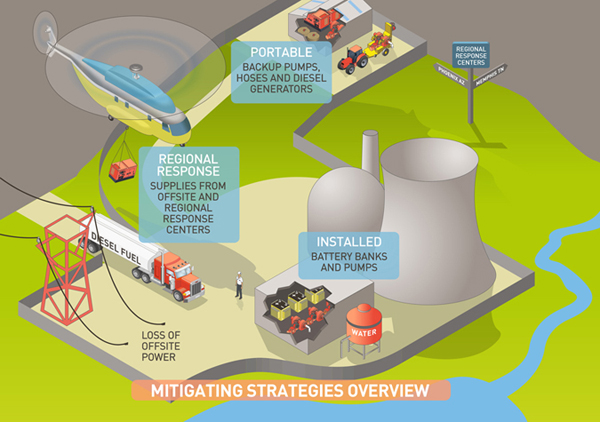
 Operating reactor sites are using present-day information to reevaluate
the earthquake effects—or hazards—that could impact their site. These
newly reevaluated hazards, if worse than what the plant had originally
calculated, will be analyzed to determine if plant structures, systems,
and/or components need to be updated to protect against the new hazard.
The NRC will review each step in the analysis process and take action
to require plant changes as necessary.
Operating reactor sites are using present-day information to reevaluate
the earthquake effects—or hazards—that could impact their site. These
newly reevaluated hazards, if worse than what the plant had originally
calculated, will be analyzed to determine if plant structures, systems,
and/or components need to be updated to protect against the new hazard.
The NRC will review each step in the analysis process and take action
to require plant changes as necessary.  During the accident at Fukushima, the plants lost their ability to cool
the spent fuel pools. Plant operators couldn't determine how much
water was in the pools during the accident, which was a problem. If
enough water boiled away or was otherwise lost, the spent fuel rods
could emerge from the receding water and potentially release significant
amounts of radiation. Weeks later it was learned that the spent fuel
was always covered, but the information gap diverted significant
attention and extremely limited resources from more important tasks
during the accident. The NRC issued an Order on March 12, 2012,
requiring all U.S. nuclear power plants to install water level
instrumentation in their spent fuel pools. The instrumentation must
remotely report at least three distinct water levels: 1) normal level;
2) low level but still enough to shield workers above the pools from
radiation; and 3) a level near the top of the spent fuel rods where more
water should be added without delay.
During the accident at Fukushima, the plants lost their ability to cool
the spent fuel pools. Plant operators couldn't determine how much
water was in the pools during the accident, which was a problem. If
enough water boiled away or was otherwise lost, the spent fuel rods
could emerge from the receding water and potentially release significant
amounts of radiation. Weeks later it was learned that the spent fuel
was always covered, but the information gap diverted significant
attention and extremely limited resources from more important tasks
during the accident. The NRC issued an Order on March 12, 2012,
requiring all U.S. nuclear power plants to install water level
instrumentation in their spent fuel pools. The instrumentation must
remotely report at least three distinct water levels: 1) normal level;
2) low level but still enough to shield workers above the pools from
radiation; and 3) a level near the top of the spent fuel rods where more
water should be added without delay. Operating reactor sites are using present-day information to reevaluate
the flooding effects—or hazards—that could impact their site. These
newly reevaluated hazards, if worse than what the plant had originally
calculated, will be analyzed to determine if plant structures, systems,
and/or components need to be updated to protect against the new hazard.
The NRC will review each step in the analysis process and take action
to require plant changes as necessary.
Operating reactor sites are using present-day information to reevaluate
the flooding effects—or hazards—that could impact their site. These
newly reevaluated hazards, if worse than what the plant had originally
calculated, will be analyzed to determine if plant structures, systems,
and/or components need to be updated to protect against the new hazard.
The NRC will review each step in the analysis process and take action
to require plant changes as necessary.  The
NRC requires U.S. nuclear power plants to be designed and built to
safely withstand a set of unlikely but harmful events such as equipment
failure, pipe breaks, and severe weather; these are called design-basis
requirements. The nuclear power plants at Fukushima experienced flooding
and seismic events that went beyond the design-basis levels set by the
Japanese regulator. The NRC's Near Term Task Force, in their
examination of the Fukushima event, recognized that the NRC's
design-basis requirements needed to be enhanced to deal with events that
are very unlikely but beyond the current design-basis requirements. As a
result, the task force recommended that the NRC establish a logical,
systematic, and coherent regulatory framework that appropriately
balances multiple layers of protection and risk considerations to deal
with events beyond the current NRC design basis.
The
NRC requires U.S. nuclear power plants to be designed and built to
safely withstand a set of unlikely but harmful events such as equipment
failure, pipe breaks, and severe weather; these are called design-basis
requirements. The nuclear power plants at Fukushima experienced flooding
and seismic events that went beyond the design-basis levels set by the
Japanese regulator. The NRC's Near Term Task Force, in their
examination of the Fukushima event, recognized that the NRC's
design-basis requirements needed to be enhanced to deal with events that
are very unlikely but beyond the current design-basis requirements. As a
result, the task force recommended that the NRC establish a logical,
systematic, and coherent regulatory framework that appropriately
balances multiple layers of protection and risk considerations to deal
with events beyond the current NRC design basis. The Fukushima accident disabled the plants' ability to cool their
reactor cores, causing heat and pressure to build within the concrete
containment buildings that surround the reactors. This buildup
eventually damaged the buildings and made it easier for radioactive
material to reach the environment. The NRC issued an Order on March 12,
2012, requiring all U.S. nuclear power plants with the Fukushima-style
containment design to install a reliable, hardened vent that can remove
heat and pressure before potential damage to a reactor core occurs. This
not only helps preserve the integrity of the containment building, but
can also help delay reactor core damage or melting. After issuing the
order, additional NRC evaluations examined the benefits of venting after
reactor core damage occurs. In June 2013, the NRC modified the Order
to ensure those vents will remain functional in the conditions following
reactor core damage. The NRC considered revising its regulations
through the
The Fukushima accident disabled the plants' ability to cool their
reactor cores, causing heat and pressure to build within the concrete
containment buildings that surround the reactors. This buildup
eventually damaged the buildings and made it easier for radioactive
material to reach the environment. The NRC issued an Order on March 12,
2012, requiring all U.S. nuclear power plants with the Fukushima-style
containment design to install a reliable, hardened vent that can remove
heat and pressure before potential damage to a reactor core occurs. This
not only helps preserve the integrity of the containment building, but
can also help delay reactor core damage or melting. After issuing the
order, additional NRC evaluations examined the benefits of venting after
reactor core damage occurs. In June 2013, the NRC modified the Order
to ensure those vents will remain functional in the conditions following
reactor core damage. The NRC considered revising its regulations
through the  In light of the effects from the extreme earthquake and tsunami of
March 11, 2011, on the nuclear power plants at Fukushima, the NRC
concluded U.S. nuclear power plants needed to reaffirm their existing
ability to resist quakes and flooding. On March 12, 2012, the NRC asked
U.S. nuclear power plants to perform a detailed inspection, or
"walkdown," of their currently installed seismic and flooding protection
features. The plants had to ensure the features met current
requirements, and also identify, correct, and report any degraded
conditions. The plants completed their walkdowns by November 2012; NRC
inspectors have done follow-up inspections and the agency has issued
plant-specific assessments of the licensee's walkdown reports.
In light of the effects from the extreme earthquake and tsunami of
March 11, 2011, on the nuclear power plants at Fukushima, the NRC
concluded U.S. nuclear power plants needed to reaffirm their existing
ability to resist quakes and flooding. On March 12, 2012, the NRC asked
U.S. nuclear power plants to perform a detailed inspection, or
"walkdown," of their currently installed seismic and flooding protection
features. The plants had to ensure the features met current
requirements, and also identify, correct, and report any degraded
conditions. The plants completed their walkdowns by November 2012; NRC
inspectors have done follow-up inspections and the agency has issued
plant-specific assessments of the licensee's walkdown reports. 


 After the Fukushima accident, a task force of senior NRC staff reviewed
the circumstances of the event to determine what lessons could be
learned. In July 2011, the task force provided
After the Fukushima accident, a task force of senior NRC staff reviewed
the circumstances of the event to determine what lessons could be
learned. In July 2011, the task force provided 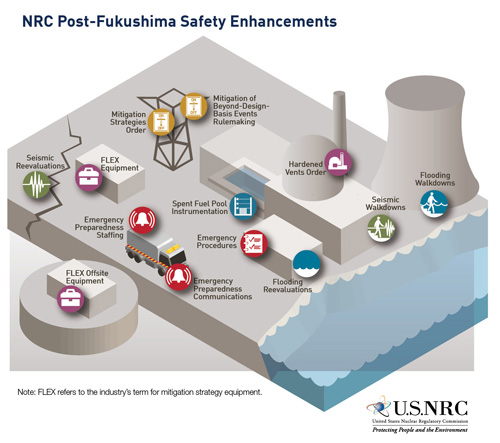

An International Atomic Energy Agency (IAEA) team of experts
said Poland has significantly enhanced its regulatory framework for
nuclear and radiation safety in recent years, while noting that work
remains in implementing its nuclear and radioactive waste-management
programmes.
The Integrated Regulatory Review Service (IRRS) team concluded an eight-day follow-up mission to Warsaw today to assess the regulatory safety framework in Poland. The mission was hosted by the Government and the National Nuclear Energy Agency (PAA), which is responsible for nuclear and radiation safety regulation in the country.
Using IAEA safety standards and international best practices, IRRS missions are designed to strengthen the effectiveness of the national nuclear regulatory infrastructure, while recognizing the responsibility of each State to ensure nuclear and radiation safety.
The team found that the PAA had addressed each recommendation and suggestion made by an IRRS mission in 2013, and continues to focus on implementing a framework for effective protection of public health and safety. The team also offered the PAA three new suggestions to develop additional guidance in specific technical and management support areas.
After a thorough review, the team concluded that Poland had either fully implemented the 31 recommendations and suggestions from 2013 or made sufficient progress to establish confidence in their effective completion,” said team leader Robert Lewis, who is the Assistant for Operations at the United States Nuclear Regulatory Commission. “This very strong result is indicative of the PAA’s commitment to its nuclear safety and radiological protection mission and to the principles of learning from one another that underlie the IRRS programme.”
In 2014, the Government approved a Polish Nuclear Power Programme aimed at developing the capacity to generate 6000 MWe by 2035. Poland currently operates the MARIA research reactor and is decommissioning another research reactor, both located near the central town of Otwock. Almost 4000 facilities use radiation sources in Poland, which is planning a low- and intermediate-level nuclear waste-storage facility. Waste is currently stored at the National Radioactive Waste Repository, in the town of Różan.
“The positive results of this follow-up review provide the PAA with another confirmation of the good direction of our efforts in improving the national safety framework,” PAA President Andrzej Przybycin said. “By implementing all recommendations and suggestions from the original mission in 2013, we have improved our readiness to be one of the crucial stakeholders of the Polish Nuclear Power Programme.”
Peter Johnston, Director of the IAEA’s Division of Radiation, Transport and Waste Safety, said: “The mission has provided valuable insights that the PAA can use in pursuing regulatory excellence. Other countries will also benefit from the progress Poland has made.”
The final mission report will be provided to the Government of Poland in about three months. Polish authorities told the IAEA they plan to make the report public.
The Integrated Regulatory Review Service (IRRS) team concluded an eight-day follow-up mission to Warsaw today to assess the regulatory safety framework in Poland. The mission was hosted by the Government and the National Nuclear Energy Agency (PAA), which is responsible for nuclear and radiation safety regulation in the country.
Using IAEA safety standards and international best practices, IRRS missions are designed to strengthen the effectiveness of the national nuclear regulatory infrastructure, while recognizing the responsibility of each State to ensure nuclear and radiation safety.
The team found that the PAA had addressed each recommendation and suggestion made by an IRRS mission in 2013, and continues to focus on implementing a framework for effective protection of public health and safety. The team also offered the PAA three new suggestions to develop additional guidance in specific technical and management support areas.
After a thorough review, the team concluded that Poland had either fully implemented the 31 recommendations and suggestions from 2013 or made sufficient progress to establish confidence in their effective completion,” said team leader Robert Lewis, who is the Assistant for Operations at the United States Nuclear Regulatory Commission. “This very strong result is indicative of the PAA’s commitment to its nuclear safety and radiological protection mission and to the principles of learning from one another that underlie the IRRS programme.”
In 2014, the Government approved a Polish Nuclear Power Programme aimed at developing the capacity to generate 6000 MWe by 2035. Poland currently operates the MARIA research reactor and is decommissioning another research reactor, both located near the central town of Otwock. Almost 4000 facilities use radiation sources in Poland, which is planning a low- and intermediate-level nuclear waste-storage facility. Waste is currently stored at the National Radioactive Waste Repository, in the town of Różan.
“The positive results of this follow-up review provide the PAA with another confirmation of the good direction of our efforts in improving the national safety framework,” PAA President Andrzej Przybycin said. “By implementing all recommendations and suggestions from the original mission in 2013, we have improved our readiness to be one of the crucial stakeholders of the Polish Nuclear Power Programme.”
Peter Johnston, Director of the IAEA’s Division of Radiation, Transport and Waste Safety, said: “The mission has provided valuable insights that the PAA can use in pursuing regulatory excellence. Other countries will also benefit from the progress Poland has made.”
The final mission report will be provided to the Government of Poland in about three months. Polish authorities told the IAEA they plan to make the report public.