Michele Kearney's Nuclear Wire

Major Energy and Environmental News and Commentary affecting the Nuclear Industry.
Showing posts with label Anders Fogh Rasmussen. Show all posts

Sunday, December 12, 2010

How Will Iran Respond to NATO's Missile Shield? By Michael Eisenstadt

How Will Iran Respond to NATO's Missile Shield?

By Michael Eisenstadt
The new "Strategic Concept" that NATO is expected to adopt at its Lisbon summit this weekend offers the advantage of an early initial capability to defend Europe against the emerging Iranian ballistic missile threat, even though -- in deference to Turkish sensibilities -- NATO is not expected to identify Iran as the source of the threat. For now, the Islamic Republic is unable to reach targets in Eastern Europe, but that could change as early as 2012 if Tehran decides to commence production of the medium-range Sajjil-2 missile. And because the NATO concept hinges first on the deployment of ship-based missile systems to the eastern Mediterranean, followed later by the deployment of land-based interceptors, it entails certain vulnerabilities that Iran could exploit in the near term.
http://www.realclearworld.com/articles/2010/11/21/how_will_iran_respond_to_natos_missile_shield_99286.html
Enhanced by Zemanta

Tuesday, November 16, 2010

NATO eyes 'fresh start' with Russia


China, India, Russia vow to deepen cooperationBeijing (AFP) Nov 15, 2010 - The foreign ministers of developing giants China, India and Russia pledged on Monday to step up cooperation in trade, energy and geopolitical affairs including climate change. The pledges were made in a joint communique after two days of meetings in the central Chinese city of Wuhan by Chinese Foreign Minister Yang Jiechi and his Russian and Indian counterparts Sergei Lavrov and S.M. Krishna. The communique also said China, India and Russia had deepened cooperation on international and regional issues during the talks, but stressed that such cooperation would not target "any other country". The foreign ministers said they supported a "multi-polar, equitable and democratic world order" and expressed their commitment to the use of "multilateral instruments" for finding solutions to global and regional issues.

China and Russia are members of the Shanghai Cooperation Organisation, a grouping of mostly central Asian states that many view as a bid by China and Russia to counter global US influence. India is an observer country in the body. They also pledged to further explore potential cooperation in energy, high-tech sectors, innovation, aerospace, cultural exchanges and disaster relief, the communique said, without providing details. Noting that the global recovery remained "uneven, fragile and unbalanced", the three ministers called for worldwide coordinated efforts to promote "strong, sustainable and balanced" growth and oppose "all forms of protectionism". Russia's entry to the World Trade Organisation also received backing at the foreign ministers' meeting from China and India, already members of the global trade body. WTO chief Pascal Lamy said last month that Russia's 17-year membership bid was accelerating after significant progress in recent weeks.
http://www.spacewar.com/reports/NATO_eyes_fresh_start_with_Russia_999.html Brussels (AFP) Nov 15, 2010 NATO will launch a "fresh start" with Russia this week with a deal to step up collaboration on Afghanistan and efforts to end suspicion over a European missile shield, the alliance's chief said Monday. NATO leaders meeting in Lisbon on Friday and Saturday are expected to endorse a plan to mount a missile shield that will defend Europe from ballistic missiles and invite Russia to join the system.
At a separate summit in the Portuguese capital, NATO and Russia are also expected to reach an agreement on their first ever joint review of common security threats and deepen their cooperation on Afghanistan.
"I think we are witnessing a fresh start in the relationship between NATO and Russia and maybe I could go further and say a fresh start in the relationship between Russia and the West," Anders Fogh Rasmussen told a news conference.
"I think this is of huge strategic importance," he said.
The Western military alliance has made intense efforts to convince Russia that the system was not aimed against the former Soviet power but rather to counter threats from other countries armed with ballistic missiles.
Russia was deeply concerned about a previous US plan to install anti-missile systems in eastern Europe, but NATO wants to ease Russian concerns by inviting Moscow to join a new project.
"We will decide at the NATO-Russia summit in Lisbon to initiate a joint analysis as to how missile defence cooperation could be implemented," Rasmussen said.
"Cooperation would clearly demonstrate that this system is not directed against Russia," he said.
Enhanced by Zemanta

Monday, November 15, 2010

Russia says open to missile defence cooperation with NATO

Russia is open to cooperation with NATO on missile defence but the partnership must be an equal one, Foreign Minister Sergei Lavrov has said.
"We proceed from the fact that if this is equal cooperation, beginning with joint analysis, joint estimates of those risks that exist in the sphere of missile proliferation then such cooperation is quite possible," Lavrov told reporters at the G20 summit in Seoul on Friday.
"Strategic partnership should be built on an equal basis."
His comments came just before a scheduled weekend meeting between US President Barack Obama and his Russian counterpart Dmitry Medvedev, on the sidelines of the APEC summit in Yokohama, and ahead of the NATO summit in Lisbon which the Kremlin chief agreed to attend.
NATO chief Anders Fogh Rasmussen travelled to Moscow for talks with Medvedev earlier this month.
"The Russian president said he will be ready to formulate our additional proposals... in relation to the creation of an anti-missile pool of interested states," Lavrov said, referring to Russia, the United States and European countries.
Moscow's Defence Minister Anatoly Serdyukov said last month his country was open to talks on NATO's planned European missile shield but wants to play an equal role in developing it.
"The most important thing for us is firstly to define what are the real threats to Europe, and secondly is to see Russia put on an equal footing as a participant," Serdyukov said in an interview with German weekly Der Spiegel.
"It is only thus can an anti-missile defence system be put in place which satisfies everyone."
Previous US plans to deploy an anti-missile system in former Soviet satellite states in eastern Europe angered the Kremlin. NATO now hopes to ease these doubts by including Moscow in the planning of a broader system.
Lavrov said a joint anti-missile shield would be possible "with the existence of goodwill, readiness to cooperate on an equal footing, with mutual respect, taking into account each others' interests".
"It will not be directed against any third countries but it will highlight that Russia and NATO have common approaches, that we have common risks
Enhanced by Zemanta

Thursday, November 4, 2010

NATO, Russia must 'bury ghosts' at landmark summit:


http://www.spacewar.com/reports/NATO_Russia_must_bury_ghosts_at_landmark_summit_chief_999.html Moscow (AFP) Nov 3, 2010 NATO's chief Anders Fogh Rasmussen Wednesday called on the alliance and Russia to "bury the ghosts" of past Cold War enmity at an upcoming summit to be attended by President Dmitry Medvedev. The Russian president is to attend NATO's Lisbon summit on November 19, marking a major thawing in relations after the crisis caused by the war between Russia and the pro-Western ex-Soviet state of Georgia in 2008.
"I think that the summit will send a clear message to the Russian people. NATO does not see Russia as an enemy. We see Russia as a partner of strategic importance," Rasmussen said on a visit to Moscow.
The "summit is a real chance to turn the page once and for all to bury the ghosts of the past," the secretary general added, speaking after talks with Foreign Minister Sergei Lavrov.
In a bid to take relations to a new level, NATO has invited Moscow to join its proposed new missile defence shield, but Moscow has still voiced suspicions over its purpose, despite alliance assurances that it was not aimed at Russia.
"NATO is trying to develop a NATO-based territorial missile defence system and we would very much like to cooperate with Russia in that respect," Rasmussen said.
Medvedev stressed last month Moscow needed to hear more about the project and Rasmussen insisted the alliance was in no way pressuring its former Cold War-era foe.
"We do not want to impose a specific missile defence architecture on Russia," he said.
"Today, I suggested a procedure, a way forward and I hope we can agree it at the summit."
Lavrov said that Russia wanted to see "responsible, far-sighted decisions" being taken at the summit.
He said there should now be a switch "from the stage of overcoming the consequences of the Cold War to building a true strategic partnership."
Previous US plans to deploy an anti-missile system in former Soviet satellite states in eastern Europe angered the Kremlin, despite Western assurances they were aimed at states like Iran.
Medvedev hailed an improvement in ties, saying after his talks with Rasmussen that "overall, relations between Russia and NATO have become more productive and intensive."
Enhanced by Zemanta

Friday, October 29, 2010

NATO, Nuclear Weapons and the New Strategic Concept By: Simon Lunn and Zachary Selden | Feature


With global support for nuclear arms control and disarmament gathering momentum, it might seem like an appropriate moment for NATO to fundamentally rethink its approach to the role that nuclear weapons play in its strategic posture. Instead, the alliance is likely to stress continuity, with nuclear weapons continuing to occupy a significant position in its new Strategic Concept.
Enhanced by Zemanta

Global Insights: Toward a NATO-Russian Summit Bargain By: Richard Weitz | Column


Three of the most divisive issues separating NATO and Russia concern Iran's emerging nuclear weapons capability, the alliance's missile defense plans, and NATO and Russian non-strategic nuclear weapons. Looked at individually, each of these questions are difficult to solve. But if addressed in combination, then a package deal between NATO and Russia becomes more possible. More at:
http://www.worldpoliticsreview.com/articles/6827/global-insights-toward-a-nato-russian-summit-bargain
Enhanced by Zemanta

Thursday, October 28, 2010

Russia Raises Its Price to Rescue NATO From Afghan Quagmire By: Kim Sengupta | The Independent


Russia is setting out tougher terms for Nato, in return for its assistance in Afghanistan, with demands that the Alliance restricts the number of troops it bases in member countries which were former members of the Warsaw Pact. http://www.independent.co.uk/news/world/politics/russia-raises-its-price-to-rescue-nato-from-afghan-quagmire-2118458.html
Enhanced by Zemanta

US stresses will to cooperate with Russia on missile shield


by Staff Writers Berlin (AFP) Oct 27, 2010 The United States wants to cooperate with Russia on setting up an European missile defence shield, a senior US official said Wednesday ahead of next month's NATO summit in Lisbon. "It's absolutely clear we want to do this cooperatively with Russia," assistant US Secretary of State for European and Eurasian affairs Philip Gordon told reporters Wednesday during a visit to Berlin.
"Russia faces the same potential threat as Europe," he said, adding that NATO's proposed policy did not aim to undermine Russia's own defence strategy.
Missile defence will be one of the key topics at the NATO summit which will be attended by Russian President Dmitry Medvedev.
NATO and the United States want to set up a missile shield to protect Europe against what they perceive is a growing threat of short and medium-range missiles launched from the Middle East, and more particularly from Iran.
The United States has "proposed resuming theatre missile defence exercises with Russia" as a way of boosting cooperation with Moscow on the subject, he said. More at:
US stresses will to cooperate with Russia on missile shield
Enhanced by Zemanta

Wednesday, October 27, 2010

U.S. Wants Missile Defense Collaboration With Russia, Diplomat Says -- Global Security Newswire


The Growing NATO - Russian Alliance

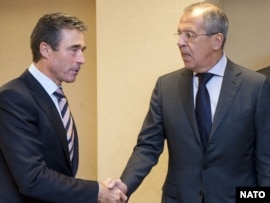
Photo: NATO Secretary-General Anders Fogh Rasmussen (left) talks with Russian Foreign Minister Sergei Lavrov about renewed cooperation between Russia and NATO. Photo from Radio Free Europe.


A senior U.S. diplomat today reaffirmed the Obama administration's desire to collaborate with Russia in developing antimissile systems in Europe, Agence France-Presse reported (see GSN, Oct. 25).

"It's absolutely clear we want to do this cooperatively with Russia," Assistant Secretary of State Philip Gordon said in Berlin. "Russia faces the same potential threat as Europe," he added.

Read more ....

More News On U.S./NATO - Russian Relations

NATO's Rasmussen to Moscow for Afghan, missile talks
-- Reuters
NATO Chief Sees 'New Start' With Russia -- Radio Free Europe
Report: Russia seeks to limit new NATO members -- AP
Russia wants cap on NATO troops: report -- AFP
Russia seeks restrictions on NATO military contingents - paper -- RIA Novosti
Russia-NATO relations depend on alliance's strategic concept - Lavrov -- RIA Novosti
Russia's approach to NATO depends on its strategy: Lavrov -- Xinhuanet
Moscow Wants to 'Participate as an Equal Partner': SPIEGEL Interview With Russia's Defense Minister -- Spiegel Online
Will the U.S. Lose Europe to Russia? -- John Vinocur, New York Times
Enhanced by Zemanta

Monday, October 25, 2010

Russia wants equal role in NATO missile shield: minister

Russia wants equal role in NATO missile shield: minister
Berlin (AFP) Oct 23, 2010 - Russia is open to talks on NATO's planned European missile shield but wants to play an equal role in its development, Russian Defence Minister Anatoly Anatoly Serdyukov told the German weekly Der Spiegel. "The most important thing for us is firstly to define what are the real threats to Europe, and secondly is to see Russia put on an equal footing as a participant," Serdyukov said in an inte ... morehttp://www.spacewar.com/reports/Russia_wants_equal_role_in_NATO_missile_shield_minister_999.html
Enhanced by Zemanta

Thursday, October 21, 2010

Russia Seeks Further Dialogue on NATO Antimissile Plan


Russia yesterday indicated it would maintain dialogue with NATO and the United States regarding an invitation to collaborate with the military alliance on missile defense operations, the Xinhua News Agency reported (see GSN, Oct. 19).
Any options for a joint antimissile effort "will be discussed," Russia Deputy Foreign Minister Alexander Grushko said.
"NATO Secretary General Anders Fogh Rasmussen has put forth an initiative (on the creation of a joint missile defense system) and it is now being studied thoroughly," Grushko said. "We'll continue contacts with American partners and NATO countries on this issue in the short term" (Xinhua News Agency, Oct. 21).
NATO nations are expected to determine at their Nov. 19-21 summit in Lisbon, Portugal, whether to formally include missile defense among alliance objectives, paving the way for a program to integrate and augment the antimissile systems of member countries. The 28-state organization has sought Russian collaboration on the project, which it says is intended to increase protection from ballistic missiles held by countries including Iran and North Korea. More at:http://gsn.nti.org/gsn/nw_20101021_7766.php
Enhanced by Zemanta

Wednesday, September 22, 2010

Russia, NATO Should Fully Analyze Missile Threat To Europe

.
Brussels, Belgium (RIA Novosti) Sep 20, 2010 Russia believes that Moscow and NATO should properly assess missile risks before starting on a missile defense plan for Europe, Russia's envoy to the military alliance said on Friday. "We continue to insist that, before discussing what may be meaningful in the framework of the possible European missile shield project and other serious projects, we need to carry out a serious analysis of missile threats," Dmitry Rogozin told RIA Novosti.
"To settle on guilty parties in this issue means to dodge a discussion of more serious issues," Rogozin said.
"It is not only Iran that possesses missiles in Europe's southern 'underbelly,' but other countries as well, so if we are to start this analysis, we should analyze all those who possess this kind of technology."
Iran still poses a threat to Russia and NATO, the alliance's Secretary General Anders Fogh Rasmussen said earlier on Friday.
He reiterated calls for the creation of missile defenses in Europe, saying they would bring NATO and Russia closer.
Enhanced by Zemanta

Monday, September 20, 2010

The End of Tactical Nukes in Europe? By Stephen Herzog, September 20, 2010

The End of Tactical Nukes in Europe?

With little notice from most press outlets, NATO recently developed contingency plans to defend its Central and Eastern European member states against potential Russian aggression. This move follows the disclosure in January that the alliance would create such plans for Estonia, Latvia, and Lithuania. But in late July, NATO Secretary General Anders Fogh Rasmussen said, “We have all necessary plans in place to defend and protect all allies. I think the Russians would be surprised if we didn’t. That’s the core purpose of the alliance.” This statement indicates that — in addition to developing plans for the Baltic region — NATO’s military wing has also produced strategies to protect states like the Czech Republic and Turkey, which previously lacked alliance defense planning.
Enhanced by Zemanta

Bring Russia Inside Security "Tent," NATO Chief Says

Bring Russia Inside Security "Tent," NATO Chief Says

NATO Secretary General Anders Fogh Rasmussen on Friday emphasized the importance of bringing Russia inside the security "tent" amid plans to cover alliance states with a ballistic missile shield, Agence France-Presse reported (see GSN, Sept. 16).
"If we manage to create an inclusive missile defense system, it can reinforce a virtuous circle," Rasmussen said during an event in Rome.
"If Russia and other countries feel like they are inside the tent with the rest of us, rather than outside the tent looking in, it will build trust," he said.
Moscow took a strong view against U.S. plans during the Bush administration to deploy missile interceptors in Poland and a radar base in the Czech Republic. It has remained wary of the Obama administration's revised plan for European missile defenses, which officially focus on fielding land- and sea-based versions of the Standard Missile 3 system around the continent as a hedge against Iranian short- and medium-range missiles.
Meanwhile, NATO could decide at its November summit in Lisbon to establish alliance-wide missile defenses.
Iran "already has missiles that can hit NATO territory and Russia too (and) is expanding their range," Rasmussen said.
A "more flexible" program on missile defense would not be prohibitively expensive, he added.
"To expand a system to protect all our nations" would require a "small investment" of roughly $275 million over two decades, according to the one-time Danish prime minister. "How can we afford not to?" he said.
Rasmussen has said he would like to see Moscow participate in the Nov. 19-20 alliance conference. The 28 NATO states should use the event to "invite Russia to cooperate, linking a (missile defence) system of ours with capabilities of theirs."
"Unless we make a clear offer to Russia, we would risk that it will feel, rightly or wrongly, kept out of the tent," he said (Agence France-Presse/Yahoo!News, Sept. 17).
Enhanced by Zemanta