

The Transuranic Storage Area Retrieval Enclosure — the wide T-shaped building in the foreground — is undergoing closure under federal and state regulations at the Radioactive Waste Management Complex at the Idaho National Laboratory Site. The north end of the building must be removed to make room for a 150-acre soil cover and associated drainage system over the Subsurface Disposal Area, shown in the background.
Cleanup Progress at ETEC Advances EM 2020 Priorities

All waste has been removed from the site of EM’s 10th and final building demolition at the Energy Technology Engineering Center (ETEC) Radioactive Materials Handling Facility complex earlier this month. EM is set to continue additional building demolitions at ETEC in collaboration with the State of California.
EM continues to make progress on its 2020 priorities. EM Update is highlighting accomplishments in EM’s priority groups through the end of this year.
Crews are maintaining momentum on removal of contaminated buildings at the Energy Technology Engineering Center (ETEC). Earlier this month, they completed demolition of the last of 10 buildings at the Radioactive Materials Handling Facility (RMHF) at ETEC. The cleanup takes place in Area IV of the Santa Susana Field Laboratory in Ventura County, California.
With teardown of the 10 buildings at the RMHF complex complete, only eight DOE-owned structures remain at ETEC. Earlier this month, DOE announced the signing of an Amendment to the May 2020 Order on Consent with the State of California to demolish those eight remaining DOE buildings. The action will fulfill DOE’s commitment to complete building demolition at ETEC.
Separately, DOE on Nov. 10 published a Record of Decision (ROD) outlining planned groundwater remediation activities at the site where nuclear and liquid metals research was conducted from the 1950s until site operations ended in the late 1980s.
Those actions will address areas of the site where investigations indicated the presence of chemical solvents and metals from historic site activities. The ROD describes monitoring and treatment approaches tailored to address the contaminants and potential impacts in each affected area of the site, as well as interim actions.
“We are thrilled that crews were able to accomplish demolition of the RMHF buildings at ETEC on time, even with the hurdles of COVID. The positive momentum continues with DOE and the State of California working together on the Amended Order to advance cleanup at the site,” said John Jones, ETEC federal project director.
In May, DOE and the State of California signed a consent order to demolish the 10 DOE buildings at the RMHF site. Demolition started in July.
Removing all 10 RMHF facilities, which were used for the processing, packaging, and shipment of radioactive and mixed hazardous wastes, reduces potential risk of release of hazardous substances due to wildfires or erosion from severe storms.
-Contributors: Stephanie Shewmon, Christina Swanson
Hanford WTP Treatment Commissioning Technicians Finish Desk Training

OAK RIDGE, Tenn. – Reuse of transport platforms — large elevator-like devices installed outside facilities that allow workers to access multiple floors — among EM cleanup projects in Oak Ridge will save nearly $3.5 million.
“Our cleanup program is focused on completing projects successfully while also being extremely mindful of any efficiencies we can achieve to be responsible stewards of tax dollars,” Oak Ridge Office of Environmental Management (OREM) Manager Jay Mullis said. “We recently completed core cleanup at the East Tennessee Technology Park $80 million under budget, and that is a trend we look to continue as we move forward with cleanup at the Y-12 National Security Complex and Oak Ridge National Laboratory (ORNL).”
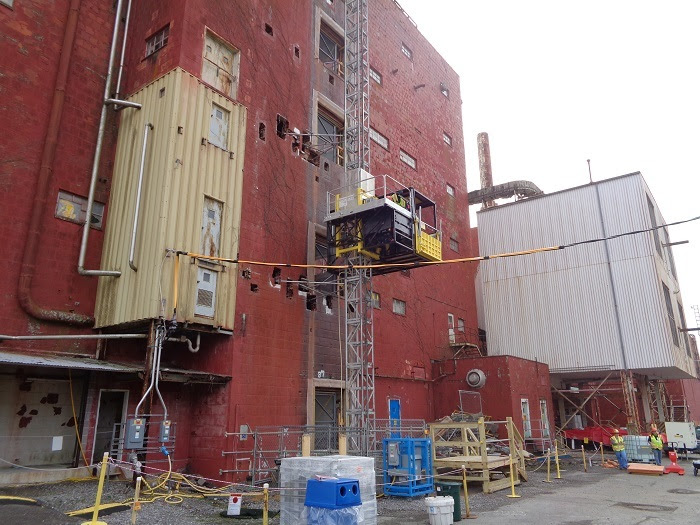
A view of one of the transport platforms installed outside the six-story Building 9207 at the Y-12 National Security Complex’s Biology Complex. These platforms allowed crews to move abatement equipment and remove packaged asbestos and hazardous waste from the building’s higher floors and roof.
OREM and cleanup contractor UCOR had the platforms installed at Y-12’s Biology Complex to support deactivation activities to prepare remaining structures in the complex for demolition. The platforms allowed crews to accelerate that work and paved the way for a teardown that began last week.
With the transport platforms, crews were able to more easily move asbestos abatement equipment and restock supplies inside the Biology Complex’s three-story- and six-story-tall buildings. Workers also used the platforms to remove packaged asbestos and hazardous waste from higher floors and the roof.
As the start of demolition on the Biology Complex approached, OREM and UCOR worked collaboratively to identify additional uses for the equipment.
Only a few miles away, at ORNL, OREM and UCOR were starting to plan for another major deactivation project at the Experimental Gas-Cooled Rector. Standing eight stories tall, it presented a perfect opportunity to reuse the platforms.
Due to the size of the reactor, crews will again need additional capacity to reach the upper levels to support deactivation activities.
“Transferring the transport platforms from a cleanup project at Y-12 to one at ORNL became an obvious ‘win-win,’ eliminating the need to buy more costly equipment,” said Dan Macias, Oak Ridge Reservation environmental cleanup program manager for UCOR.
-Contributor: Susanne Dupes
Hanford Meteorological Station: Keeping Workers Safe and History Alive

The sun begins to rise behind the 400-foot Hanford Meteorological Station tower, a source of current and historical weather data for the Hanford Site since 1944.
RICHLAND, Wash. – At the Hanford Site, weather data drives decisions that keep the workforce safe and healthy through high temperatures in the desert summer, powerful winds, and freezing rain and snow in the winter. The Hanford Meteorological Station is an invaluable resource for work planners and site leaders.
In operation since 1944 and currently managed by EM Richland Operations Office (RL) contractor Mission Support Alliance, the station receives data from 30 instrument towers on and around the 580-square-mile site. The most recognizable to workers is the 400-foot tower located near the center of the site, which collects meteorological data from sensors at several levels of the structure.
The meteorological team’s toolbox also includes remote sensors, giving them an edge in collecting accurate data across the site for the heat index, winter weather, thunderstorms, and wind speeds. Winds can gust above 40 miles per hour more than 20 days during the year.
“The weather station is a significant aid to our workforce, from keeping them safe in the summer heat or providing advance warnings to weather systems such as extreme wind conditions that could impair personal safety or force the temporary halt of work on the site to protect both the workers and the surrounding communities,” said Kyle Rankin, RL chief engineer. “Having access to this data and forecasters who understand weather patterns is a huge asset to the site.”

From left, meteorologists Matt Eckhoff, Grant Gutierrez, Perry Perrault, and Josh Markel with Mission Support Alliance help monitor weather conditions around the site 24 hours a day, seven days a week. This photo was taken prior to the COVID-19 pandemic.
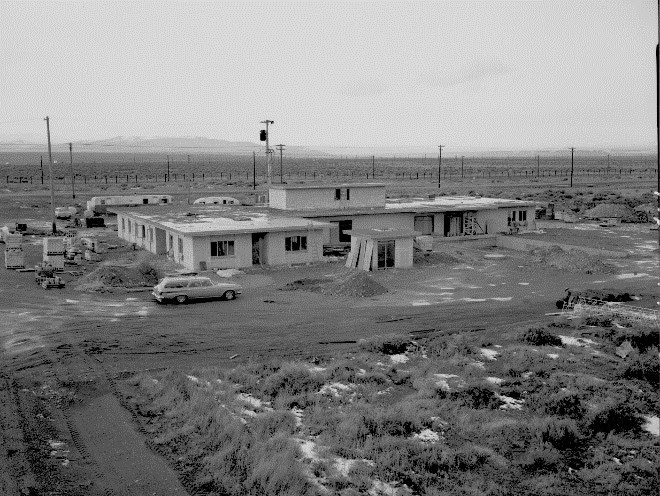
Constructed in the 1960s, the current Hanford Meteorological Station replaced the original small two-story station, shown above.

Bryan Hurt, with Mission Support Alliance’s radio maintenance organization, works on cables for critical communications systems located 365 feet up the 400-foot Hanford Meteorological Station tower.
Handwritten logs dating back to the beginning of site meteorological operations highlight weather data that helped forecast potential impacts from natural disasters and conveyed personal insights on memorable weather moments. Following the eruption of Mt. Saint Helens on May 18, 1980, a forecaster cited “heavy ash” and wrote “the birds don’t know what to do, and I don’t either” in the weather log.
Using decades of historical data and readings from today’s network of sensors, Hanford meteorologists are able to make accurate forecasts of conditions across the site.
“The weather and telephone logs are an exceptional source of information,” said Perry Perrault, Hanford meteorologist and forecaster. “You’ll find historic information on momentous wind storms, blizzards, dust storms, range fires, and thunderstorms over the decades. This data is important for climatology research and daily analysis of the weather for our Hanford Site contractors.”
Check out real-time data from the station here.
-Contributor: Melissa Ver Steeg
Portsmouth Site Installs Water Treatment System for Disposal Facility

PIKE COUNTY, Ohio – EM’s Portsmouth/Paducah Project Office is installing the water treatment system for its On-Site Waste Disposal Facility at the Portsmouth Gaseous Diffusion Plant site. The disposal facility will hold much of the debris and other material from demolition of the large gaseous-diffusion process buildings and other plant facilities. Construction crews, led by EM cleanup contractor Fluor-BWXT Portsmouth, recently installed the Modular Leachate Treatment System that includes a million-gallon water tank and support structures. The tank allows for storage of additional water that might result from significant storms.
-Contributor: Donnie Locke
Oak Ridge Employs Drone Technology for Safer Inspections
A drone hovers over the 3039 exhaust stack at Oak Ridge to lower a camera inside to conduct a visual inspection.
OAK RIDGE, Tenn. – What’s the safest way to climb and inspect a 70-year-old, 250-foot-tall brick exhaust stack?
That’s the question employees in Oak Ridge worked to answer, and through the use of technology and innovation, they determined no one had to climb after all.
In October, the Oak Ridge Office of Environmental Management (OREM) used a drone to conduct visual inspections inside and outside the 3039 stack. The chimney-like structure, built in 1950, is located in the central campus area of the Oak Ridge National Laboratory. Due to the age of the structure, it requires periodic inspections to evaluate its structural integrity.
The 3039 stack provides high-efficiency particulate air (HEPA)-filtered ventilation exhaust for numerous radiological facilities, including various isotope facilities in the central campus. OREM is responsible for its operation and maintenance because it is part of the Liquid and Gaseous Waste Operations infrastructure.

A close-up view of the drone, which resembles a mini-helicopter. Following commands from a ground-based operator, the camera-mounted drone circles around the stack making recordings that can be evaluated by engineers and safety experts.

|
EM Update | Vol. 12, Issue 36 | Nov. 24, 2020 |

|
EM Intergovernmental Meeting on Cleanup Spotlights Ties to StakeholdersA number of notable accomplishments have positioned EM for continued success, and work completed ahead of schedule and under budget is due to effective partnerships with state and local officials in the communities around EM sites, regulators, and tribal nations, Under Secretary for Science Paul Dabbar said during the 19th Annual Combined Intergovernmental Meeting last week. Members of the Energy Communities Alliance, Environmental Council of the States, National Association of Attorneys General, National Governors Association’s Federal Facilities Task Force, National Conference of State Legislatures, and State and Tribal Government Working Group joined DOE for the two-day meeting held virtually due to the COVID-19 pandemic. More than 200 people participated. Dabbar, who provided opening remarks, pointed to recent EM accomplishments, such as the successful operations of the Savannah River Site’s Salt Waste Processing Facility to accelerate EM’s ability to empty and close waste tanks. He also noted progress in the Direct-Feed Low-Activity Waste (DFLAW) approach at the Hanford Site and the Integrated Treatment Waste Unit, which is set to treat the remaining 900,000 gallons of liquid sodium-bearing waste at the Idaho National Laboratory Site. “Today is a truly exciting time for the complex in terms of specific accomplishments and where we are going,” Dabbar said. “Our engagement that we have had between the federal employees, contractors, and communities — local communities, tribal communities, states — have never been better.” EM Senior Advisor William “Ike” White provided an update on the EM program. He noted that the workforce has adapted to the challenges of 2020 in ways not thought of just a year ago, and described 2020 as an inflection point as EM begins the treatment and disposition of tank waste across the complex. “I am really proud to say in the midst of all this, we have been able to get quite a bit of what we intended to accomplish in 2020 done over the course of the past year,” White said. “We have realized some really significant accomplishments across the board that have positioned us well for the cleanup program going into the next decade.” White discussed his visits to EM sites, including Hanford, where he got a firsthand look at the DFLAW system. He highlighted Oak Ridge’s historic accomplishment — the first-ever removal of a former uranium enrichment complex. White also noted the importance of EM’s intergovernmental program and discussed the status of revisions to the program’s Strategic Vision. He added that he values receiving feedback from the intergovernmental community. “I really appreciate and value the role all of you play in helping us shape the cleanup program of the future, and I look forward to facilitating further engagement as we talk about what that program looks like,” he said. Meeting attendees also discussed the importance of capturing lessons learned at EM sites to benefit the program and improve technical processes, communications, and procedures. For example, DOE is documenting its response to COVID-19 to ensure a record of new procedures and protocols if something similar occurs in the future, EM Principal Deputy Assistant Secretary Todd Shrader said. “Early on we were having daily calls with our site managers around the complex, to talk about what we learned, what they learned, what can we do better, how can we transfer ideas,” Shrader said. “We also memorialized our processes for how we did work and how we made decisions based on the EM framework for COVID response. And we published that on our website. “Hopefully it doesn’t happen ever again, but if it does, we at least have a starting point moving forward,” Shrader said. EM leaders and representatives of EM field sites discussed the priorities of individual sites, and their community engagement in sessions led by members of the intergovernmental groups. Shrader joined Brian Vance, manager of the Office of River Protection and Richland Operations Office, Russell McCallister, federal cleanup director of the Moab Uranium Mill Tailings Remedial Action Project, and intergovernmental representatives in a panel session on the impacts of COVID-19. They highlighted the importance of communications during the pandemic, including the need for employees to remain connected as they work remotely. McCallister remarked about a strong esprit de corps as employees worked together creatively to continue work safely. Shrader added that DOE is continually monitoring and assessing conditions at each site, and will adjust the pace of operations and remobilization as necessary. -Contributor: Beth Lisann Closure of Largest Building at Idaho Site Underway |
RICHLAND, Wash. – The final class of commissioning technicians recently completed the classroom portion of their in-depth systems training for operating the Hanford Site’s Waste Treatment and Immobilization Plant. The technicians began their shift work earlier this month to finish the on-the job training portion of their curriculum. The training qualifies the technicians to run more than 200 separate systems and remote operations software for the plant’s Low-Activity Waste Facility, Analytical Laboratory, and 14 other support facilities needed to prepare for and conduct operations to treat Hanford tank waste using the Direct-Feed Low-Activity Waste approach. In total, approximately 140 technicians have completed systems training. -Contributor: Staci West |
Reuse of Cleanup Equipment in Oak Ridge Saves Millions |
 |
A view of the 3039 exhaust stack, which was built in 1950 and stands 250 feet tall. It provides high-efficiency particulate air (HEPA)-filtered ventilation exhaust for numerous radiological facilities, including various isotope facilities in Oak Ridge National Laboratory’s central campus. The drone resembles a mini-helicopter. Following commands from a ground-based operator, the camera-mounted drone circles around the stack, searching for flaws that could threaten the stack’s structural integrity. The cameras record as the drone circles the stack and as it is lowered into the stack. Then, engineers and safety experts assess the footage to note any areas of concern. The external portion of the inspection was performed using an onboard camera system, while the internal portion was performed by hovering the drone over the top opening and lowering the camera into the stack. Previous stack inspections required inspectors to physically climb the 250-foot-tall structure. Now, technology is eliminating the need for workers to climb the stack and establish work platforms high in the air. This is the latest example of how OREM and its contractors are working together to identify approaches that will keep employees safe while performing EM’s complex and challenging cleanup mission. -Contributor: Ben Williams |
Like EM on Facebook at: https://www.facebook.com/
|


