Status of quake-stricken reactors at Fukushima nuclear power plants
TOKYO, March 19, Kyodo

Michele Kearney's Nuclear Wire - Major Energy and Environmental News and Commentary affecting the Nuclear Industry. Nuclear Activities
o At 9:20AM (JST) on March 17, radiation level at elevation of 1,000ft above Fukushima Daiichi Nuclear Power Station: 4,130 micro sievert.Fukushima Daiichi Unit 1 reactor
o At 9:20AM on March 17, radiation level at elevation of 300ft above Fukushima Daiichi Nuclear Power Station: 87,700 micro sievert.
o At 11:10AM on March 17, radiation level at main gate (approximately 3,281 feet from Unit 2 reactor building) of Fukushima Daiichi Nuclear Power Station: 646.2 micro sievert.
o At 7:50PM on March 17, radiation level outside main office building (approximately 1,640 feet from Unit 2 reactor building) of Fukushima Daiichi Nuclear Power Station: 3,599 micro sievert.
o For comparison, a human receives 2,400 micro sievert per year from natural radiation in the form of sunlight, radon, and other sources. One chest CT scan generates 6,900 micro sievert per scan.
o Since 10:30AM on March 14, the pressure within the primary containment vessel cannot be measured.Fukushima Daiichi Unit 2 reactor
o At 12:50PM on March 17, pressure inside the reactor core: 0.185MPa.
o At 12:50PM on March 17, water level inside the reactor core: 1.7 meters below the top of the fuel rods.
o At 12:25PM on March 16, pressure inside the primary containment vessel: 0.40MPaabs.Fukushima Daiichi Unit 3 reactor
o At 12:50PM on March 17, pressure inside the reactor core: -0.027MPa.
o At 12:50PM on March 17, water level inside the reactor core: 1.8 meters below the top of the fuel rods.
o At 12:40PM on March 16, pressure inside the primary containment vessel: 0.23MPaabs.Fukushima Daiichi Unit 5 reactor
o At 6:15AM on March 17, pressure inside the suppression chamber was observed to fluctuate.
o At 7:00AM on March 17, pressure inside the suppression chamber: 0.22MPa.
o At 7:05AM on March 17, pressure inside the suppression chamber: 0.44MPa.
o At 7:10AM on March 17, pressure inside the suppression chamber: 0.26MPa.
o At 7:15AM on March 17, pressure inside the suppression chamber: 0.52MPa.
o At 7:20AM on March 17, pressure inside the suppression chamber: 0.13MPa.
o At 7:25AM on March 17, pressure inside the suppression chamber: 0.57MPa.
o At 9:48AM on March 17, a Self Defense Forces helicopter made four water drops aimed for the spent fuel pool.
o At 4:35PM on March 17, pressure inside the reactor core: 0.005MPa.
o At 4:35PM on March 17, water level inside the reactor core: 1.95 meters below the top of the fuel rods.
o At 7:05PM on March 17, a police water cannon began to shoot water aimed at the spent fuel pool until 7:22PM.
o At 7:35PM on March 17, five Self Defense Forces emergency fire vehicles shot water aimed at the spent fuel pool, until 8:09PM.
Allen has been at MTSU since 2007, but earlier in his career he worked more than 14 years at Sandia National Laboratories in New Mexico, where -- among other assignments -- he headed the federal lab's work on "severe accident phenomenology." That work included using a research reactor to actually melt the core of another reactor to better assess how the core relocates in an accident, as well as the release of fission products. He also conducted hydrogen and steam explosions at desert test sites outside Albuquerque, using reactor fuel simulants to assess the results.
Much of his research directly addressed accident scenarios in which the nuclear fuel is no longer submerged in water, a situation that Japanese workers have been battling for days at the Daiichi reactor complex.
Allen agrees with reports that explosions caused by a hydrogen buildup likely blew the roof off the outer containment buildings at least two of the reactor sites, exposing pools that store highly radioactive spent nuclear fuel rods to the environment. But, based on reports he's heard or read, he thinks the explosion that occurred March 14 at the Daiichi Unit 2 reactor was a steam explosion inside the reactor pressure vessel that probably occurred when part of the exposed fuel core melted and allowed some of the liquefied fuel or super-hot fragments to drop into the water below.
"When that happens, you're going to have a massive steam explosion, which creates extremely high pressure in the reactor pressure vessel," Allen said. As has been noted in various news reports, the pressure dropped inside the reactor and radiation levels outside the unit rose significantly at about that time. That, he said, would seem to support conjecture that the vessel protecting the nuclear core may have been damaged or possibly ruptured and released some of the radioactive constituents.
"I've done many of these experiments," he said. "When you drop a molten core into water, there's a big explosion."
The worst of the worst could come if Japan can't come up with a way to sufficiently cool down the reactor fuel cores. That has reportedly become increasingly difficult with workers evacuating the sites -- at least temporarily -- because of high radiation fields.
"These things play out over a long period of time, longer than people would think," Allen said. "You have an earthquake that lasts maybe a minute, a tsunami that lasts maybe 15 minutes. But these things could go on for months. You could lose all six of the reactors."
If workers are unable to get additional cooling water into the reactor vessel, the molten fuel core will collapse into the water in bottom of the vessel. Eventually the heat from the decaying fuel would boil away the water that's left, leaving the core sitting on the vessel's lower head made of steel.
Should that happen, "It'll melt through it like butter," Allen said.
That, in turn, would cause a "high-pressure melt injection" into the water-filled concrete cavity below the reactor. Because the concrete would likely be unheated, the reaction created by the sudden injection of the reactor's ultra-hot content would be immense, he said.
"It'll be like somebody dropped a bomb, and there'll be a big cloud of very, very radioactive material above the ground," Allen said, noting that it would contain uranium and plutonium, as well as the fission products.
Should these events happen, the best outcome would be if the winds are blowing east and push the radioactive plume over the Pacific Ocean, he said. "It (the radioactivity) will fall out in the ocean and everything will be fine," he said.
The worst case, Allen said, would be if winds pushed a radioactive cloud south toward Tokyo and Japan's highly populated cities. If that were to happen, he said, the consequences would likely be greater than the 1986 accident at Chernobyl, where an entire area of Ukraine had to be evacuated because of the radioactive conditions that increased the risk of developing cancer.
Are the spent fuel in the pools in Units 3 and 4 are now uncovered? The big concern here is that unlike the releases from damaged fuel in the reactor cores of Units 1, 2, and 3, which were largely filtered by scrubbing in the containment suppression pools (wetwell torus), releases of volatile fission products (e.g., cesium and iodine) from these spent fuel pools have direct pathways to the environment, if they remain dry for an extended period.
Efforts to deliver water to these pools have proven to be very difficult, and fuel damage may be occurring. If they are exposed, then the use of the evaporation of salt water as a heat sink over periods of more than a few days is not viable because the quantities of salt deposited as the water evaporates becomes large in volume and plugs the flow paths through the fuel, degrading heat removal. Everything that is cooled becomes a heat sink to condense anything volatilized. Unfortunately, a fresh water supply seems difficult to come by.
In sum, this accident is now significantly more severe than Three Mile Island in 1979. It resulted from a unique combination of failures to plant systems caused by the tsunami, and the broad destruction of infrastructure for water and electricity supply which would normally be reestablished within a day or two following a reactor accident. My initial estimates of the extent of the problem, on March 12, did not anticipate the cascading problems that arose from the extended loss of externally sourced AC power to the site, and my prediction that ‘there is no credible risk of a serious accident‘ has been proven quite wrong as a result. It remains to be seen whether my forecast on the possibility of containment breaches and the very low level of danger to the public as a result of this tragic chain of circumstances will be proven correct. For the sake of the people there, I sure hope it does stand the test of time.
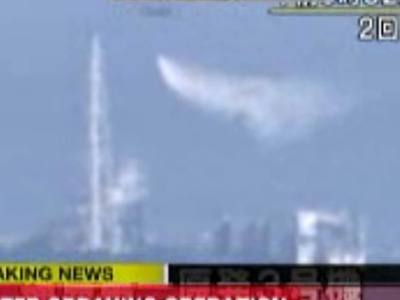 The following is not a significant new update on the situation at Fukushima (see here for the 18 March morning update), because so little information has emerged since my last update this morning. But there is some new information.
The Tokyo Fire Department is slated to join in the operation at the Fukushima plant with 30 trucks capable of discharging massive amounts of water to high places and some 140 firefighters of its ''hyper rescue'' team, who are specialists in rescue operations in large-scale disasters.Read more of this post
But a Tokyo police water cannon truck, whose contribution Thursday was revised Friday to 44 tons from the initially reported 4 tons, and the SDF choppers were not mobilized Friday.
Radiation readings at the troubled nuclear plant have consistently followed a downward path through Friday morning, according to data taken roughly 1 kilometer west of the plant's No. 2 reactor, but plant operator Tokyo Electric Power Co. stopped short of calling the move a trend.
The radiation level at 11 a.m. dropped to 265.0 microsievert per hour from 351.4 microsievert per hour at 12:30 a.m. Thursday. It measured 292.2 microsievert per hour at 8:40 p.m. Thursday, shortly after SDF trucks sprayed water at the No. 3 reactor pool as part of efforts to avert any massive emission of radioactive materials into the air from the facility.
