
Michele Kearney's Nuclear Wire

Major Energy and Environmental News and Commentary affecting the Nuclear Industry.

Friday, September 25, 2020

“This Plane Is Not Going to Land in Cairo”: Saudi Prince Sultan Boarded a Flight in Paris. Then, He Disappeared | Vanity Fair

“This Plane Is Not Going to Land in Cairo”: Saudi Prince Sultan Boarded a Flight in Paris. Then, He Disappeared | Vanity Fair: Prince Sultan bin Turki II was cut off from the Saudi royal family’s cash flow after criticizing the regime. So he appealed to Prince Mohammed bin Salman for help—and was never seen again.

Should American Support for Taiwan be Ambiguous?

Should American Support for Taiwan be Ambiguous?: Experts respond to Richard Haass and David Sacks’ article "American Support for Taiwan Must Be Unambiguous"

Leaked docs expose massive Syria propaganda operation waged by Western govt contractors and media | The Grayzone

Leaked docs expose massive Syria propaganda operation waged by Western govt contractors and media | The Grayzone: Syria leaks reveal Western government contractors trained Syrian opposition. Documents show they planted media propaganda in BBC & Al Jazeera

Free exchange - Can China’s economic miracle continue? | Finance & economics | The Economist

Free exchange - Can China’s economic miracle continue? | Finance & economics | The Economist: In a new book, Thomas Orlik argues China is “the bubble that never pops”

The U.S. Needs An Endgame Before It Plunges Into the Next Cold War

The U.S. Needs An Endgame Before It Plunges Into the Next Cold War: China would be a tougher, longer-lasting opponent than the Soviet Union.

Thursday, September 24, 2020

Fauci to a Meddling HHS Official: 'Take a Hike' - The Atlantic

Fauci to a Meddling HHS Official: 'Take a Hike' - The Atlantic: The nation’s top public-health expert addresses political interference in the COVID-19 response, but urges Americans to focus on the winter ahead.

Intel: US push to get Sudan to recognize Israel faces setback

Intel: US push to get Sudan to recognize Israel faces setback: Sudan's government is asking for $3 billion in emergency economic aid

EM News Flash September 24, 2020: Waste Shipment Represents First Application of DOE's HLW Interpretation

 header

EM News Flash | Sept. 24, 2020

Waste Shipment Represents First Application of DOE's HLW Interpretation

p

A truck containing a small amount of Defense Waste Processing Facility recycle wastewater departs a loading area at the Savannah River Site.


WASHINGTON, D.C. – The Department of Energy (DOE) has completed the first application of its science-based approach to managing reprocessing waste with the safe and successful shipment of a small quantity of liquid waste from the Savannah River Site (SRS).

The Department on Sept. 22 completed the shipment of 8 gallons of recycle wastewater from the Defense Waste Processing Facility (DWPF) at SRS for treatment and disposal. The waste was sent to Waste Control Specialists in Andrews, Texas, which is a licensed commercial disposal facility for low-level radioactive waste.

The shipment represents the first application of DOE’s science-based high-level radioactive waste (HLW) interpretation.

“The high-level waste interpretation enables the Department to better address one of its largest environmental risks by potentially allowing the opening of new disposition paths for waste that has been stored for decades at DOE sites with no near-term path for disposal,” said Paul Dabbar, Under Secretary for Science.

This HLW interpretation allows for reprocessing waste to be managed according to how radioactive it is, and not by its source. DWPF recycle wastewater was analyzed and determined to meet criteria for disposal as low-level radioactive waste in accordance with its radiological characteristics.

The DWPF recycle wastewater meets the waste acceptance criteria at Waste Control Specialists, and its treatment and disposal at this site is fully protective of public health, safety, and the environment.

More information on DWPF recycle wastewater and the HLW interpretation can be found here.

Follow EM on Twitter: @EMcleanup
Like EM on Facebook: https://www.facebook.com/DOEEnvironmentalManagement

New priest-led band forms from international lay Catholic movement

New priest-led band forms from international lay Catholic movement: Regnum Christi Music Collective features the musical talents of clergy and laity alike.

Safe, extra long-life nuclear batteries could soon be a reality


Safe, extra long-life nuclear batteries could soon be a reality

An upgrade on the tech that powers spacecraft across the cosmos could soon be used to create incredibly long-lasting batteries back on Earth


https://www.newscientist.com/article/mg24733010-700-safe-extra-long-life-nuclear-batteries-could-soon-be-a-reality/?utm_source=NSNEW&utm_campaign=a1a20c0098-NSNEW_170920_COPY_01&utm_medium=email&utm_term=0_e65fab71ff-a1a20c0098-379277727

Report sees opportunities for nuclear supply chain : Nuclear Policies - World Nuclear News

Report sees opportunities for nuclear supply chain : Nuclear Policies - World Nuclear News: The 2020s are likely to be a time of uncertainty for global energy systems with the growing recognition that business-as-usual is unsustainable and represents a threat to humanity, but the global transition to low-carbon energy and the post-COVID recovery will be a time of opportunity for the nuclear energy sector and its supply chain, according to the 2020 edition of a World Nuclear Association report that analyses the economic value of the nuclear power industry. The report is the work of the Association's Supply Chain working group, which is chaired by Laurent-Olivier Coudeyre of EDF.

Energy Department Green Lights Critical Decision 1 for Versatile Test Reactor Project


Energy Department Green Lights Critical Decision 1 for Versatile Test Reactor Project

September 23, 2020
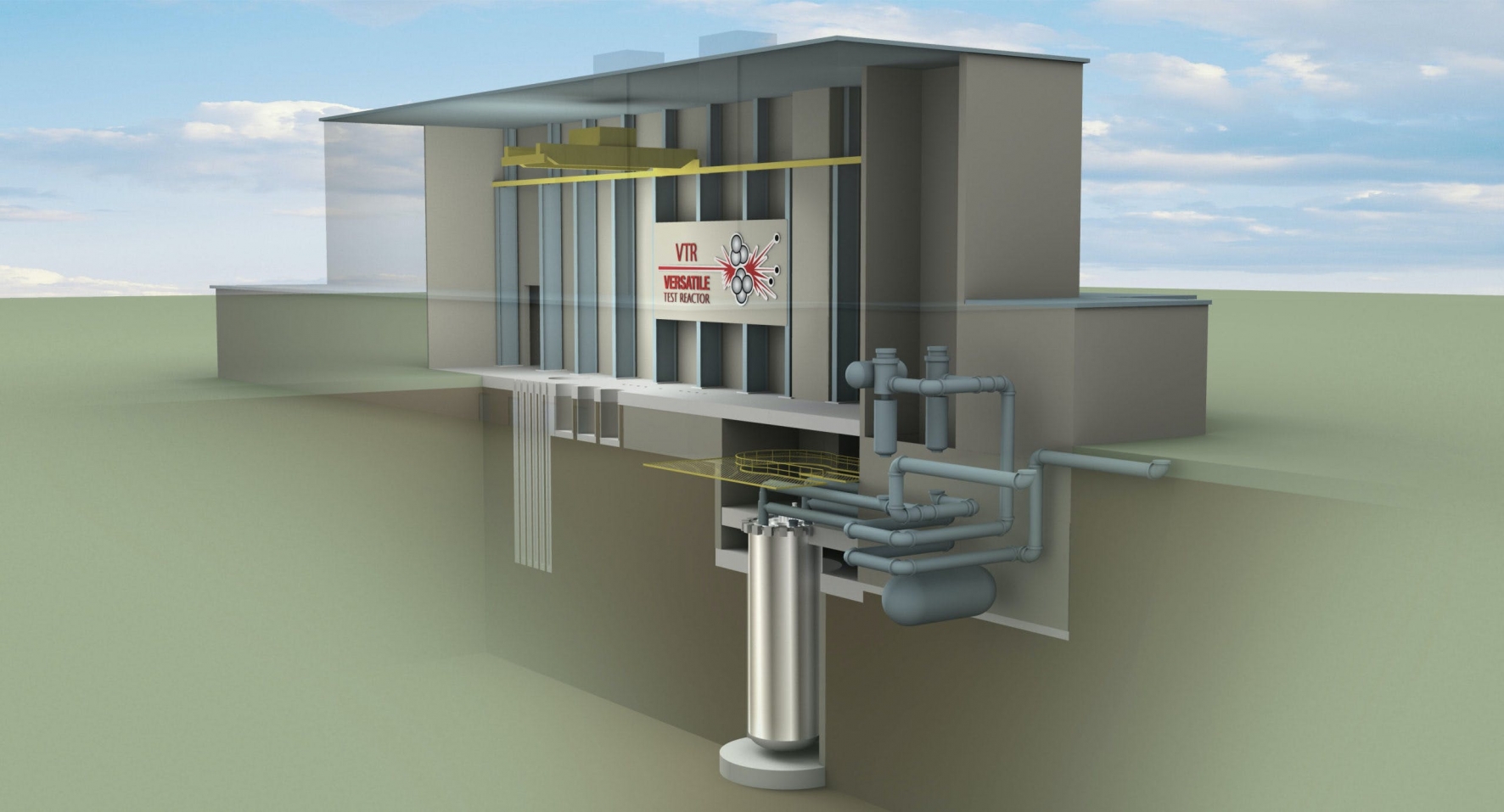
Versatile Test Reactor mock up
Versatile Test Reactor
Idaho National Laboratory

WASHINGTON, D.C. – The U.S. Department of Energy (DOE) today announced it has approved Critical Decision 1 for the Versatile Test Reactor (VTR) project, a one-of-a-kind scientific user facility that would support research and development of innovative nuclear energy and other technologies.

Critical Decision 1, known as “Approve Alternative Selection and Cost Range,” is the second step in the formal process DOE uses to review and manage research infrastructure projects. As part of Critical Decision 1, federal committees reviewed the conceptual design, schedule, and cost range, and analyzed potential alternatives. DOE also issued a Notice of Intent to prepare the Environmental Impact Statement (EIS) for VTR, which was published in the Federal Register on August 5, 2019, as part of Critical Decision 1 activities. The VTR project now moves to the engineering design phase as soon as Congress appropriates funding. DOE has requested $295 million for FY 2021 for the project.

Secretary of Energy Dan Brouillette said the approval of Critical Decision 1 represents a significant step toward re-establishing the United States as a global leader in nuclear energy research, safety and security, and developing new technologies that will help supply the world with low-carbon energy.

“The Versatile Test Reactor addresses a long-standing gap in research infrastructure in the United States,” Brouillette said. “We have not had a fast neutron spectrum test facility for decades. Many of the new reactor designs under development by in the United States require this sort of long-term testing capability. Not only will VTR support the research and development of much-needed clean energy technologies, but it is key to revitalizing our nuclear industry, which has long been the model for safe operations and security for the world.”

DOE’s Office of Nuclear Energy established the VTR program in 2018 in response to reports outlining the need for a fast spectrum test reactor and requests from U.S. companies developing advanced reactors. Many of the new designs require different testing capabilities than the existing testing infrastructure that supports today’s nuclear energy technologies. Since then, a team of experts from six national laboratories, 19 universities and nine industry partners have been developing a design, cost estimate, and schedule for VTR.

VTR will generate neutrons at higher speeds and higher concentrations than existing test infrastructure. It will provide leading edge capability for accelerated testing of advanced nuclear fuels, materials, instrumentation, and sensors.

“The approval of Critical Decision 1 establishes a solid foundation upon which the design phase can begin,” said Dr. Rita Baranwal, Assistant Secretary for DOE’s Office of Nuclear Energy. “We have repeatedly heard from industry and other stakeholders that the United States needs a fast neutron scientific user facility to maintain our global leadership in nuclear energy. This decision puts us firmly on the path toward achieving that goal.”

The Department will make a final decision on the design, technology selection and location for VTR following the completion of the EIS and Record of Decision, which is expected in late 2021.

###

News Media Contact: (202) 586-4940

ANEEL: Thorium-Based Reactor Fuel Could Support A New Wave Of Nuclear Power

ANEEL: Thorium-Based Reactor Fuel Could Support A New Wave Of Nuclear Power: A new nuclear fuel made from both uranium and thorium, especially when used in CANDU/PHWRs, can address several issues with nuclear power – proliferation, waste and cost. Plus it’s made-in-America makes it a prime candidate for export to emerging markets.

Doug Hunter: Nuclear project needed for abundant, carbon-free energy - The Salt Lake Tribune

Doug Hunter: Nuclear project needed for abundant, carbon-free energy - The Salt Lake Tribune

IAEA Completes Review Of Ringhals 3 - News - Nuclear Power News - Nuclear Street - Nuclear Power Plant News, Jobs, and Careers

IAEA Completes Review Of Ringhals 3 - News - Nuclear Power News - Nuclear Street - Nuclear Power Plant News, Jobs, and Careers: The latest nuclear news in Nuclear Power Industry about utilities, companies, suppliers in the nuclear energy market.

Amentum To Lead $10 Billion Hanford Contract - News - Nuclear Power News - Nuclear Street - Nuclear Power Plant News, Jobs, and Careers

Amentum To Lead $10 Billion Hanford Contract - News - Nuclear Power News - Nuclear Street - Nuclear Power Plant News, Jobs, and Careers: The latest nuclear news in Nuclear Power Industry about utilities, companies, suppliers in the nuclear energy market.

Energy Department Green Lights Critical Decision 1 for Versatile Test Reactor Project - News - Nuclear Power News - Nuclear Street - Nuclear Power Plant News, Jobs, and Careers

Energy Department Green Lights Critical Decision 1 for Versatile Test Reactor Project - News - Nuclear Power News - Nuclear Street - Nuclear Power Plant News, Jobs, and Careers: The latest nuclear news in Nuclear Power Industry about utilities, companies, suppliers in the nuclear energy market.

DOE Green Lights Critical Decision 1 for Versatile Test Reactor Project


News Media Contact: (202) 586-4940

Energy Department DOE 

WASHINGTON, D.C. – The U.S. Department of Energy (DOE) today announced it has approved Critical Decision 1 for the Versatile Test Reactor (VTR) project, a one-of-a-kind scientific user facility that would support research and development of innovative nuclear energy and other technologies.

Critical Decision 1, known as “Approve Alternative Selection and Cost Range,” is the second step in the formal process DOE uses to review and manage research infrastructure projects. As part of Critical Decision 1, federal committees reviewed the conceptual design, schedule, and cost range, and analyzed potential alternatives. DOE also issued a Notice of Intent to prepare the Environmental Impact Statement (EIS) for VTR, which was published in the Federal Register on August 5, 2019, as part of Critical Decision 1 activities. The VTR project now moves to the engineering design phase as soon as Congress appropriates funding. DOE has requested $295 million for FY 2021 for the project.

Secretary of Energy Dan Brouillette said the approval of Critical Decision 1 represents a significant step toward re-establishing the United States as a global leader in nuclear energy research, safety and security, and developing new technologies that will help supply the world with low-carbon energy.

“The Versatile Test Reactor addresses a long-standing gap in research infrastructure in the United States,” Brouillette said. “We have not had a fast neutron spectrum test facility for decades. Many of the new reactor designs under development by in the United States require this sort of long-term testing capability. Not only will VTR support the research and development of much-needed clean energy technologies, but it is key to revitalizing our nuclear industry, which has long been the model for safe operations and security for the world.”

DOE’s Office of Nuclear Energy established the VTR program in 2018 in response to reports outlining the need for a fast spectrum test reactor and requests from U.S. companies developing advanced reactors. Many of the new designs require different testing capabilities than the existing testing infrastructure that supports today’s nuclear energy technologies. Since then, a team of experts from six national laboratories, 19 universities and nine industry partners have been developing a design, cost estimate, and schedule for VTR.

VTR will generate neutrons at higher speeds and higher concentrations than existing test infrastructure. It will provide leading edge capability for accelerated testing of advanced nuclear fuels, materials, instrumentation, and sensors.

“The approval of Critical Decision 1 establishes a solid foundation upon which the design phase can begin,” said Dr. Rita Baranwal, Assistant Secretary for DOE’s Office of Nuclear Energy. “We have repeatedly heard from industry and other stakeholders that the United States needs a fast neutron scientific user facility to maintain our global leadership in nuclear energy. This decision puts us firmly on the path toward achieving that goal.”

The Department will make a final decision on the design, technology selection and location for VTR following the completion of the EIS and Record of Decision, which is expected in late 2021.

The climate risks of China's Belt and Road Initiative - Bulletin of the Atomic Scientists

The climate risks of China's Belt and Road Initiative - Bulletin of the Atomic Scientists: Evidence of the environmental harm the Chinese government wreaks beyond its borders via the Belt and Road Initiative abounds. China has long been the world’s largest exporter of coal power equipment. Chinese banks are financing more than 70 percent of all coal plants outside of China, with Chinese firms constructing many of them, including in countries like Egypt and Pakistan that previously burned little to no coal.

Why does missile defense still enjoy bipartisan support in Congress? - Bulletin of the Atomic Scientists

Why does missile defense still enjoy bipartisan support in Congress? - Bulletin of the Atomic Scientists: When Congress gets serious about cutting waste from the federal budget, missile defense should be a low-hanging fruit.