
Defense in Depth Part I: A War for Safety
Posted by on July 11, 2016
Historian
One hundred years ago the French and German armies of World War I devised a new defensive strategy called “defense in depth.” Its aim was to prevent an enemy breakthrough of an army’s frontline with a deep system of interconnected trench lines and strong points.
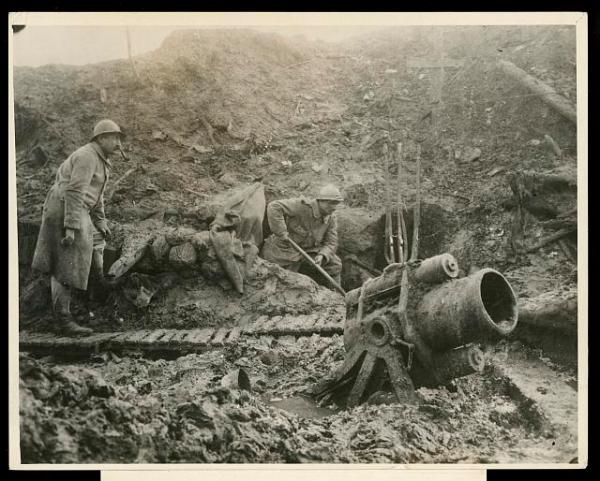
Defense in depth circa WWI. Photo courtesy of the Library of Congress
The NRC’s use of the term has roots in the Manhattan Project of World War II. Military metaphors seemed particularly apt for those charged with ensuring the safety of the early plutonium production reactors at Hanford, Washington. They worried about the potential for a reactor “catastrophe” from a radiation release of “explosive violence.” Their solution was to erect multiple “lines of defense” of trained operators and emergency personnel, carefully sealed fuel rods, shielding walls, backup cooling and power systems, and even a backup to the backup shutdown system—a final solution so drastic that it would destroy the reactor to save the operators lives. Fittingly, its moniker derived from another military term — the “last ditch” safety device.
After the war, the “lines of defense” in reactor safety were categorized into functions by Atomic Energy Commission safety committees:
- Features that made a reactor inherently safe;
- “Static,” or physical, barriers, such as containment buildings, were to halt the escape of radiation; and
- Active systems were to shut down and cool the reactor in the case of unusual conditions.
Over time, “defense in depth” replaced the scattered concept of “lines of defense.” Its first use appears to have been in 1958 to describe safety design in the plutonium extraction processes at Hanford. In a 1965 letter to Congress, AEC Chairman Glenn Seaborg applied the term to civilian reactor safety as an accident prevention and mitigating strategy.
It provided, he wrote, “multiple safeguards against the occurrence of a serious accident, and for containment of fission product release.” The term stuck.
But the story continues. The Office of Nuclear Regulatory Research has published a report on the history of defense in depth up to the present, which covers the term’s application to the whole nuclear fuel cycle. It’s a fascinating look at how this bedrock safety concept has evolved under the influence of events and new knowledge. We’ll have more on this report on Wednesday.

No comments:
Post a Comment