Crossing the Finish Line at Watts Bar
Joey Ledford
Public Affairs Officer
Region II
Watts Bar Unit 2, the nation’s first new commercial nuclear unit in a
generation, received its NRC operating license last October and is
closing in on its first nuclear chain reaction. (Power production is
still a ways off.) The NRC is still on the job as the staff transitions
to operational inspection duties.

An NRC inspector looks on as TVA workers install components at Watts Bar Unit 2.
The agency’s Region II-based construction inspection staff,
supplemented by headquarters staff, have booked more than 127,000 hours
making sure the new unit has been built according to its design
specifications. More than 350 agency inspectors and other staff have
been involved in the inspection and project management effort, which
geared up in earnest in 2008 when the Tennessee Valley Authority
committed to completing the unit it had initially started building in
1973 and later suspended.
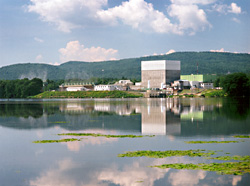
The Watts Bar plant, located about 50 miles northeast of Chattanooga,
Tenn., has a unique history. Unit 1, which also traces its roots to
1973, was the last U.S. plant to come on line when it was finally
licensed in 1996 after a similarly lengthy construction hiatus.
When work resumed on Unit 2, the NRC recalled a handful of staffers
who had been involved in inspecting work on the sister unit to ensure
“knowledge transfer.”
“Our goal is to verify the design is accurate,” said James Baptist,
who was a team leader for several years during Watts Bar 2 construction
and has recently become chief of the Region II branch overseeing the
transition from construction to operation. “We want to ensure Unit 2
looks and operates just like Unit 1. It greatly assists the effort when
you have a working model right beside you.”
As is the case with most NRC inspection efforts, the corps of
construction resident inspectors led the way, reporting to the site
daily and amassing a big percentage of those 127,000 hours.
“Everything came through the residents in terms of what was going on
at the site,” said Chris Even, who recently transitioned from senior
construction project manager to senior project inspector in the new
branch overseeing the transition. “We always relied on the residents for
knowing exactly what was going on.”
The workload was huge from the beginning, with more than 550
construction inspection items to be inspected and closed. And Baptist
noted that even though the plant was designed in the 1970s, it’s built
to today’s standards.
“They purposely built Unit 2 to be a mirror image of Unit 1 while
including all the updated safety enhancements that have accrued over the
last 25 or 30 years,” he said.
For example, Watts Bar is the first plant in the nation to comply
with all the NRC’s post- Fukushima upgrades as well as the newest
cybersecurity requirements.
One might think that with the license issued and the plant about to
start up that the NRC inspection effort would be winding down. Baptist
said that is not the case.
“We still have our foot on the gas,” he said.
Just as the NRC inspectors were dedicated to make sure Watts Bar Unit
2 was constructed and tested according to the design and NRC regulatory
requirements, they will continue to maintain that vigilance as the
plant begins and continues to operate.




 In December of 2014, the


 Scientists in Germany
flipped the switch on an experiment they hope will advance the quest for
nuclear fusion, considered a clean and safe form of nuclear power.
…
Continue Reading
Scientists in Germany
flipped the switch on an experiment they hope will advance the quest for
nuclear fusion, considered a clean and safe form of nuclear power.
…
Continue Reading


