
Michele Kearney's Nuclear Wire - Major Energy and Environmental News and Commentary affecting the Nuclear Industry. Nuclear Activities
Saturday, March 19, 2011

Update to Information Sheet Regarding the Tohoku Earthquake The Federation of Electric Power Companies of Japan (FEPC) Washington DC Office As of 12:30PM (EST), March 19, 2011
Update to Information Sheet Regarding the Tohoku Earthquake
The Federation of Electric Power Companies of Japan (FEPC) Washington DC Office
As of 12:30PM (EST), March 19, 2011
- Radiation Levels
- At 10:30PM (JST) on March 19, radiation level outside main office building (approximately 1,640 feet from Unit 2 reactor building) of Fukushima Daiichi Nuclear Power Station: 2,854 micro Sv/hour.
- Measurement results of ambient dose rate around Fukushima Nuclear Power Station announced at 4:00PM and 7:00PM on March 19 are shown in the attached two PDF files respectively.
- For comparison, a human receives 2,400 micro Sv per year from natural radiation in the form of sunlight, radon, and other sources. One chest CT scan generates 6,900 micro Sv per scan.
- Fukushima Daiichi Unit 1 reactor
- At 4:50PM on March 19, pressure inside the reactor core: 0.205MPa.
- At 4:50PM on March 19, water level inside the reactor core: 1.75 meters below the top of the fuel rods.
- At 4:50PM on March 19, pressure inside the primary containment vessel: 0.18MPaabs.
- As of 9:00PM on March 19, the injection of seawater continues into the reactor core.
- Recovery work of power supply is to be scheduled.
- Fukushima Daiichi Unit 2 reactor
- At 9:05PM on March 18, access to the substation for reserve power supply from external transmission line was completed.
- As of 1:30PM on March 19, the work for laying the electric cable from the substation to the load site is being carried out.
- At 4:30PM on March 19, pressure inside the reactor core: -0.009MPa.
- At 4:30PM on March 19, water level inside the reactor core: 1.3 meters below the top of the fuel rods.
- At 4:30PM on March 19, pressure inside the primary containment vessel: 0.135MPaabs.
- As of 9:00PM on March 19, the injection of seawater continues into the reactor core.
- Activities for connecting the commercial electricity grid are underway.
- Fukushima Daiichi Unit 3 reactor
- At 0:30AM on March 19, Tokyo Fire Department began to shoot water aimed at the spent fuel pool, continuously until 01:10AM.
- At 5:25PM on March 19, pressure inside the reactor core: -0.050MPa.
- At 5:25PM on March 19, water level inside the reactor core: 1.85 meters below the top of the fuel rods.
- At 5:25PM on March 19, pressure inside the primary containment vessel: 0.210MPaabs.
- At 5:30PM on March 19, Tokyo Fire Department began to shoot water continuously aimed at the spent fuel pool.
- As of 9:00PM on March 19, the injection of seawater continues into the reactor core.
- As of 9:00PM on March 19, activities for recovering the external power supply are underway.
- Fukushima Daiichi Unit 4 reactor
- No official updates to the information in our March 19 update have been provided.
- As of 9:00PM on March 19, activities for recovering the external power supply are underway.
- Fukushima Daiichi Unit 5 reactor
- At 5:00AM on March 19, pump for Residual Heat Removal (RHR) started up and cooling of spent fuel storage pool has started.
- At 6:00AM on March 19, the temperature of the spent fuel pool was measured at 155.8 degrees Fahrenheit.
- At 9:15AM on March 19, making 3 holes in the roof of reactor building to prevent hydrogen from accumulating has been completed.
- At 6:00PM on March 19, the temperature of the spent fuel pool was measured at 118.6 degrees Fahrenheit.
- Fukushima Daiichi Unit 6 reactor
- At 4:22AM on March 19, the second unit of emergency diesel generator started up.
- At 5:11AM on March 19, Fuel Pool Cooling (FPC) pump started to circulate the water of spent fuel pool.
- At 6:00AM on March 19, the temperature of the spent fuel pool was measured at 151.7 degrees Fahrenheit.
- At 9:15AM on March 19, making 3 holes in the roof of reactor building to prevent hydrogen from accumulating has been completed.
- At 6:00PM on March 19, the temperature of the spent fuel pool was measured at 152.6 degrees Fahrenheit.
- Fukushima Daiichi Common Spent Fuel Pool
- At 11:19AM on March 18, the temperature of the spent fuel pool was measured at 131.0 degrees Fahrenheit.
Our official sources are:
- Office of The Prime Minister of Japan
- Nuclear and Industrial Safety Agency (NISA)
- Tokyo Electric Power Company (TEPCO) Press Releases
- Ministry of Education, Culture, Sports, Science and Technology (MEXT)
Links to websites providing information on the accident at Fukushima Daichii NPP in Japan
1) JAIF (Japan Atomic Industrial Forum) website: http://www.jaif.or.jp/english/
2) TEPCO Press Releases: http://www.tepco.co.jp/en/
3) NISA (Nuclear and Industrial Safety Agency) website: http://www.nisa.meti.go.jp/
4) IAEA website: http://www.iaea.org/
5) World Nuclear News: http://www.world-nuclear-news.
6) Nuclear Energy Institute (NEI) website: http://nei.cachefly.net/
7) MEXT (Ministry of Education, Culture, Sports, Science and Technology) website: http://www.mext.go.jp/english/ (provides data on radiological monitoring)
8) Japan broadcast services: NHK World live stream: http://www3.nhk.or.jp/
9) Wikipedia pages: http://en.wikipedia.org/wiki/
ANS outreach via members to Congress
The American Nuclear Society has sent the following letter to its members. The full text follows below. A PDF attachment in the original is now hosted at Google DOS and has been converted to a link. You may share the link, below, to it with anyone.
Dan Yurman
Email: djysrv@gmail.com
Blog: ANS Nuclear Cafe Twitter: @djysrv
Google Voice: 208-419-3881
-----------------------------
March 19, 2011
Dear ANS Members,
We are all saddened by the catastrophic earthquake and tsunami in Japan and the resulting damage to the Fukushima Daiichi Nuclear Station. As we move forward, it is critically important that we work together to ensure that our federal policy makers have accurate information about nuclear technology and radiation.Your Senators and Members of Congress are returning to their States and Districts next week, and I encourage you to schedule a meeting with them while they are back home. They need to know they have constituents with nuclear related technical expertise who can help them make sense of this very complex and dynamic situation in Japan.
I suggest you take these steps:
1. Find the phone numbers of your Senators' state offices by accessing their website here <http://www.senate.gov/
2. Call their scheduler and ask for an appointment. Let them know you are a constituent and a member of the American Nuclear Society with knowledge relevant to technical aspects of the situation in Japan. If you are offered a meeting with staff, accept.
3. Once you have an appointment, arm yourself with information. Unfortunately, we cannot provide you with up-to-date talking points since the situation itself is so fluid. Instead, your role is to help the member understand some of the many technical issues, learn about their concerns and share your expertise. Below are some reliable sources of information, which are being updated regularly:
* American Nuclear Society Japan Page ansnuclearcafe.org
* Nuclear Energy Institute www.nei.org
* World Nuclear News www.world-nuclear-news.org
* ANS Radiation Dose Chart www.new.ans.org/pi/resources/
* NHK Television www3.nhk.or.jp/
* Japan Times www.japantimes.co.jp
4. On the day of the meeting,
* Be prompt and patient. It is not uncommon for a member of Congress to be late or to have a meeting interrupted due to a crowded schedule.
* Be grateful. Make sure you open the conversation by thanking the members/staff for his/her time, and send a handwritten thank you note afterwards.
* Be honest. The situation in Japan is a difficult one. Don't feel the need to provide "spin." Stick to the facts as you know them and don't be afraid to say that you do not know the answer to a question. The goal is to be a technical resource for them to contact in the future and let them know your support for NS&T in general.
* Be responsive. Make sure you follow up promptly if the member/staff has asked you to provide any additional information or analysis. Contact us at japanfacts@ans.org if you need help.
Again, your goal is to be a technical resource to your Senators/Representative and their staffs, providing perspective and correcting misperceptions without sugarcoating the situation.
Finally, we encourage you to send ANS a message to let us know how your meeting went. Send an e-mail to japanfacts@ans.org with the subject line "MEETING."
Any help you can give would be greatly appreciated.
Joe Colvin
ANS President
Attachment: Information About Conditions in Japan, March 18, 2011 http://tinyurl.com/ANSJPINFO WebinarThe Facts About Japan's Nuclear Situation"
Webinar - the facts about Fukushima
http://nuclearfabrication.org/
This is a briefing set up by the Nuclear Fabrication Consortium (NFC) and the Greater Cleveland Partnership. Both groups promote the interests of U.S. businesses that manufacture components for nuclear power plants. See web site for more information, list of members, etc. http://nuclearfabrication.org/
See my coverage of NFC's annual meeting in Fuel Cycle Week last September.
http://djysrv.blogspot.com/
You may share this invitation with others in the nuclear industry, and especially those organizations involved in making components for reactors, but please be selective. I ask that you do not "broadcast" this invitation on a blog, web site, or by other means. The primary audience is the business community.
WEBINAR
Event: “The Facts About Japan's Nuclear Situation”
Time: Tuesday, March 22th at 2:00pm Eastern
Listening method: Phone + Web Simulcast
Phone number: (614) 384-5247
PIN Code: 029468#
Panelists
David Blee - Nuclear Infrastructure Council
Lake Barrett – Former Deputy Director, Office of Radioactive Waste Management
Marc Goldsmith – Principal, MGA LLC & Former VP, Stone & Webster
Edward Davis – Former President, American Nuclear Energy Council
Dan Yurman - American Nuclear Society
Note that while I am a speaker provided to the webinar by the American Nuclear Society, I am not speaking in an official capacity for the society. The views expressed during the webinar will be my own responsibility.
http://nuclearfabrication.org/
This is a briefing set up by the Nuclear Fabrication Consortium (NFC) and the Greater Cleveland Partnership. Both groups promote the interests of U.S. businesses that manufacture components for nuclear power plants. See web site for more information, list of members, etc. http://nuclearfabrication.org/
See my coverage of NFC's annual meeting in Fuel Cycle Week last September.
http://djysrv.blogspot.com/
You may share this invitation with others in the nuclear industry, and especially those organizations involved in making components for reactors, but please be selective. I ask that you do not "broadcast" this invitation on a blog, web site, or by other means. The primary audience is the business community.
WEBINAR
Event: “The Facts About Japan's Nuclear Situation”
Time: Tuesday, March 22th at 2:00pm Eastern
Listening method: Phone + Web Simulcast
Phone number: (614) 384-5247
PIN Code: 029468#
Panelists
David Blee - Nuclear Infrastructure Council
Lake Barrett – Former Deputy Director, Office of Radioactive Waste Management
Marc Goldsmith – Principal, MGA LLC & Former VP, Stone & Webster
Edward Davis – Former President, American Nuclear Energy Council
Dan Yurman - American Nuclear Society
Note that while I am a speaker provided to the webinar by the American Nuclear Society, I am not speaking in an official capacity for the society. The views expressed during the webinar will be my own responsibility.
Fukushima nuclear accident: Saturday 19 March summary
Fukushima nuclear accident: Saturday 19 March summary Barry Brook | 20 March 2011 at 12:04 AM | Categories: Hot News, Nuclear | URL: http://wp.me/piCIJ-15h |
Yes, the IAEA has now formally listed the overall accident at an INES level 5 (see here for a description of the scales), up from the original estimate of 4. This is right and proper -- but it doesn't mean the situation has escalated further, as some have inferred. Here is a summary of the main site activities for today, followed by the latest JAIF and FEPC reports. You also might be interested in the following site map:

Another large cohort of 100 Tokyo fire fighters joined the spraying operation to cool down the reactors and keep the water in the spent fuel ponds. They have set up a special vehicle called 'Hyper Rescue' for firing a water cannon from 22 m high (in combination with a super pump truck), and today have been targeting the SNF pond in unit 3. About 60 tons of sea water successfully penetrated the building in the vicinity of the pool, at a flow rate of 3,000 litres per minute. Spraying with standard unmanned vehicles was also undertaken for 7 hours into other parts of the the unit 3 building (delivering more than 1,200 tons), to keep the general containment area cool. The temperature around the fuel rods is now reported by TEPCO (via NHK news) to be below 100C.
Conditions in unit 3 are stabilising but will need attention for many days to come. Promisingly, TEPCO has now connected AC cables to the unit 1 and 2 reactor buildings, with hopes that powered systems can be restored to these building by as early as tomorrow (including, it is hoped, the AC core cooling systems), once various safety and equipment condition checks are made.
Holes were made in the secondary containment buildings of Units 5 and 6 as a precautionary measure, to vent any hydrogen that might accumulate and so prevent explosions in these otherwise undamaged structures. The residual heat removal system for these units has now been brought back on line and these pools maintain a tolerable steady temperature of 60C. More here. These buildings were operating on a single emergency diesel generator, but now have a second electricity supply via the external AC power cable.
Read more of this post
Three Mile Island (TMI-2) Recovery and Decontamination Collection Engineering Library
Three Mile Island (TMI-2) Recovery and Decontamination Collection
Engineering Library
3/19/11 NISA News Release
3/19/11 NISA News Release
・ It was confirmed that a part of wall in the operation area of Unit 4 was
damaged. (06:14 March 15th)
・ The fire at Unit 4 occurred. (09:38 March 15th) TEPCO reported that
the fire was extinguished spontaneously. (11:00 March 15th)
・ The temperature of water in the Spent Fuel Pool at Unit 4 had
increased. (84 ℃ at 04:08 March 14th)
・ It was confirmed that a part of wall in the operation area of Unit 4 was
damaged. (06:14 March 15th)
・ The fire at Unit 4 occurred. (09:38 March 15th) TEPCO reported that
the fire was extinguished spontaneously. (11:00 March 15th)
・ The temperature of water in the Spent Fuel Pool at Unit 4 had
increased. (84 ℃ at 04:08 March 14th)
Insight to Fukushima engineering challenges
Insight to Fukushima engineering challenges
18 March 2011
ORIGINALLY PUBLISHED: 3.48pm GMTCORRECTION: 4.09pm GMT Correct size of tsunami below, plus altitude difference between Daini and Daiichi
Official notices of the accidents at the Fukushima nuclear power plants give insight into the challenges faced by power plant engineers in the aftermath of last week's natural disasters.
 |
| Elena Buglova, acting head of the IAEA Incident and Emergency Centre at a press briefing yesterday |
The remainder of the nuclear crisis has its origins specifically in the tsunami that followed. Information accompanying the ratings gives insight into the starting point of the crisis and the technical challenges faced by Tokyo Electric Power Company (Tepco) in the immediate aftermath of the tsunami.
Fukushima Daini
At the Daini plant, all three large boiling water reactors were operating at full power ratings of 1100 MWe when the earthquake hit. They shut down automatically and began using diesel generators to power core cooling systems.
One hour later the plant was inundated by a tsunami said to be seven metres in height, compared to design basis surge of 6.51 metres. Unit 3 was undamaged and continued to cold shutdown status, but the other units suffered flooding to pump rooms where equipment transfers heat from the reactor circuit to the sea - the ultimate heat sink.
With these out of action, the challenge for engineers was to manage the heat and pressure inevitably building within power plant systems until the seawater pumps could be brought back online.
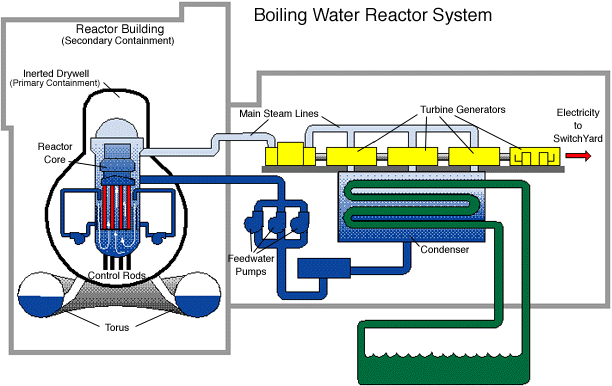
Core cooling systems continued to work and these were complimented by a high pressure coolant injection (HPCI) system, powered directly by steam emerging from the main reactor system. Separate from the large steam turbine used to generate power, the HPCI is connected only to a pump which injects cooler water from the large torus suppression chamber beneath the reactor as well as a water storage tank.
 |
| The boiling water reactor system |
However, all the systems rely on a finite source of water within the plant, which gradually heats up. The HPCI and torus venting systems also rely on a difference in temperature between the reactor system and the torus. When the temperature in the torus heats up to 100ºC, the system, including the injection from the HPCI, becomes ineffective.
When this occurred at Fukushima Daini 1, a technical emergency was declared. Today's INES ratings reveal that the same sequence of events happened at units 1, 2 and 4. These were each rated at Level 3 - 'serious incidents'.
Site workers were able to repair some equipment in pump rooms and restart operation. Going from one unit to the next they were able to achieve cold shutdown status for all of the units.
 |
| In happier times: The Fukushima Daiichi plant |
Fukushima Daiichi
Similar problems occurred at the Daiichi plant. Units 1, 2 and 3 were operating at full power but shut down on the earthquake. They too were flooded by the tsunami and lost their sea water pumps - but this was exacerbated by the loss of emergency diesels as well. One factor in this could be that the Daiichi plant is at a slightly lower altitude than Daini, making the tsunami relatively more powerful.
This meant that heat was building up in the power plant in the same way as at Daini 1, 2 and 4, but that core cooling sprays could not be powered.
At Daiichi 1, 2 and 3, the steam-driven HPCIs were left as the only cooling system, which eventually heated the units' toruses to the point that they stopped working. Pressure from the reactor vessels built several times to the point that it required release. Separately, gas in the containment vessel was vented and this was enough to raise radiation levels at the site boundary to 0.5 millisieverts per hour.
Japanese officials reported that for each unit, "The behaviour of the pressure of the reactor vessel and the containment vessel, and the behaviour of the water level of the reactor were complicated. Some measurements were not possible because of failures of measuring equipment. As a result, a detailed estimate cannot be done." However, they said, the radiation signature of the releases matched a theory that a few percent of each reactor core had suffered damage.
Enough hydrogen was also produced within the reactor vessel by the interaction between water and hot fuel to cause an explosion at each unit when this was vented to the secondary containment. For units 1 and 3 this removed the top part of the reactor building. At unit 2 this may have taken place in the torus, causing damage there.
Core damage is rated at Level 5 on the INES scale, an 'accident with wider consequences'. This is applied to units 2 and 3, while unit 1's INES Level 5 rating is attributed to the abnormal rise of radiation dose at the site boundary.
After the total failure of plant cooling systems, seawater is being pumped into the reactor cores of units 1, 2 and 3 to prevent overheating and further core damage. This will likely continue for some time, although plant cooling systems may come back into operation once external power is restored.
Fukushima Daiichi 4
While Fukushima Daiichi 4 was fully defuelled for maintenance, it suffered the loss of seawater pumps and 'electricity rooms'. This led to the loss of cooling and water supply functions to the cooling ponds.
Eventually the water boiled, hydrogen was produced by the interaction of water and hot fuel and a hydrogen explosion wrecked the building. This event was was rated at INES Level 3 - a 'serious incident'.
Fuel pond work at Fukushima
Fuel pond work at Fukushima
19 March 2011
ORIGINALLY PUBLISHED: 11.38am GMTCORRECTION: 1.16pm GMT Correct number and size of holes. Clarity on hydrogen productionRecent work at Fukushima Daiichi has included making holes to vent hydrogen in units 5 and 6, while unit 3's fuel pond is said to have stabilised.
An announcement of stability at unit 3's pond came from chief cabinet secretary Yukiyo Edano. This follows the deployment of Hyper Rescue, a truck featuring a 22 metre arm that pumps some 3000 litres of water per minute, in combination with Super Pump Truck. Together the machines sprayed seawater through the holes left in the sides of the reactor building.
Police riot trucks and army fire engines had already been working on the job. Helicopters were tried two days ago, but this approach was not effective.
Edano made clear that unit 3 remains a concern and that spraying may continue.
Units 5 and 6
Elsewhere on site, two diesel generators at unit 6 are now providing power to units 5 and 6 to circulate water in the fuel ponds.
Engineers have also brought back the residual heat removal system of unit 5 allowing heat from its fuel pond to be removed to the sea, which is the ultimate source of cooling for any thermal power plant on the coast.
Holes have been bored through the roofs of reactor buildings 5 and 6 in an 11-hour operation to ensure that hydrogen can vent naturally. Each unit has three holes measuring seven centimetres.
Tokyo Electric Power Company said the temperature of fuel ponds in units 5 and 6 was about 60 degrees. They did not say that hydrogen was being produced but that the move to bore holes was a precaution.
NRC to hold public meeting on NRC response to Japan
NUCLEAR REGULATORY COMMISSION TO HOLD PUBLIC MEETING ON
NRC RESPONSE TO RECENT JAPAN EVENT
The U.S. Nuclear Regulatory Commission will be briefed by its staff on the NRC’s response to the ongoing nuclear event in Japan in a public meeting on March 21 at 9 a.m. at NRC Headquarters, 11555 Rockville Pike, Rockville, Md. The commission meeting will be open to public observation and will be webcast at:
Due to limited space availability, the meeting will be set up for a CBS broadcast network pool camera crew. Broadcast media outlets interested in receiving the feed should contact the network pool at 202-457-444. For still photographers, this meeting will be pooled with AP, Reuters, AFP and Getty only.
In order for us to try to ensure sufficient seating for reporters, please notify the Office of Public Affairs at the contact information above if you plant to attend. There will be additional space available in our auditorium on a first-come, first-serve basis.
Pool photographers will have limited space at the meeting in which to take photos. Movement must be kept to a minimum so as not to be distracting and entry into the inner well closest to the Commission briefing table is prohibited. Plan to arrive in advance of the meeting at the Marinelli Road entrance of the NRC with proper media credentials. The NRC offices are located across the street from the White Flint Metr

Breaking News Japan finds elevated radiation levels in food

Tsunami and after effects and earthquake after shocks are bigger threat than nuclear power plants
Tsunami and after effects and earthquake after shocks are bigger threat than nuclear power plants
BBC News - Even under this worst case, though, the direct health consequences of the nuclear accident would be very small compared with the thousands already killed by the earthquake and tsunami, let alone the continued suffering of the survivors (by David Spiegelhalter Professor of the Public Understanding of Risk, Cambridge University.The Daily Mail science editor, Michael Hanlon, has already boldly claimed that "what has happened in Japan should in fact be seen as a massive endorsement of nuclear power", given the success of most Japanese plants at withstanding a disaster they were never designed for, but others will use exactly the same information to reach the directly opposite conclusion.

Fukushima Daiichi nuclear power plant reported in stable condition
Fukushima Daiichi nuclear power plant reported in stable condition
NEI - UPDATE AS OF 11:20 A.M. EDT, FRIDAY, MARCH 18:Reactors 1, 2 and 3 at the Fukushima Daiichi nuclear power plant are in stable condition, with workers continuing to provide seawater cooling into the reactors. Containment integrity is believed to be intact on reactors 1, 2 and 3, and containment building pressures are elevated but are within design limits.
Site radiation doses have been decreasing since March 16. Radiation dose rates are fluctuating based on some of the relief operations, such as adding cooling water to the used fuel pools. Recent readings at the plant boundary are about 2 millirem per hour. Radiation dose rates at reactor 3 range between 2,500 and 5,000 millirem per hour.
The Japanese Self-Defense Force restarted cooling water spray into the Unit 3 reactor building and spent fuel pool at around 1 a.m. EDT on March 18. Plans are to spray 50 tons of water on the reactor 3 reactor building/spent fuel pool using seven fire-fighting trucks.
A diesel generator is supplying power to reactors 5 and 6. TEPCO is installing high voltage cables from a nearby transmission line to reactors 1 and 2. Once electricity supply is re-established, priority will be given to restoring power to reactor heat removal systems and cooling water pumps. Workers are seeking to install electrical cables to reactors 3 and 4 components in about two days.

One Plus One - Fukushima's legacy Barry Brook
 | One Plus One - Fukushima's legacy Barry Brook | 19 March 2011 at 4:59 PM URL: http://wp.me/piCIJ-159 |
Meanwhile, follow the comments in this thread for the real-time updates by commenters.
Below is a 10 minute interview with me that was shown on ABC TV (Australia's national television broadcaster) during the weekend, on the conversation magazine-style program "One Plus One". I'm interviewed by Mike Sexton.
Please watch this if you really want to understand where I'm coming from on all of this (including my background and motivations), and for my speculation on what the legacy of Fukushima might be, if rational and logical heads are not kept.
watch?v=SFs_-8DtZvo
For readers in Australia, you can also watch this on ABC iView.
For other videos on the BraveNewClimate YouTube channel, see here. For my 16 x 5-min audio podcasts (and ongoing), which cover nuclear power and climate change, see here. This one is a good starter: Integral Fast Reactor nuclear power - what is it and why should you care?
Press Release (Mar 19,2011) Status of TEPCO's Facilities and its services after Tohoku-Taiheiyou-Oki Earthquake (as of 1:00AM)
 |
|

Subscribe to:
Posts (Atom)