Michele Kearney's Nuclear Wire

Major Energy and Environmental News and Commentary affecting the Nuclear Industry.
Showing posts with label Energy development. Show all posts

Wednesday, December 29, 2010

US Renewables Now Neck-And-Neck With Nuclear Power


-
http://www.energy-daily.com/reports/US_Renewables_Now_Neck_And_Neck_With_Nuclear_Power_999.html Washington DC (SPX) Dec 29, 2010 According to the most recent issue of the "Monthly Energy Review" by the U.S. Energy Information Administration (EIA), "nuclear electric power accounted for 11% of primary energy production and renewable energy accounted for 11% of primary energy production" during the first nine months of 2010 (the most recent period for which data have been released). More specifically, renewable energy sources (i.e., biomass/biofuels, geothermal, solar, water, and wind) accounted for 10.9% of domestic energy production and increased by 5.7% compared to the same period in 2009.
Meanwhile, nuclear power accounted for 11.4% of domestic energy production but provided 0.5% less energy than a year earlier.
Among the renewable energy sources, biomass and biofuels accounted for 51.95%, hydropower for 31.50%, wind for 10.52%, geothermal for 4.65%, and solar for 1.38%. Comparing the first three-quarters of 2010 against the same period in 2009, hydropower declined by 5.2% but geothermal expanded by 1.8%, solar grew by 2.4%, biomass/biofuels increased by 10.0%, and wind grew by 26.7%; combined, non-hydro renewables expanded by 11.5%.
Preliminary data also show that fossil fuels accounted for 78% of primary energy production. Overall, U.S. primary energy production rose by 2% compared with the first nine months of 2009.
"Members of the incoming Congress are proposing to slash cost-effective funding for rapidly expanding renewable energy technologies while foolishly plowing ever-more federal dollars into the nuclear power black hole," said Ken Bossong, Executive Director of the SUN DAY Campaign.
"The numbers clearly show this would be betting on the obvious loser while ignoring the clearly emerging winner in the energy race."
And according to EIA's latest "Electric Power Monthly," renewable energy sources accounted for 10.18% of U.S. electrical generation during the first three-quarters of 2010. Compared to the same period in 2009, renewables - including hydropower - grew by 2.2%.
While conventional hydropower dropped by 5.2%, non-hydro renewable used in electrical generation expanded by 16.8% with geothermal growing by 4.9%, biomass by 5.5%, wind by 27.3%, and solar by 47.1%. Non-hydro renewables accounted for 3.9% of total electrical generation from January 1 - September 30, 2010 - up from 3.5% the year before.
Enhanced by Zemanta

Tuesday, December 7, 2010

S.Korea to build 14 new nuclear reactors by 2024

The coat of arms of South KoreaImage via Wikipediahttp://www.nuclearpowerdaily.com/reports/SKorea_to_build_14_new_nuclear_reactors_by_2024_999.html Seoul (AFP) Dec 7, 2010 South Korea said Tuesday it plans to build 14 new nuclear reactors by 2024 to help meet growing energy needs and cut dependence on fossil fuel. South Korea, which currently has 20 operational nuclear reactors, will build 14 new facilities to make atomic power the biggest source of energy by 2024, state-run Korea Power Exchange said.
As a result, nuclear energy will provide 48.5 percent of the nation's energy consumption by the target year from the current 32 percent, KPE said in a long-term national energy development plan.
Coal is currently the biggest source of energy in South Korea that meets 42 percent of the nation's energy needs.
Renewable energy sources like solar and wind power will also provide 8.9 percent of the nation's energy needs by 2024 compared with the current 1.3 percent, it said.
Asia's fourth-largest economy imports 97 percent of its energy needs from overseas and has moved to cut dependence on fossil fuels and to diversify energy sources.
In October Seoul unveiled a five-year plan to spend 36 billion dollars developing renewable energy as its next economic growth engine, with a goal to become one of the world's five top players in the sector.
Enhanced by Zemanta

Monday, December 6, 2010

Researchers discover a way to simultaneously desalinate water, produce hydrogen and treat wastewater

http://www.physorg.com/news/2010-12-simultaneously-desalinate-hydrogen-wastewater.html

December 3, 2010 Researchers discover a way to simultaneously desalinate water, produce hydrogen and treat wastewater
(PhysOrg.com) -- Fresh water and reusable energy. Humans are on a constant hunt for a sustainable supply of both. Water purification requires a lot of energy, while utility companies need large amounts of water for energy production. Their goal is to find a low-energy-required treatment technology. Researchers from the University of Colorado Denver College of Engineering and Applied Science may have discovered an answer.
Enhanced by Zemanta

Monday, November 22, 2010

CO2-Free Energy Can Meet Global Energy Needs In 2050


Danish wind and biomass resources in particular will make it possible to phase out fossil fuels in connection with power generation and heat production before 2040. It will take further 10 years to eliminate fossil fuels within the transport sector.
by Staff Writers Copenhagen, Denmark (SPX) Nov 22, 2010 Riso Energy Report 9 lists a wide range of energy technologies in the market with low or no emissions of greenhouse gases, describing how several of these will be made commercially available in the next decades. However, it is not possible to make the world's energy supply CO2-free as cheaply as possible, using only technology development in the current energy systems.
There must be room for technological leaps and there is a need for an integrated process to optimise the entire energy system, from energy production, through transformation into energy carriers, to energy transportation and distribution and efficient end use.
There is also a need for a smart grid, connecting production and end use at local level. End users should contribute to maintain balance in the future energy system and new technologies should be introduced to the end users, including houses with low and flexible consumption, smart electronic equipment, heat pumps, energy storage and local energy supplies such as solar cells and micro CHP.
Information and communication technology (ICT) will determine how successful the integration of renewables into the grid actually will be.
Considering the security of supply in the short and long term, there is still a need for access to fossil fuels, but they must be continuously replaced with renewable energy sources. If we do not make efforts to promote renewable energy sources, coal and gas might easily be prevailing in the global energy supply for the rest of this century.
For many countries, however, it could be advantageous to switch to renewable energy sources in order to reduce dependence on imported oil and gas. In addition, this transition can help the countries achieve their environmental policy goals.
Seen in isolation, Denmark has a great chance for achieving these goals and for phasing out fossil fuels at a rapid pace and thus reduce emissions of greenhouse gases at the required pace.
Danish wind and biomass resources in particular will make it possible to phase out fossil fuels in connection with power generation and heat production before 2040. It will take further 10 years to eliminate fossil fuels within the transport sector.
A future smart energy system requires that we start investments now. If we do not make these investments, future generations will look back on this period wondering how we could be satisfied with an outdated energy system, without taking advantage of the opportunities which we already were aware of.
Enhanced by Zemanta

Tuesday, November 2, 2010

TerraPower - Alternative Nuclear Technology

TerraPower began as a series of explorations related to many energy technologies. Out of these explorations came an advanced nuclear energy solution that presents a new path toward an affordable, safe form of carbon-free energy.
TerraPower aims to develop a sustainable and economic nuclear energy system while greatly reducing proliferation risks and creating new options for converting low-level waste into vast energy resources.

An Innovative Reactor Design

Artist's renditon of fissionIn this video, TerraPower CEO John Gilleland gives a basic explanation of the traveling wave reactor (TWR) technology and how the TWR turns depleted uranium into fuel.
http://www.terrapower.com/Home.aspx
Enhanced by Zemanta

Sunday, October 17, 2010

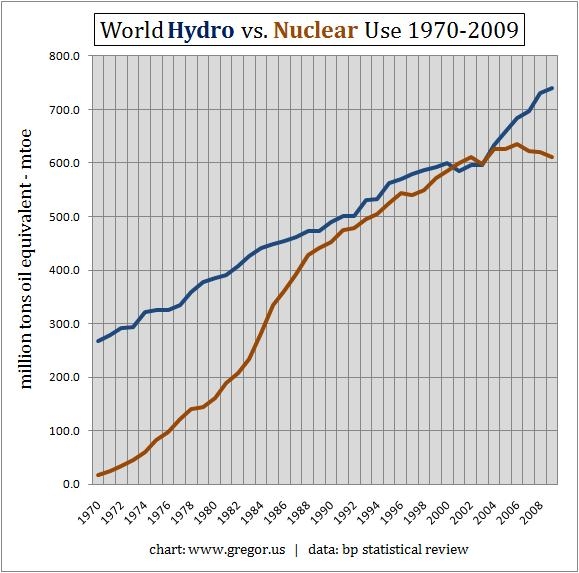
Global Hydro and Nuclear Power in Perspective by Gregor Macdonald

Image representing Seeking Alpha as depicted i...Image via CrunchBase

At the recent ASPO conference in Washington, DC I found myself in a lunchtime conversation discussing the contributions Nuclear and Hydro were making to world energy supply. It’s worth noting that Hydropower did experience an uptick in global use in the past five years. Nuclear meanwhile, which has seen a slowing rate of consumption since the 1980′s, leveled off and fell during the same period. While these two energy sources are worth discussing, they pale in comparison to oil and coal use globally, as the second chart shows (click on charts to enlarge).
In a post earlier this year, I showed similar graphics as below for global energy use by source for two distinct years: 1998, and 2008. With updated data, it’s worth juxtaposing the latest information (for 2009) with the close-up of Hydro and Nuclear to give a sense of proportion.
Complete Story http://seekingalpha.com/article/230374-global-hydro-and-nuclear-power-in-perspective?source=feed
Enhanced by Zemanta

Monday, October 4, 2010

Fast reactor future – the vision of an atomic energy pioneer

Fast reactor future – the vision of an atomic energy pioneer

When I was in Idaho Falls in August 2010, one of the places I visited was the Experimental Breeder Reactor I. It’s now a publicly accessible U.S. National Historic Landmark, and has some incredible experimental X-39 atomic aircraft engines sitting out the front (see little inset photo). I’ll talk more about this visit in a later BNC post, but one thing is relevant here. That is, there is a blackboard (now preserved permanently under glass) which includes the chalked signatures of the original EBR-I research crew. One of the names on that list is a young engineer called Leonard Koch — (see photo with him standing there almost 60 years before I looked at the same board!). Well, Len, at 90, is still going strong, and recently sent the IFRG a speech he gave in 2005 in Russia on fast reactors and the future. It’s a terrific essay, and not available anywhere on the internet (until now — I transcribed his scanned copy). Len kindly gave me permission to post it here on BNC. He also said to me:
I am pleased that you visited EBR-I. It is pretty primitive compared to the very sophisticated plants that are being built today, but it got things started. The plane the Wright Brothers built was even more primitive but they got the airplane business started. The key is to get things started and persist.

Enjoy:

Brief bio: A retired, “Pioneer”, Leonard Koch is probably the oldest continuing supporter and participant in the development of the original concept of nuclear power. He joined Argonne National Laboratory in early 1948 and participated in the development, design, construction and early operation of EBR-l as the Associate Project Engineer. He was responsible for the development, design and construction of the EBR-ll as the Project Manager. He wrote the book, “EBR-ll”, published by the American Nuclear Soceity, which describes that activity. More here.

Nuclear energy can contribute to the solution of global energy problems

Leonard J. Koch, winner of the 2004 Global Energy International Prize.
This paper was originally presented at the Programme of International Symposium “Science and Society”, March 13, 2005, St. Petersburg, Russia, the year after his prize was awarded, in recognition of the 75th birthday of Zhores Alferov, the founder of the Global Energy International Prize. A large number of Nobel Laureates and Global Energy Laureates participated in the symposium.
Energy has become a dominant, if not the dominant, field of science impacting society. In the last century, man’s use of energy increased more than it did in the entire previous history of civilization. It has resulted in the highest standard of living in history, but it has also created a global dependence on energy that may become very difficult to meet. That is the primary global energy problem. More specifically, it is the growing recognition that the increasing global demand for petroleum will exceed the supply.
Science has produced many uses for petroleum, but by far the most demanding of the unique capabilities of petroleum is its use for transportation of people and goods. Science has created a very mobile global society. Petroleum has made this possible because of its unique capability to serve as an energy source and as an energy “carrier”. Excluding natural gas, which I include in a very broad definition of “petroleum”, there is no alternative to petroleum that can serve both functions. There are energy sources and there are energy carriers, but no single alternative that can satisfactorily combine both capabilities.
It is generally agreed that the Earth was endowed with about two trillion barrels of oil and that about one trillion barrels have been extracted and used. Also, it is rather generally agreed that the present extraction rate of about 82 million barrels a day is at, or near, the peak rate that is achievable. Demand has been increasing and is expected to continue to increase. Although these figures would suggest that there is only a 35 year supply of petroleum remaining, of course, this is not what will happen, or what should be used for planning purposes. A long, gradual transition period will occur during which a variety of alternatives to petroleum in its various applications must be found and used. The challenge for science and technology is to endure that sufficient alternatives are acceptable, available and ready when needed.
Many people and organizations are addressing this matter. They have produced a variety of predictions and conclusions. They are readily and extensively available on the internet. At best, these predictions are disturbing and describe a difficult and, perhaps, an unpleasant transition period. At worst, they predict a catastrophe and the end of life and we now know it.
They generally agree that no single substitute for petroleum will be found and there is a wide disparity in the predicted acceptability of combinations of energy sources and energy carriers. Electricity and hydrogen are recognized as potential energy carriers. Electricity is well established. Hydrogen possesses superb “combustion” characteristics, but will require much more development and, will require an immense infrastructure. Its distribution will be difficult and expensive. If it is to be the eventual substitute for petroleum, a huge energy source with very long term availability will be required to produce the hydrogen.
There is little agreement on energy sources that can fulfill this potential demand. Coal is environmentally unacceptable, wind and solar are unreliable, because they require ”the wind to blow or the sun to shine’” while hydro and nuclear are considered inadequate because of available resources.
Nuclear energy is included in this latter category because the estimated reserves of uranium are found to be inadequate. this conclusion is scientifically incorrect! It is based on an immature technology which does not incorporate established scientific knowledge.
The ‘science” of nuclear energy is very simple and very specific. a pound of uranium contains the energy equivalent to about 5,000 barrels of oil or about 200,000 gallons of gasoline. in scientific terms, one kilogram of uranium contains the energy equivalent of almost two million liters of gasoline.
The United States has an inventory of more than one million tons of uranium in storage in the form of “spent fuel” from reactors, and “depleted uranium” from uranium enrichment plants. This inventory contains the energy equivalent of about ten trillion barrels of oil! The total global inventory of this material must be at least 3 or 4 times as large. These nuclear energy reserves are already mined and refined, the uranium (and thorium) still remaining in the Earth combined with the existing stockpile make this a virtually inexhaustible energy supply.
Clearly, the problem is not that the global uranium reserves are inadequate; it is that the contained energy is not being extractable using today’s immature technology, only about one percent of the energy is extracted from natural uranium! The balance remains in the inventories described earlier. The scientific requirements for extracting this energy have been understood for more than 50 years. The technology for doing so has not yet been developed.
Nuclear energy is produced by the fission of uranium atoms in a nuclear reactor. Natural uranium, as it occurs in the earth, is composed of two isotopes, uranium-235 which is fissionable, and uranium-238 which is not fissionable, but is “fertile” and when it absorbs a neutron it is transformed into plutonium-239 which is fissionable.
Natural uranium consists of about 0.7% U-235 and about 99.3% U-238. Rhe U-238 can only be fissioned if it is first “transmuted” to Pu-239. Therefore, natural uranium can only produce energy effectively by transmuting U-238 to Pu-239. The combination of fission and transmutation occurs in any nuclear reactor in which the fuel contains U-235 and U-238 or Pu-239 and U-238.
It occurs in all of the power reactors operating in the world today. In most of them, an adjustment is made in the U-235 concentration to enhance operation. The 0.7% U-235 content is “enriched” to about 3.0%. This process produces “depleted uranium” which contains about 99.8% U-238. None of the energy contained in this enormous global inventory of depleted uranium has been extracted.
The current generation of nuclear power reactors convert about 1 atom of U-238 into Pu-239 for each 2 atoms of U-235 fissioned. Some of the Pu-239 atoms are fissioned in situ. Therefore, a very small amount of the energy contained in the U-238 is extracted in today’s nuclear power plants. Virtually all of it remains in the spent fuel. The net result of these operations is that about one percent of the energy contained in the original natural uranium energy source has been extracted. The remaining 99% is contained in the spent fuel and depleted uranium. Virtually all of this energy is contained in U-238 which must be converted to Pu-239 to extract it.
This can be accomplished most efficiently in fast reactors fueled with Pu-239 and U-238. In this system, about 3 atoms of U-238 are converted to Pu-239 for each 2 atoms of Pu-239 fissioned. Because these machines can produce more plutonium than they consume, they are called “breeders”. The current conventional reactors which are about one third as efficient are called “converters”.
From the very early days of the nuclear age, it was predicted that the energy contained in uranium could be extracted by recycling nuclear fuel in fast reactors. It was recognized also that this could only be accomplished if the following questions were answered favorably. Would the neutronics produce a “breeder” type performance? Could energy be extracted usefully and acceptably from large fast neutron power reactors? Could nuclear fuel be recycled through such reactors in the manner required to extract the energy?
The first two questions have been answered. The plutonium – uranium fuel system in fast reactors will permit energy to be extracted from U-238. It has been shown that large fast power reactors can indeed produce useable energy. This has been done, probably most convincingly, in Russia at the BN-600 power station. In addition, work in other countries corroborate that fast power reactors can be used to produce electricity and for other uses.
The third question has not been answered adequately. Nuclear fuel has not been recycled to the extent necessary to demonstrate the capability to extract a significant fraction of the energy contained in uranium! This is the remaining challenge for science and technology.
I was deeply involved in a very early attempt to advance this technology. It evolved into the EBR-ll project; the Experimental Breeder Reactor No. 2., developed by Argonne National Laboratory in the United States. It was developed to demonstrate, on a small scale, the feasibility of power generation, but much more importantly, to advance fuel recycle technology. It was a relatively small plant, generating only 20,000 kilowatts of electricity, but it incorporated a complete “fuel cycle facility” interconnected to the nuclear reactor plant. Although fast reactor power plant projects were proceeding in the United States and other countries, none of them incorporated provisions for direct on-site fuel recycle. Therefore, the EBR-II experience is unique and important.
The fuel selected for the first phase of operation was an enriched uranium metal alloy which was actually established by the fuel refining process which had been selected. Neither plutonium, nor plutonium-uranium technology, were available at the time (the 1950′s). A relatively simple and imperfect fuel processing system was selected to provide a “starting point” for the development of this technology, with recognition that much additional technology development would be required. The uranium metal fuel was to be processed by melt refining which removed fission products from molten uranium by volatilization and oxidation. This process provided adequate purification for fast reactor fuel recycle, even though all of the fission products were not removed.
It was estimated that at nominal equilibrium conditions, after several fuel cycles, this process would produce an alloy consisting of about 95% uranium and 5% fission products (about 2.5% molybdenum and 2% ruthenium plus a small amount of “others”). This alloy was named “fissium” and it was decided to create this alloy for the initial fuel loading to avoid a constantly changing fuel composition with each fuel recycle. It was not expected that this first phase of operation would demonstrate a true breeder fuel recycle. That was planned for the next phase.
Simultaneously, some very preliminary laboratory-scale experiments indicated that electrorefining of plutonium-uranium metallic alloys might prove to be suitable for recycle of this fuel in fast power reactors. As a result, the EBR-II program plan was to operate initially on an enriched uranium fuel cycle and shift to a plutonium-uranium fuel cycle later when the technology for that fuel cycle was developed. It was thought that valuable power reactor fuel recycle experience could be obtained during the first phase even though it was not a true breeder fuel cycle.
Only the first phase was accomplished, and only on a limited scale. Five total reactor core loadings were recycled through the reactor. About 35,000 individual fuel elements were reprocessed, fabricated and assembled into almost 400 fuel subassemblies. An administrative decision was made that the United States nuclear power program would concentrate on oxide nuclear fuel for all power reactors, including fast reactors. The EBR-II fuel recycle program, based on metal fuel, was terminated. Reactor operation was continued for more than 20 years, but the fuel was not recycled. The reactor continued operation as a “fissium-fueled”, base load, electrical generating station and a fast neutron irradiation facility. The fuel cycle facility was used for examination of irradiated fuel and other materials.
Even though this program was interrupted, it produced and demonstrated some very useful technology that will be applicable to future recycle systems and provides an overall perspective of nuclear fuel recycle requirements. It includes the performance of highly complex operations in a very strong radiation field and the removal of fission product decay heat during fuel fabrication and assembly operations. Even though future systems may be less demanding, this technology and experience will be invaluable.
Each future recycle system will create unique requirements related specifically to the fuel, the fuel form and the design of the individual fuel elements. They will include removing the spent fuel from its container; (most probably a cylindrical tube), reprocessing the fuel and installing it in a new container.
It is this part of the total fuel recycle process that requires much development and demonstration. There are a variety of potential fuels and fuel forms and a variety of potential purification and fabrication processes which will produce a variety of fuel recycle characteristics and requirements . The composition of the fuel will change during recycle and an equilibrium, or near equilibrium, composition will eventually result. This scenario has not been produced for any of the potential fuel systems, nor will it be, until the required operational experience has been obtained. Global attention is needed because this will be a very slow, long-term undertaking. There are no quick fixes! A fuel cycle will probably take about three years, and several cycles will be required to establish a reasonable demonstration of the total performance of a specific recycle process. There will be, almost certainly, more than one total fuel recycle system to pursue; possibly several. Each will be unique and produce its own results and create its own requirements.
I have proposed that the United States initiate a program to begin the process by constructing a “fuel recycle reactor” (FRR) designed specifically to provide a facility in which these fuels can be recycled. I do not believe that a single facility of this kind can begin to do the job that is necessary to establish this badly needed technology. I know that it is presumptuous of me to suggest what other countries should do; but, I propose that a vigorous international effort be undertaken to develop and establish the technology required to recycle nuclear fuel in fast power reactors and thus make it possible for the world to use the tremendous capability which exists in the global resources of nuclear fuel.
This is a timely international challenge. I note that Japan is considering the restart of their Monju fast reactor and are exploring international participation ¡n fuel cycle technology. I note also that India is proceeding with their first fast power reactor with a capacity of 500 megawatts and plans to build three more by 2020. I find this to be a very interesting development; India has maintained a continuing technical interest in fast reactors since the very early days of nuclear power. I expect this program will bring a new perspective to nuclear power and fuel recycle. India has a strong interest in the U-233 thorium cycle because of their large indigenous supply of thorium.
Th-232, which is not fissionable, is similar to U-238; when it absorbs a neutron, it is transformed into fissionable U-233. This process also can be best accomplished in fast reactors and requires fuel recycle. Therefore, fuel recycle technology also must be developed to extract this source of energy. The vast global thorium reserves should be included in estimates of total global nuclear energy capability.
On a longer range basis, the magnitude of the demand for energy sources will eventually become dominant. In addition to providing an alternative to dwindling petroleum resources, there will be the need to provide for the continuing growth in demand for energy to satisfy the needs of increasing global population and their standard of living.
For nuclear energy to contribute significantly to satisfying this enormous potential demand, it will be necessary to not only develop the technology, but to make it acceptable!
History has established a relationship between nuclear energy and nuclear weapons that is not clearly defined or well understood. Nuclear weapons are produced from fissionable materials, but recycled power reactor fuel is not a suitable source for that material. Even the spent fuel after only one fuel cycle in current generation power reactors is unsuitable for weapons use. After multiple recycles, the fuel is essentially useless for weapons.
It will be necessary to demonstrate that nuclear energy on the vast scale I have suggested will not result in unacceptable nuclear waste. Efficient fuel recycle has the potential capability of virtually eliminating this requirement. The primary problem presented by the long term storage of spent fuel is the long half-life of the actinides produced in the spent fuel. They can be destroyed by fission.
A complete nuclear fuel recycle process will destroy these actinides and produce energy from those that fission. At equilibrium, all of the necessary processes will be operating simultaneously. Pu-239 will be fissioning, the higher isotopes of plutonium will be fissioning, or absorbing neutrons and transmuting into isotopes that fission and are destroyed.
The ideal fuel cycle will recycle all of the uranium, the plutonium isotopes and the other actinides and remove only fission products during each fuel cycle. The nuclear waste will consist primarily of fission products which will be far easier to store and virtually all of the energy will have been extracted from the original energy source, natural uranium. A similar scenario can be developed for thorium. The science is firmly established. The technology is needed. The incentive to do so is enormous. It is to provide an inexhaustible supply of energy for the foreseeable future and beyond.http://bravenewclimate.com/2010/09/14/fast-reactor-future/

Enhanced by Zemanta

Monday, September 27, 2010

Friday, September 24, 2010

Fueling the American Nuclear Revival By Katherine Berezowskyj

Industry experts discussed the importance of the nuclear fuel life cycle today in the latest session of the ongoing series, The American Nuclear Energy Revival, hosted by the U.S. Energy Association, The Sept. 23 briefing examined the steps of nuclear fuel cycle from mining to uranium enrichment to used fuel recycling.
Discussing uranium mining, Grant Isaac of Cameco, explained the operations involved to obtain the natural resource – exploration, mining, milling, and conversion – and emphasized the important of sustainability and life cycle environmental impact. Isaac pointed out a common misconception regarding the scale that mining’s impact on the environment. Compared to other energy sources, uranium is quite small. Specifically, he pointed out that uranium mine covering one square mile, such as one Cameco operates in Canada, yields the same amount of energy as produced by 71 billion barrels of oil or 17 billion tons of coal.
From UX Consulting Company, Ruthanne Neely discussed the global enrichment market. While current capacity does not meet U.S. demand, Neely explained that AREVA and Urenco have two centrifuge enrichment facilities under various stages of development that will add domestic capacity to the U.S. market. She noted that this growth will be rivaled by the Russians and the Chinese as they expand their enrichment resources and build more nuclear reactors.
On the back end of the nuclear fuel cycle, AREVA’s Dr. Alan Hanson discussed that with Yucca Mountain off of the table, and with the growing nuclear revival, he recommended that the United States make a more sustainable decision for managing its used fuel. While dry-cask storage is a safe approach for the interim, he noted that recycling as part of integrated fuel management presents a solid option.
Hanson explained that the countries with large nuclear generation that have chosen to recycle used fuel have done so, because it enhances the security of supply. In effect, recycled nuclear fuel offers a domestic source of material for nations that are reliant on imports. The other benefits he listed include making final waste management easier, conserving natural resources, and supporting non-proliferation objectives.
More importantly, Hanson pointed out that finding a solution is a social responsibility, and these materials should not be left for the next generation. Americans recycle soda cans and newspapers even though it is not necessarily less expensive and no shortage of these resources exists.
Enhanced by Zemanta

Thursday, September 16, 2010

Study: Worst CO2 emissions are yet to come

image credit: kleineolive (Wikimedia Commons)
Future fossil fuel infrastructure set to be built between now and 2060 will have the strongest effect on climate change, according to a report in the journal Science.
The global demand for energy is quickly rising, while political agreements and regulations to curb the resultant rise in greenhouse gas emissions have so far failed.
A new study from scientists in the US and Canada has calculated that most of the ‘key’ impacts of climate change could be avoided if no further CO2 power plants were built and that the real risks come from fossil fuel-based energy infrastructure which has yet to be built.
While previous policies have largely focused on regulating greenhouse gas emissions, a tactic that has so far not produced their desired results, the new study stresses the need for alternative sources of energy and technological innovation.
Enhanced by Zemanta

Wednesday, September 15, 2010

China Sector Watch: Energy

Nuclear power
According to the World Nuclear Association, China is currently using eleven nuclear power reactors while seven remain under construction, and another ten about to start construction. This signals a huge change in China’s energy policy as it only developed less than 10 nuclear plants in the last 30 years. The government wants to lessen dependence on coal-powered plants and diversify its energy mix.
Coal processing is the main cause of China’s pollution troubles; costing an estimated 6 percent of its GDP according to the World Bank. Nuclear power in comparison is a more efficient and cleaner way to produce energy.
tianwan-nuclear-power-china-dailyChina is also looking to move towards becoming self-sufficient in reactor design and construction. So far, it has had to mix nuclear technology imported from France, United States, Russia, and Canada. Another motivation for shifting to nuclear power is it will lessen the use of railways. The transport of  coal from China’s north uses almost half the country’s rail capacity.
By 2020, China is looking to build more reactors leading to a sixfold increase in nuclear capacity to at least 50 GWe or possibly to 60 GWe and an eventual increase to 120-160 GWe by 2030.
For its nuclear power program, China relies heavily on imported uranium to fuel its nuclear power program.The State Power Grid Corporation expects to supply 3810 billion kWh in 2010 from 850-900 GWe. Growth is then expected to slow to 2020, when capacity is expected to reach 1500 GWe. At the end of 2007 there was reported to be 145 GWe of hydro capacity, 554 GWe fossil fuel, 9 GWe nuclear and 4 GWe wind, total 713 GWe.
Nuclear power serves those provinces located in the country’s coastal areas to rely on another source of energy besides coal brought in from the north. This is a better option considering how coastal cities are the places that attract the highest amount of foreign investment while also being the places that use the most amount of electricity. In 2007, nuclear power sources provided 2.3 percent of total electricity used in the country or 62.86 billion kWh.
Building more nuclear energy plans also corresponds to the government goals to provide more jobs and improve domestic demand during the economic downturn as they will need purchases from the steel and metal industry. China’s largest nuclear company, the China National Nuclear Corp., has already signed agreements with domestic banks in billions of yuan to finance projects.
According to statistics, investment in nuclear and wind power investments rose by 71.85 percent and 88.10 percent last year. State-owned power companies were stepping up investment to meet growing demand and boost economic growth as part of a government stimulus plan, said Zhang Guobao, director of China’s National Energy Administration. He also called on ministers to ensure there were appropriate measures to raise and save energy as well as using it more efficiently.http://www.china-briefing.com/news/2009/03/02/china-sector-watch-energy.html#more-2578
Enhanced by Zemanta

Friday, September 10, 2010

Kuwait plans to develop 4 nuclear reactors by 2022

Kuwait plans to develop 4 nuclear reactors by 2022
Kuwait intends to construct four nuclear reactors by 2022, joining the push among oil-rich countries seeking alternative energy sources. Kuwait is in talks with foreign entities on "how nuclear energy fits in the energy mix of Kuwait for the next 20 years," said Ahmad Bishara, secretary general of the country's National Nuclear Energy Committee. Bloomberg

Enhanced by Zemanta

Thursday, September 9, 2010

Group: Nuclear power is clean, safe and reliable

Se belowImage via WikipediaOpinion: Nuclear energy helps curb carbon emissions
Years of research verifies that nuclear energy is clean, safe and reliable, writes Karen Walsh of the Pennsylvania Energy Alliance. It is the only energy source capable of producing continuous electricity without emitting greenhouse gases, she writes. Nuclear-generated power saves the atmosphere nearly 700 million tons of carbon dioxide and 3 million tons of sulfur dioxide every year, Walsh writes. The Mercury (Pottstown, Pa.)
Enhanced by Zemanta

Friday, September 3, 2010

Nuclear project gets support from local Idaho chamber

Nuclear project gets support from local Idaho chamber
The Chamber of Commerce in Payette County, Idaho, backed Alternate Energy Holdings' proposal to construct a nuclear power plant in the county, saying it would generate thousands of jobs. "Nuclear power has proven itself as one of the safest, cleanest and most reliable sources of energy in the world," the chamber said. Boise Weekly (Idaho)
Enhanced by Zemanta

Sunday, August 29, 2010

Green Power Getting ready to build next generation nuclear power plants Source: CONCRETE CONSTRUCTION MAGAZINE Publication date: 2008-08-01 By Tom Klemens and Joe Nasvik

For a number of years, the United States government has chosen not to have an energy policy. Because of the scarcity of energy, we now are paying a high price. Today, average citizens are learning the difficult lesson that energy plays a much more significant role in their lives than they ever realized, and conditions will get worse before they improve. Between now and 2050, worldwide demand for electricity will double. Although new developments have been made in renewable power, the bulk of this need will be met with either coal-fired or nuclear-reactor power plants. Unfortunately, power plants take years to build; with nuclear types taking the longest.
As the cost of oil skyrockets, worldwide demand increases and supplies decrease. All forms of energy production are increasing as well; the cost to mine and ship coal has doubled in the past year. At the same time, the percentage of greenhouse gases in the atmosphere continue to increase, while public awareness of the effects of global warming changes the way we think about natural resources. Electricity is the form of energy we most depend upon and this dependence will only increase with time. In the world of tomorrow, electricity will charge electric cars batteries, produce hydrogen cheaply for fuel cell-powered vehicles, and possibly heat buildings in order to reduce the dependence on fossil fuels.
The question is where will all this power come from? At best, the electricity generated from wind, solar, and hydroelectric will supply 20% of our need—possibly even less 50 years from now, which leaves coal and nuclear fuels as the primary source for energy. The big problem with coal-fired generators, however, is the release of radiation, airborne mercury, and carbon dioxide (CO2) into the atmosphere. As a clean source of energy nuclear fission reactors will generate the needed power for the next 50 years. After that, it's hoped that fusion reactors (which combine small atoms to make bigger ones instead of breaking heavy atoms apart into smaller ones) will solve the energy needs.

The circular form in the center of this photo is for the hatch that will provide access for moving equipment through the containment walls into the center of the structure. Note the heavy reinforcement in the outer protective structure wall to the right of the photo.
Mark Peters, deputy to the associate laboratory director at Argonne National Laboratory, Argonne, Ill., says the public has three concerns about nuclear reactors: they must be safe from extreme forces of nature, such as tornadoes and earthquakes, and man, as well as secure from terrorist attacks; they must not leak radiation; and highly radioactive spent fuels must be recycled, not stored.
The greatest cost of producing electricity from nuclear power plants is the initial cost of construction. The goal is to build better plants with longer life expectancies on a shorter construction cycle. David Matthews, director of the division of new reactor licensing at the Nuclear Regulatory Commission (NRC), Washington, D.C., says that before the Three Mile Island (TMI) accident in 1979, it took, on average, a little more than five years to build a new nuclear power plant following issuance of a construction permit by the NRC. After the accident, the process took more than 11 years, making the it prohibitively expensive. The NRC is reducing the permitting time by precertifying standardized power plant designs submitted by reactor manufacturers such as AREVA, General Electric, Mitsubishi, and Westinghouse. These certified designs then can be built at locations around the country, while owners apply for a combined construction and operating license (COL). This process is expected to lead to a reduction in construction time, in contrast to the lengthy delays experienced during the post-TMI period, because the design is expected to be essentially complete before the start of construction. The design life for reactors built in the 1970s and 1980s was 40 years. However, most of these plants have performed well and have been recertified for an additional 20 years. The current thought is that most will win certification for an additional 20 years after that, making the cost of producing electricity very reasonable. New reactor facilities may start with certifications of 40 years but with a design life of 60. Given the advancements in concrete technology, it should be possible to specify 100-year and longer service lives; this is also done with structural concrete bridges today. It means that the extended service life of a reactor will depend more on improvements to the steel vessels that contain the nuclear reaction.

The technology of pumping concrete and placing under extreme conditions has changed significantly since the Generation II reactor constructions in the United States, allowing for reduced construction times and greater efficiencies with new constructions. Temporary protective structures like the one shown here were used throughout the first two years of construction on the Olkiluoto 3 facility.
Currently the United States has 104 operating nuclear power plants, generating 20% of our electricity (90% of Chicago's power is from nuclear power plants). However, 80% of France's power is from its 59 nuclear power plants. The French company AREVA, Bethesda, Md., now leads the world in nuclear power plant construction.
More at link:


http://www.concreteconstruction.net/industry-news-print.asp?sectionID=718&articleID=755617


Enhanced by Zemanta