Michele Kearney's Nuclear Wire

Major Energy and Environmental News and Commentary affecting the Nuclear Industry.
Showing posts with label Agence France-Presse. Show all posts

Tuesday, December 28, 2010

S.Korea must improve offer to win nuke deal: Turkish envoy


Seoul (AFP) Dec 27, 2010 South Korea must make an improved offer if it wants to secure a project to build a Turkish nuclear power plant, the country's ambassador to Seoul said Monday. Erdogan Iscan said negotiations that began in March effectively halted after last month's G20 summit in Seoul, when the two sides failed to settle key differences.
"The plan offered by South Korea did not meet Turkey's expectations," he told Yonhap news agency by phone. The embassy confirmed his comments.
South Korea operates 20 reactors, which generate 30 percent of its electricity needs, and is eager to export its expertise as a new growth engine for the economy.
In December 2009 a South Korean-led consortium won a 20.4 billion dollar contract to build four nuclear plants in the United Arab Emirates, and Seoul hoped to cap this with a deal with Ankara.
But the ambassador told Yonhap the price of electricity was one of three or four major sticking points that held up progress, although he did not elaborate.
Iscan said Turkey has not closed the "Korean file" on the bid to build the Sinop nuclear power plant on the Black Sea coast, but has started formal negotiations with Japan.
He said Turkey cannot delay too long since rapid economic growth is causing energy demand to rise by an average four percent every year.
Turkey wants both the Sinop plant and the Akkuyu plant in the south of the country, that was won by Russia, to go into operation in 2018-2020.
Iscan said that if Seoul decides to improve its offer, Ankara will review it as a competitive bid and consider it along with the proposal made by Tokyo.
Enhanced by Zemanta

Tuesday, November 30, 2010

Nukes WikiLeak 'illegal, irresponsible and dangerous': NATO


http://www.spacewar.com/reports/Nukes_WikiLeak_illegal_irresponsible_and_dangerous_NATO_999.html Brussels (AFP) Nov 30, 2010 NATO slammed Tuesday the release of confidential US files revealing where the United States has deployed nuclear weapons in Europe as "illegal, irresponsible and dangerous," spokeswoman Oana Lungescu said. "As a matter of policy we won't comment on classified information and we strongly condemn the leaking of confidential documents," Longescu insisted.
However, "it is illegal, irresponsible and dangerous, regardless of whether the leaked material is diplomatic or military," she underlined.
Sensitive US diplomatic cables placed on the Internet show that most of the 200 US nuclear bombs still left in Europe are located in Belgium, the Netherlands, Germany and Turkey.
While these countries have raised the issue of disarmament, the precise location of these tactical bombs had not been made official prior to the latest leaks.
In the text files, a top Berlin official is logged as having told US counterparts it "made no sense to unilaterally withdraw 'the 20' tactical nuclear weapons still in Germany while Russia maintains 'thousands' of them."
He added that a "withdrawal of nuclear weapons from Germany and perhaps from Belgium and the Netherlands could make it very difficult politically for Turkey to maintain its own stockpile."
WikiLeaks at the weekend began releasing around 250,000 cables, after two other leaks this year involving hundreds of thousands of classified files on the US wars in Iraq and Afghanistan.
The whistleblowing site's Australian founder Julian Assange on Tuesday appealed to Sweden's Supreme Court to overturn a ruling he should be detained for questioning on allegations of rape.
Enhanced by Zemanta

Sunday, November 28, 2010

Russia's nuclear concern 'out of control': watchdog


http://www.nuclearpowerdaily.com/reports/Russias_nuclear_concern_out_of_control_watchdog_999.html Moscow (AFP) Nov 26, 2010 Russia's Rosatom state nuclear energy enterprise is out of government control and facing a heightened risk of corruption, Transparency International said in a report released Friday. The corruption watchdog called Rosatom "a state within a state" that conducted rigged auctions and overpaid for contracts that could have been struck at a lower and more competitive price.
"Rosatom, like the other public firms, is a state within a state and cannot be controlled by the the anti-monopoly service or the audit court," said Elena Panfilova, head of Transparency International Russia.
The group said it analysed 200 orders made by Rosatom for construction materials, and Panfilova said that firms often complained they were not allowed to take part in Rosatom tenders.
"Rosatom only allows chosen firms to take part in its offers, which are made at high prices in violation of its own norms," added deputy head of Transparency in Russia Ivan Ninenko.
Led by former prime minister Viktor Kiriyenko, Rosatom succeeded the Soviet Union's Ministry of Nuclear Energy and Industry in 1992. It was transformed into a state corporation in 2004.
Rosatom also controls nuclear weapons companies and oversees the country's construction of the first nuclear power plant in Iran.
Enhanced by Zemanta

Tuesday, November 16, 2010

S.Korea voices concern at N.Korea nuclear report


http://www.spacewar.com/reports/SKorea_voices_concern_at_NKorea_nuclear_report_999.html Seoul (AFP) Nov 15, 2010 South Korea said Monday it could not confirm a report that North Korea is building a light-water nuclear reactor, but that any such move would run counter to disarmament hopes. A US scientist who travelled to the North last week said Saturday he had been told by officials there that work has started on such a reactor.
"They were saying that they are constructing a small experimental light-water reactor (at Yongbyon), eventually of the size of about 25 to 30 megawatts," Siegfried Hecker said in footage carried by Japanese public broadcaster NHK.
Light-water reactors are generally used for civilian nuclear purposes. Experts say it is relatively difficult to extract plutonium from them to make atomic weapons.
Some Seoul analysts say the North may be stressing its overall atomic expertise in hopes of prodding the United States into resuming stalled six-nation nuclear disarmament talks.
Foreign ministry spokesman Kim Young-Sun said the South has no information on its neighbour's capabilities in light-water reactors.
However, Kim said the project, if confirmed, "would be going contrary to expectations from members of the six-party talks and the international community."
The North promised to give up all nuclear weapons and nuclear-related programmes in a 2005 six-party agreement, Kim said.
"It is important for the North to sincerely carry out the promise and international obligations for peace and stability on the Korean peninsula."
The North quit the talks in April 2009 and staged its second nuclear test a month later.
In recent months it has expressed conditional willingness to resume talks, but in return it wants a lifting of sanctions and a US commitment to hold separate talks on a peace treaty.
The United States says the North must show willingness to denuclearise and mend ties with South Korea before the six-party talks can resume.
In 1994 the United States reached an agreement with the North Korea under which several countries were to build it two light-water reactors to generate electricity.
In return, the North was to shut down its plutonium-producing reactor at Yongbyon.
The deal broke down in 2002. The light-water reactors were never completed and the North restarted its original reactor.
Enhanced by Zemanta

Thursday, November 11, 2010

Nuclear deal between Russia, Australia goes into force

http://www.nuclearpowerdaily.com/reports/Nuclear_deal_between_Russia_Australia_goes_into_force_999.html


Seoul (AFP) Nov 11, 2010 A nuclear cooperation agreement between Russia and Australia went into force Thursday after their two leaders exchanged notes to ratify the deal. Under the agreement Australia will sell uranium to Russia, against the advice of an Australian parliamentary committee.
Legislators had called for the deal to be blocked unless Russia met a number of conditions, including speeding up reforms to separate civilian and military nuclear plants.
"To open a new page, we have a good event today, an exchange of ratification notes," Russian President Dmitry Medvedev told Australian Prime Minister Julia Gillard at a meeting before the opening of the G20 summit in Seoul.
The agreement, which allows Australian uranium to be enriched in Russia and used in Russian nuclear reactors, was signed in Sydney in 2007 and ratified by the lower house of Russia's parliament this summer.
It last for 30 years but can remain in force indefinitely if there are no objections from either side.
The agreement means uranium supplied to Russia can be used only for peaceful purposes, must meet International Atomic Energy Agency safeguards and can be used only in facilities agreed by Australia.
A previous agreement signed in 1990 specified that Australian uranium supplied to Russia could be enriched for use by third countries only.
Enhanced by Zemanta

Monday, November 8, 2010

No signs of N.Korea nuclear processing: US envoy


Tokyo (AFP) Nov 6, 2010 There are no signs North Korea has resumed nuclear activity at the site where it previously produced weapons-grade plutonium, a former US envoy was quoted as saying Saturday after a trip to the country. Charles Pritchard, former top negotiator with North Korea, was quoted as saying that the Yongbyon complex -- where the isolated state processed plutonium for past nuclear tests -- did not appear to be in operation.
"My reaction is that the reactor, the 5-megawatt reactor, remains shut down, the cooling tower is still destroyed," Pritchard told reporters after a five-day trip to North Korea, Japan's Kyodo news agency reported.
"So at this point, I don't believe there is any additional reprocessing or anything going on" at the reactor, the former top US negotiator with Pyongyang said at a Beijing airport, according to Kyodo.
Enhanced by Zemanta

Monday, November 1, 2010

Bolivia plans nuclear plant with Iranian help

La Paz (AFP) Oct 30, 2010 - President Evo Morales confirmed Saturday that Bolivia plans to build a nuclear plant with Iran's help, stressing the facility would be for peaceful purposes. "There is nothing to lie about: one of the things we are working on with Iran is of course to have a nuclear plant, to generate energy," Morales said. "When we talk about a nuclear plant people will claim it is linked to a nuclear b ... more
http://www.nuclearpowerdaily.com/reports/Bolivia_plans_nuclear_plant_with_Iranian_help_999.html
Enhanced by Zemanta

Vietnam, Russia sign deal on first nuclear plant

Hanoi (AFP) Oct 31, 2010 - Russia and Vietnam on Sunday signed a deal worth an estimated 5.6 billion dollars for the Southeast Asian country's first nuclear power plant as Moscow seeks greater influence in the region. Russian President Dmitry Medvedev witnessed the signing, part of an effort to boost ties with his country's former Soviet-era communist ally. "This is a very important project," he told reporters, bu ... more
http://www.nuclearpowerdaily.com/reports/Vietnam_Russia_sign_deal_on_first_nuclear_plant_999.html
Enhanced by Zemanta

Vietnam to give Japan deal for nuclear reactors: report

Hanoi (AFP) Oct 30, 2010 - Hanoi has decided to give Japan contracts to build two nuclear reactors, a Japanese report said, while Russia is expected to sign a deal already announced for Vietnam's first nuclear energy plant. The communist country wants to build eight nuclear plants in the next two decades. Initial government plans call for four reactors, with a total capacity of 4,000 megawatts and at least one of them ... more
http://www.nuclearpowerdaily.com/reports/Vietnam_to_give_Japan_deal_for_nuclear_reactors_report_999.html
Enhanced by Zemanta

Russia hails Asia ties as it eyes nuclear projects

Hanoi (AFP) Oct 30, 2010 - Russian President Dmitry Medvedev on Saturday invited closer ties with Southeast Asia as Moscow positions itself for lucrative nuclear projects in the energy-hungry region. "Russia is open for such cooperation, including on the creation of various alliances," Medvedev told the 10-member Association of Southeast Asian Nations (ASEAN) at a summit in Vietnam's capital. Medvedev will Sunday ... more 
http://www.nuclearpowerdaily.com/reports/Russia_hails_Asia_ties_as_it_eyes_nuclear_projects_999.html
Enhanced by Zemanta

Wednesday, October 27, 2010

U.S. Wants Missile Defense Collaboration With Russia, Diplomat Says -- Global Security Newswire


The Growing NATO - Russian Alliance

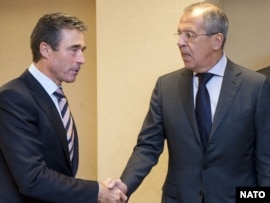
Photo: NATO Secretary-General Anders Fogh Rasmussen (left) talks with Russian Foreign Minister Sergei Lavrov about renewed cooperation between Russia and NATO. Photo from Radio Free Europe.


A senior U.S. diplomat today reaffirmed the Obama administration's desire to collaborate with Russia in developing antimissile systems in Europe, Agence France-Presse reported (see GSN, Oct. 25).

"It's absolutely clear we want to do this cooperatively with Russia," Assistant Secretary of State Philip Gordon said in Berlin. "Russia faces the same potential threat as Europe," he added.

Read more ....

More News On U.S./NATO - Russian Relations

NATO's Rasmussen to Moscow for Afghan, missile talks
-- Reuters
NATO Chief Sees 'New Start' With Russia -- Radio Free Europe
Report: Russia seeks to limit new NATO members -- AP
Russia wants cap on NATO troops: report -- AFP
Russia seeks restrictions on NATO military contingents - paper -- RIA Novosti
Russia-NATO relations depend on alliance's strategic concept - Lavrov -- RIA Novosti
Russia's approach to NATO depends on its strategy: Lavrov -- Xinhuanet
Moscow Wants to 'Participate as an Equal Partner': SPIEGEL Interview With Russia's Defense Minister -- Spiegel Online
Will the U.S. Lose Europe to Russia? -- John Vinocur, New York Times
Enhanced by Zemanta

Tuesday, October 26, 2010

Saudi cabinet gives nod to nuclear pact with Russia

Saudi cabinet gives nod to nuclear pact with Russia
Riyadh (AFP) Oct 25, 2010 - The Saudi government on Monday approved plans to establish a pact with Russia on peaceful nuclear cooperation, a government spokesman said. It authorised the head of the new King Abdullah City for Nuclear and Renewable Energies to draft a pact with Moscow on nuclear cooperation, Information Minister Abdul Aziz Khoja told the official SPA news agency. It was the latest sign of the world's ... morehttp://www.nuclearpowerdaily.com/reports/Saudi_cabinet_gives_nod_to_nuclear_pact_with_Russia_999.html
Enhanced by Zemanta

Thursday, October 21, 2010

North Korea Reported to be Readying New Nuke Test


A U.S. satellite has reportedly spotted heightened operations at a nuclear weapons test location in North Korea, possibly indicating the Stalinist state is readying for a third nuclear test blast, Reuters reported today (see GSN, Oct. 20).
North Korean soldiers stand guard yesterday at Panmunjom, near the Demilitarized Zone dividing the Koreas. Increased activity at a site in North Korea suggests Pyongyang could be preparing to conduct a third nuclear test, a South Korean official said (Park Ji-hwan/Getty Images).
The South Korean Chosun Ilbo newspaper cited a government official in Seoul as the source of its information. The report follows satellite photographs from last month that point to renewed construction or excavation activities at the site of a destroyed cooling tower in the North's plutonium-producing Yongbyon nuclear installation.
Fully aware it is monitored by satellites, Pyongyang could be simply shifting equipment around in a ruse to suggest test preparations. The United States last spring rejected reports that the North was preparing to detonate a third test device.
North Korea carried out nuclear tests in 2006 and 2009. Those tests were used by autocratic ruler Kim Jong Il to increase his standing domestically and to build support for his military-first policy.
Another test would bolster the Stalinist state's capacity to build strategic arms while also reducing its quantity of weapon-ready material. The North is believed to have fissile material stores adequate for building six to eight weapons (Jeremy Laurence, Reuters, Oct. 20).
The anonymous government source told Chosun that "hectic movements of personnel and vehicles have recently been detected in Punggyeri," Agence France-Presse reported.
North Korea also seemed to be repairing tunnels destroyed by the previous two nuclear tests, the source said.
"However, it is unlikely (the North will) carry it out soon. It is expected to take another three months (to complete preparations for a third test)," the source said.
A South Korean Joint Chiefs of Staff spokesman, though, said there were no sure signs of groundwork for another nuclear test.
"We have no concrete evidence to support the news report," the spokesman said. "We're watching closely any development concerning the North's nuclear facilities and sharing information with countries concerned."

An unidentified South Korean Defense Ministry official indicated activities like those reported by newspaper were fairly standard, potentially for the regular upkeep of important strategic installations. More at:

http://gsn.nti.org/gsn/nw_20101021_7499.php

Enhanced by Zemanta

Thursday, October 14, 2010

North Korea Has Large CW Production Capacity, Report Says


A new report says North Korea has the ability to manufacture as much as 12,000 metric tons of chemical warfare materials, which could kill or injure large numbers of civilians if used against South Korea, Agence France-Presse reported today (see GSN, June 18).
Enhanced by Zemanta

Tuesday, October 12, 2010

NKorea Jamming Device A New Security Threat

NKorea Jamming Device A New Security Threat

The North is thought to have been responsible for the intermittent failure of GPS receivers on naval and civilian craft along the west coast from August 23 to 25, Kim said on Monday.

Seoul (AFP) Oct 12, 2010 A North Korean jamming device capable of disrupting guided weapons poses a fresh threat to South Korea's security, the South's defence chief said on Tuesday. Defence Minister Kim Tae-Young told parliament that the North had imported Russian equipment to jam South Korea's GPS (Global Positioning System) reception.
"North Korea's GPS jamming is seen as a fresh security threat" as it can disrupt guided weapons, he said.
The North is thought to have been responsible for the intermittent failure of GPS receivers on naval and civilian craft along the west coast from August 23 to 25, Kim said on Monday.
He also said the North was capable of jamming GPS reception over a distance of up to 100 kilometres (60 miles).
"This could impose a serious threat to South Korea's GPS-guided weapons such as missiles and smart weapons," Chae Yeon-Seok, a researcher at the state-run Korea Aerospace Research Institute, told AFP.
Enhanced by Zemanta

Tuesday, September 28, 2010

Iran Demands Affirmation of Atomic Rights From World Powers

Iran Demands Affirmation of Atomic Rights From World Powers

Iran said today it would seek formal acknowledgment of its atomic rights in future discussions of its nuclear program with the five permanent U.N. Security Council member nations and Germany, Agence France-Presse reported (see GSN, Sept. 27).
Senior Iranian nuclear negotiator Saeed Jalili, shown in April. Tehran today indicated it would seek official acknowledgment from six world powers of its right to develop nuclear capabilities for peaceful purposes (Frederic Brown/Getty Images).
Washington and other governments have pressed Iran to halt its uranium enrichment program and other activities that could support nuclear weapons development. The Middle Eastern nation has defended its nuclear program as a strictly peaceful endeavor.
"Iran has announced its viewpoints and readiness for talks with the P-5+1. We are seeking to have Iran's nuclear rights recognized in these talks," Iranian Foreign Ministry spokesman Ramin Mehmanparast said (Agence France-Presse I/Google News, Sept. 28).
The discussions should acknowledge Iran's right under the Nuclear Nonproliferation Treaty to establish nuclear capabilities for civilian use, Deutsche Presse-Agentur quoted Mehmanparast as saying. Tehran would not trade away any rights or capabilities in the talks, the spokesman added (Deutsche Presse-Agentur/Monsters and Critics, Sept. 28).
Saeed Jalili, Iran's top nuclear negotiator, was working to schedule "a date and venue" to speak with EU foreign policy chief Catherine Ashton, who would attend on behalf of the six world powers, AFP quoted the official as saying (AFP I).
Enhanced by Zemanta

Monday, September 20, 2010

Bring Russia Inside Security "Tent," NATO Chief Says

Bring Russia Inside Security "Tent," NATO Chief Says

NATO Secretary General Anders Fogh Rasmussen on Friday emphasized the importance of bringing Russia inside the security "tent" amid plans to cover alliance states with a ballistic missile shield, Agence France-Presse reported (see GSN, Sept. 16).
"If we manage to create an inclusive missile defense system, it can reinforce a virtuous circle," Rasmussen said during an event in Rome.
"If Russia and other countries feel like they are inside the tent with the rest of us, rather than outside the tent looking in, it will build trust," he said.
Moscow took a strong view against U.S. plans during the Bush administration to deploy missile interceptors in Poland and a radar base in the Czech Republic. It has remained wary of the Obama administration's revised plan for European missile defenses, which officially focus on fielding land- and sea-based versions of the Standard Missile 3 system around the continent as a hedge against Iranian short- and medium-range missiles.
Meanwhile, NATO could decide at its November summit in Lisbon to establish alliance-wide missile defenses.
Iran "already has missiles that can hit NATO territory and Russia too (and) is expanding their range," Rasmussen said.
A "more flexible" program on missile defense would not be prohibitively expensive, he added.
"To expand a system to protect all our nations" would require a "small investment" of roughly $275 million over two decades, according to the one-time Danish prime minister. "How can we afford not to?" he said.
Rasmussen has said he would like to see Moscow participate in the Nov. 19-20 alliance conference. The 28 NATO states should use the event to "invite Russia to cooperate, linking a (missile defence) system of ours with capabilities of theirs."
"Unless we make a clear offer to Russia, we would risk that it will feel, rightly or wrongly, kept out of the tent," he said (Agence France-Presse/Yahoo!News, Sept. 17).
Enhanced by Zemanta

Sunday, September 19, 2010

Self-sufficient Iran has stopped importing petrol: minister

Self-sufficient Iran has stopped importing petrol: minister

by Staff Writers Tehran (AFP) Sept 18, 2010 Oil Minister Masoud Mirkazemi said on Saturday that Iran had now stopped importing petrol, a commodity targeted by world powers in new sanctions against Tehran's controversial nuclear drive. "No purchase has been made of petrol since last month," Mirkazemi was quoted by Mehr news agency as saying.
It reported him as saying Iran's daily petrol production had reached 66.5 million litres per day, more than the national requirement of 64 million litres.
On September 7, Mirkazemi said that Iran had now reached "self-sufficiency" in petrol production, adding that previously it produced 44 million litres a day and imported 20 million litres in order to meet domestic need.
On Saturday, Mirkazemi said any new imports of petrol would help to boost the country's domestic reserves.
Iran recently launched an emergency plan aimed at achieving self-sufficiency in petrol production by the end of the current Iranian year to March 20, 2011.
Prior to that, Tehran said its target was to meet its own refined fuel needs by 2012.
Enhanced by Zemanta