Michele Kearney's Nuclear Wire

Major Energy and Environmental News and Commentary affecting the Nuclear Industry.
Showing posts with label Dmitry Medvedev. Show all posts

Wednesday, January 12, 2011

Russia: Nuclear Deal Takes Effect

Russia: Nuclear Deal Takes Effect

An agreement between Russia and the United States to cooperate more closely on civilian nuclear power took effect Tuesday and was hailed by both sides as a sign that a recent thaw in relations was bearing fruit. The deal, called the 123 Agreement, is intended to ease cross-border investment in nuclear power by resolving issues like liability for accidents.
Enhanced by Zemanta

Monday, December 6, 2010

Russia Tests Nuclear-Capable ICBM from GSN Daily News

http://gsn.nti.org/gsn/nw_20101206_4921.php
Russia's military yesterday carried out a successful test launch of a nuclear-capable ICBM, RIA Novosti reported (see GSN, Oct. 28).
Launched from the Astrakhan region of Russia, the RS-12M Topol missile's dummy warhead struck "a conditional target accurately at the landfill of Sary-Shagan in Kazakhstan," said a spokesman for the Russian Defense Ministry.
The Kremlin first placed the Topol missile into operation 25 years ago. Its maximum range is 6,125 miles, according to the news agency.
The RS-12M is roughly comparable to the U.S. Minuteman ICBM in stature and configuration.
The Russian strategic missile forces are set to receive RS-24 missiles that are thought to be capable of carrying up to six warheads, SMF commander Lt. Gen. Sergei Karakayev said last week. The RS-24 entered into service last year.
In August, the strategic missile forces announced the RS-24 and the one-warhead Topol-M missiles would form the backbone of Russia's land-based nuclear arsenal -- representing at least four-fifths of the organization's total stockpile within six years. Since June, the nuclear force has been operating a minimum of 18 mobile and 50 facility-based Topol-M systems.
The strategic missile forces have 10 ICBM test-launches planned for 2011, double the number conducted this year, Karakayev said (RIA Novosti, Dec. 5).
Enhanced by Zemanta

Wednesday, December 1, 2010

Russia to increase missiles unless shield agreed: Putin


Putin's remarks also come amid uncertainty about the fate of the Strategic Arms Reduction Treaty (START), signed this year by US President Barack Obama and Medvedev.

Moscow (AFP) Dec 1, 2010 Russian Prime Minister Vladimir Putin said Moscow will build up its "striking forces" including nuclear weapons to ensure security if a joint decision on missile defence fails. Putin's remarks came shortly after President Dmitry Medvedev warned in his annual address of a possible new round of the arms race if the sides do not agree on the European missile defence shield.
If Russia's proposals on the European system "are met with negative answers only" while additional threats appear, "Russia will have to ensure her own security," Putin said, according to previewed excerpts of an interview with CNN's Larry King released Wednesday.
"Striking forces" would include "new missile, nuclear technology," he said. "This is not our choice, we do not want that to happen," but this is what will happen "if we do not agree on a joint effort there," Putin said.
The full interview will air at 9:00 pm Eastern Time in the United States, or 0500 GMT.
Russia and NATO agreed to deepen missile defence cooperation at last month's summit in Lisbon.
Medvedev warned at the time that the positive response of Russia to a missile defence shield in Europe depended on the quality of cooperation between Moscow and the Alliance.
The Wall Street Journal reported that NATO leaders late last month rejected a proposal from Medvedev to unite Russia's missile defenses with a shield being built by the West.
A few hours before Putin's interview, the Russian defence ministry said its new RS-24 ballistic missile would allow Russia to bypass missile defence systems.
"The entry into service of the RS-24 will reinforce the strategic capacity of striking forces in the matter of bypassing anti-missile defence systems, therefore consolidating the nuclear deterrent," spokesman Igor Shevchenko was quoted as saying by Interfax news agency.
Putin's remarks also come amid uncertainty about the fate of the Strategic Arms Reduction Treaty (START), signed this year by US President Barack Obama and Medvedev.
START restricts the US and Russia to a maximum of 1,550 deployed warheads, a cut of about 30 percent from a limit set in 2002.
The Russian lower house of parliament, the State Duma, has indicated it will ratify the treaty only after its ratification by the US Senate.
The agreement, a top Obama foreign policy initiative, replaces a previous accord that lapsed in December 2009 but ratification has been held up by opposition Republicans.
Enhanced by Zemanta

Tuesday, November 16, 2010

Top US officials urged START treaty ratification

Two top officials from the administration of President Barack Obama urged members of the US Senate to ratify the START treaty with Russia, saying US national security depended on it. "The New START Treaty also deserves prompt ratification. Our national security depends on it," Secretary of State Hillary Clinton and Defense Secretary Robert Gates wrote in The Washington Post.
The treaty -- signed by Russian President Dmitry Medvedev and Obama at an elaborate ceremony in Prague in April -- restricts each nation to a maximum of 1,550 deployed warheads, a cut of about 30 percent from a limit set in 2002.
The agreement, a top Obama foreign policy initiative, replaces a previous accord that lapsed in December 2009 and also requires ratification by Russia's lower house, the Duma.
Republicans have said they need to be sure that the US nuclear arsenal will be modernized and that the treaty will not hamper US missile defense efforts -- but some acknowledged privately that they did not want to hand Obama a major diplomatic victory before the elections.
Clinton and Gates said the treaty would create a more stable, predictable and cooperative relationship between the world's two leading nuclear powers.
"We will be able to count the number of deployed strategic weapons more accurately, because we will exchange more data on weapons and their movement than in the past," Clinton and Gates wrote.
"New START will also set the stage for future arms reductions, including negotiations on tactical nuclear weapons," they argued.
"It will help solidify the 'reset' of U.S. relations with Russia, which has allowed us to cooperate in pursuit of our strategic interests."http://www.spacewar.com/reports/Top_US_officiald_urged_START_treaty_ratification_999.html
Enhanced by Zemanta

Monday, November 15, 2010

Nuclear deal between Russia, Australia goes into force

A nuclear cooperation agreement between Russia and Australia went into force Thursday after their two leaders exchanged notes to ratify the deal. Under the agreement Australia will sell uranium to Russia, against the advice of an Australian parliamentary committee.
Legislators had called for the deal to be blocked unless Russia met a number of conditions, including speeding up reforms to separate civilian and military nuclear plants.
"To open a new page, we have a good event today, an exchange of ratification notes," Russian President Dmitry Medvedev told Australian Prime Minister Julia Gillard at a meeting before the opening of the G20 summit in Seoul.
The agreement, which allows Australian uranium to be enriched in Russia and used in Russian nuclear reactors, was signed in Sydney in 2007 and ratified by the lower house of Russia's parliament this summer.
It last for 30 years but can remain in force indefinitely if there are no objections from either side.
The agreement means uranium supplied to Russia can be used only for peaceful purposes, must meet International Atomic Energy Agency safeguards and can be used only in facilities agreed by Australia.
A previous agreement signed in 1990 specified that Australian uranium supplied to Russia could be enriched for use by third countries only.http://www.nuclearpowerdaily.com/reports/Nuclear_deal_between_Russia_Australia_goes_into_force_999.html

Enhanced by Zemanta

Russia says open to missile defence cooperation with NATO

Russia is open to cooperation with NATO on missile defence but the partnership must be an equal one, Foreign Minister Sergei Lavrov has said.
"We proceed from the fact that if this is equal cooperation, beginning with joint analysis, joint estimates of those risks that exist in the sphere of missile proliferation then such cooperation is quite possible," Lavrov told reporters at the G20 summit in Seoul on Friday.
"Strategic partnership should be built on an equal basis."
His comments came just before a scheduled weekend meeting between US President Barack Obama and his Russian counterpart Dmitry Medvedev, on the sidelines of the APEC summit in Yokohama, and ahead of the NATO summit in Lisbon which the Kremlin chief agreed to attend.
NATO chief Anders Fogh Rasmussen travelled to Moscow for talks with Medvedev earlier this month.
"The Russian president said he will be ready to formulate our additional proposals... in relation to the creation of an anti-missile pool of interested states," Lavrov said, referring to Russia, the United States and European countries.
Moscow's Defence Minister Anatoly Serdyukov said last month his country was open to talks on NATO's planned European missile shield but wants to play an equal role in developing it.
"The most important thing for us is firstly to define what are the real threats to Europe, and secondly is to see Russia put on an equal footing as a participant," Serdyukov said in an interview with German weekly Der Spiegel.
"It is only thus can an anti-missile defence system be put in place which satisfies everyone."
Previous US plans to deploy an anti-missile system in former Soviet satellite states in eastern Europe angered the Kremlin. NATO now hopes to ease these doubts by including Moscow in the planning of a broader system.
Lavrov said a joint anti-missile shield would be possible "with the existence of goodwill, readiness to cooperate on an equal footing, with mutual respect, taking into account each others' interests".
"It will not be directed against any third countries but it will highlight that Russia and NATO have common approaches, that we have common risks

Enhanced by Zemanta

Saturday, November 13, 2010

Iran readies missile defense system?

TEHRAN, Nov. 11 (UPI) -- Tehran plans to test a domestic version of the Russian-made S-300 missile defense system, an Iranian military official declared.
Russia pulled back on a deal to sell the S-300 system to Iran, citing recent U.N. sanctions on Tehran regarding its nuclear program. However, following a visit by Venezuelan President Hugo Chavez in October, Moscow opted to sell Venezuela its S-300 anti-aircraft missile system.
Tehran wanted the system to protect its nuclear installations from a possible aerial attack by the Israelis, who bombed an Iraqi nuclear facility in the 1980s. Iranian Defense Minister Ahmad Vahidi said there were no plans to find an alternative supplier now that the Russian deal had fallen through. More at:

http://www.upi.com/Top_News/Special/2010/11/11/Iran-readies-missile-defense-system/UPI-55301289494980/
Enhanced by Zemanta

Thursday, November 11, 2010

Nuclear deal between Russia, Australia goes into force

http://www.nuclearpowerdaily.com/reports/Nuclear_deal_between_Russia_Australia_goes_into_force_999.html


Seoul (AFP) Nov 11, 2010 A nuclear cooperation agreement between Russia and Australia went into force Thursday after their two leaders exchanged notes to ratify the deal. Under the agreement Australia will sell uranium to Russia, against the advice of an Australian parliamentary committee.
Legislators had called for the deal to be blocked unless Russia met a number of conditions, including speeding up reforms to separate civilian and military nuclear plants.
"To open a new page, we have a good event today, an exchange of ratification notes," Russian President Dmitry Medvedev told Australian Prime Minister Julia Gillard at a meeting before the opening of the G20 summit in Seoul.
The agreement, which allows Australian uranium to be enriched in Russia and used in Russian nuclear reactors, was signed in Sydney in 2007 and ratified by the lower house of Russia's parliament this summer.
It last for 30 years but can remain in force indefinitely if there are no objections from either side.
The agreement means uranium supplied to Russia can be used only for peaceful purposes, must meet International Atomic Energy Agency safeguards and can be used only in facilities agreed by Australia.
A previous agreement signed in 1990 specified that Australian uranium supplied to Russia could be enriched for use by third countries only.
Enhanced by Zemanta

Monday, November 8, 2010

NATO to keep nuclear weapons


Halifax, Canada (AFP) Nov 6, 2010 NATO leaders are unlikely to agree to reduce the defense organization's tactical nuclear stockpiles when they meet later this month, defense officials said Saturday. The leaders are to meet in Lisbon on November 19-20 to map out the future of the 61-year-old alliance. Russian President Dmitry Medvedev will also attend the talks expected to touch on missile defense.
The nuclear arsenal across Europe remains a source of friction with Russia and within NATO -- with Germany, Poland and Sweden calling for a greater NATO commitment to nuclear disarmament resisted by France and the United States.
But a revised mission statement is not likely to address US nuclear weapons in Europe originally meant to deter a Russian invasion, according to defense officials.
"As long as the world is nuclear, the (NATO) alliance has to keep nuclear weapons," Stephane Abrial, Supreme Allied Commander for NATO transformation told a security conference in Halifax, Canada. More at:
http://www.spacewar.com/reports/NATO_to_keep_nuclear_weapons_999.html
Enhanced by Zemanta

Thursday, November 4, 2010

NATO, Russia must 'bury ghosts' at landmark summit:


http://www.spacewar.com/reports/NATO_Russia_must_bury_ghosts_at_landmark_summit_chief_999.html Moscow (AFP) Nov 3, 2010 NATO's chief Anders Fogh Rasmussen Wednesday called on the alliance and Russia to "bury the ghosts" of past Cold War enmity at an upcoming summit to be attended by President Dmitry Medvedev. The Russian president is to attend NATO's Lisbon summit on November 19, marking a major thawing in relations after the crisis caused by the war between Russia and the pro-Western ex-Soviet state of Georgia in 2008.
"I think that the summit will send a clear message to the Russian people. NATO does not see Russia as an enemy. We see Russia as a partner of strategic importance," Rasmussen said on a visit to Moscow.
The "summit is a real chance to turn the page once and for all to bury the ghosts of the past," the secretary general added, speaking after talks with Foreign Minister Sergei Lavrov.
In a bid to take relations to a new level, NATO has invited Moscow to join its proposed new missile defence shield, but Moscow has still voiced suspicions over its purpose, despite alliance assurances that it was not aimed at Russia.
"NATO is trying to develop a NATO-based territorial missile defence system and we would very much like to cooperate with Russia in that respect," Rasmussen said.
Medvedev stressed last month Moscow needed to hear more about the project and Rasmussen insisted the alliance was in no way pressuring its former Cold War-era foe.
"We do not want to impose a specific missile defence architecture on Russia," he said.
"Today, I suggested a procedure, a way forward and I hope we can agree it at the summit."
Lavrov said that Russia wanted to see "responsible, far-sighted decisions" being taken at the summit.
He said there should now be a switch "from the stage of overcoming the consequences of the Cold War to building a true strategic partnership."
Previous US plans to deploy an anti-missile system in former Soviet satellite states in eastern Europe angered the Kremlin, despite Western assurances they were aimed at states like Iran.
Medvedev hailed an improvement in ties, saying after his talks with Rasmussen that "overall, relations between Russia and NATO have become more productive and intensive."
Enhanced by Zemanta

Russian MPs cool on missile treaty after US vote: official

http://www.spacewar.com/reports/Russian_MPs_cool_on_missile_treaty_after_US_vote_official_999.html


Moscow (AFP) Nov 3, 2010 A Russian parliamentary committee has withdrawn its recommendation to ratify a new nuclear disarmament treaty with the United States after the results of the mid-term polls, an official said Wednesday. President Barack Obama and his Russian counterpart Dmitry Medvedev signed the new Strategic Arms Reduction Treaty in April but the accord has still to be ratified by the Russian lower house, the State Duma, or the US Senate.
The passage of the treaty -- which envisages major nuclear weapons cuts -- through the Senate already looked complicated before the elections and the polls have seen Republicans pick up seats at the expense of Democrats.
"The foreign affairs commission has taken this decision (to withdraw its recommendation)," said the chairman of the Russian Duma's foreign affairs committee Konstantin Kosachev.
"If the 'lame duck' senators from the old make-up cannot do this in the next weeks then the chances of ratification in the new Senate will be radically lower than they were until now," he told the Interfax news agency.
The decision means the committee will restart the process of reviewing the treaty.
By early Wednesday, the Republicans had 46 seats in the US Senate against 51 for the Democrats out of 100 seats. US Senate ratification for presidential treaties requires 67 votes, with Republicans traditionally less enthusiastic on diplomatic advances with Russia.
The new treaty is a cornerstone of a much-touted "reset" in relations under Obama and the failure of the legislative chambers to ratify the treaty risks turning into a major diplomatic embarrassment.
Enhanced by Zemanta

Monday, November 1, 2010

Vietnam, Russia sign deal on first nuclear plant

Hanoi (AFP) Oct 31, 2010 - Russia and Vietnam on Sunday signed a deal worth an estimated 5.6 billion dollars for the Southeast Asian country's first nuclear power plant as Moscow seeks greater influence in the region. Russian President Dmitry Medvedev witnessed the signing, part of an effort to boost ties with his country's former Soviet-era communist ally. "This is a very important project," he told reporters, bu ... more
http://www.nuclearpowerdaily.com/reports/Vietnam_Russia_sign_deal_on_first_nuclear_plant_999.html
Enhanced by Zemanta

Russia hails Asia ties as it eyes nuclear projects

Hanoi (AFP) Oct 30, 2010 - Russian President Dmitry Medvedev on Saturday invited closer ties with Southeast Asia as Moscow positions itself for lucrative nuclear projects in the energy-hungry region. "Russia is open for such cooperation, including on the creation of various alliances," Medvedev told the 10-member Association of Southeast Asian Nations (ASEAN) at a summit in Vietnam's capital. Medvedev will Sunday ... more 
http://www.nuclearpowerdaily.com/reports/Russia_hails_Asia_ties_as_it_eyes_nuclear_projects_999.html
Enhanced by Zemanta

Friday, October 29, 2010

Global Insights: Toward a NATO-Russian Summit Bargain By: Richard Weitz | Column


Three of the most divisive issues separating NATO and Russia concern Iran's emerging nuclear weapons capability, the alliance's missile defense plans, and NATO and Russian non-strategic nuclear weapons. Looked at individually, each of these questions are difficult to solve. But if addressed in combination, then a package deal between NATO and Russia becomes more possible. More at:
http://www.worldpoliticsreview.com/articles/6827/global-insights-toward-a-nato-russian-summit-bargain
Enhanced by Zemanta

Thursday, October 28, 2010

Russia Raises Its Price to Rescue NATO From Afghan Quagmire By: Kim Sengupta | The Independent


Russia is setting out tougher terms for Nato, in return for its assistance in Afghanistan, with demands that the Alliance restricts the number of troops it bases in member countries which were former members of the Warsaw Pact. http://www.independent.co.uk/news/world/politics/russia-raises-its-price-to-rescue-nato-from-afghan-quagmire-2118458.html
Enhanced by Zemanta

US stresses will to cooperate with Russia on missile shield


by Staff Writers Berlin (AFP) Oct 27, 2010 The United States wants to cooperate with Russia on setting up an European missile defence shield, a senior US official said Wednesday ahead of next month's NATO summit in Lisbon. "It's absolutely clear we want to do this cooperatively with Russia," assistant US Secretary of State for European and Eurasian affairs Philip Gordon told reporters Wednesday during a visit to Berlin.
"Russia faces the same potential threat as Europe," he said, adding that NATO's proposed policy did not aim to undermine Russia's own defence strategy.
Missile defence will be one of the key topics at the NATO summit which will be attended by Russian President Dmitry Medvedev.
NATO and the United States want to set up a missile shield to protect Europe against what they perceive is a growing threat of short and medium-range missiles launched from the Middle East, and more particularly from Iran.
The United States has "proposed resuming theatre missile defence exercises with Russia" as a way of boosting cooperation with Moscow on the subject, he said. More at:
US stresses will to cooperate with Russia on missile shield
Enhanced by Zemanta

Wednesday, October 27, 2010

U.S. Wants Missile Defense Collaboration With Russia, Diplomat Says -- Global Security Newswire


The Growing NATO - Russian Alliance

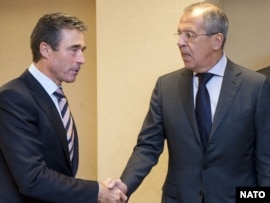
Photo: NATO Secretary-General Anders Fogh Rasmussen (left) talks with Russian Foreign Minister Sergei Lavrov about renewed cooperation between Russia and NATO. Photo from Radio Free Europe.


A senior U.S. diplomat today reaffirmed the Obama administration's desire to collaborate with Russia in developing antimissile systems in Europe, Agence France-Presse reported (see GSN, Oct. 25).

"It's absolutely clear we want to do this cooperatively with Russia," Assistant Secretary of State Philip Gordon said in Berlin. "Russia faces the same potential threat as Europe," he added.

Read more ....

More News On U.S./NATO - Russian Relations

NATO's Rasmussen to Moscow for Afghan, missile talks
-- Reuters
NATO Chief Sees 'New Start' With Russia -- Radio Free Europe
Report: Russia seeks to limit new NATO members -- AP
Russia wants cap on NATO troops: report -- AFP
Russia seeks restrictions on NATO military contingents - paper -- RIA Novosti
Russia-NATO relations depend on alliance's strategic concept - Lavrov -- RIA Novosti
Russia's approach to NATO depends on its strategy: Lavrov -- Xinhuanet
Moscow Wants to 'Participate as an Equal Partner': SPIEGEL Interview With Russia's Defense Minister -- Spiegel Online
Will the U.S. Lose Europe to Russia? -- John Vinocur, New York Times
Enhanced by Zemanta

Monday, October 25, 2010

Russia wants equal role in NATO missile shield: minister

Russia wants equal role in NATO missile shield: minister
Berlin (AFP) Oct 23, 2010 - Russia is open to talks on NATO's planned European missile shield but wants to play an equal role in its development, Russian Defence Minister Anatoly Anatoly Serdyukov told the German weekly Der Spiegel. "The most important thing for us is firstly to define what are the real threats to Europe, and secondly is to see Russia put on an equal footing as a participant," Serdyukov said in an inte ... morehttp://www.spacewar.com/reports/Russia_wants_equal_role_in_NATO_missile_shield_minister_999.html
Enhanced by Zemanta

Thursday, October 21, 2010

Russia Seeks Further Dialogue on NATO Antimissile Plan


Russia yesterday indicated it would maintain dialogue with NATO and the United States regarding an invitation to collaborate with the military alliance on missile defense operations, the Xinhua News Agency reported (see GSN, Oct. 19).
Any options for a joint antimissile effort "will be discussed," Russia Deputy Foreign Minister Alexander Grushko said.
"NATO Secretary General Anders Fogh Rasmussen has put forth an initiative (on the creation of a joint missile defense system) and it is now being studied thoroughly," Grushko said. "We'll continue contacts with American partners and NATO countries on this issue in the short term" (Xinhua News Agency, Oct. 21).
NATO nations are expected to determine at their Nov. 19-21 summit in Lisbon, Portugal, whether to formally include missile defense among alliance objectives, paving the way for a program to integrate and augment the antimissile systems of member countries. The 28-state organization has sought Russian collaboration on the project, which it says is intended to increase protection from ballistic missiles held by countries including Iran and North Korea. More at:http://gsn.nti.org/gsn/nw_20101021_7766.php
Enhanced by Zemanta

Wednesday, October 20, 2010

Obama backs Venezuela's right to nuclear energy

White House won't oppose Venezuela's nuclear plan
President Barack Obama said he will not oppose Venezuela's plan to generate nuclear power for peaceful purposes. "Our attitude is that Venezuela has rights to peacefully develop nuclear power," Obama said. His statement comes after Venezuelan President Hugo Chavez signed a deal with Russia for the first nuclear plant in the South American country. Google/Agence France-Presse
Enhanced by Zemanta