
Michele Kearney's Nuclear Wire

Major Energy and Environmental News and Commentary affecting the Nuclear Industry.

Wednesday, October 27, 2010

U.S. Wants Missile Defense Collaboration With Russia, Diplomat Says -- Global Security Newswire


The Growing NATO - Russian Alliance
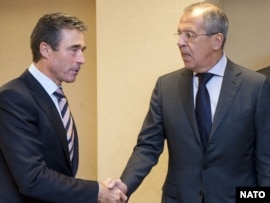
Photo: NATO Secretary-General Anders Fogh Rasmussen (left) talks with Russian Foreign Minister Sergei Lavrov about renewed cooperation between Russia and NATO. Photo from Radio Free Europe.


A senior U.S. diplomat today reaffirmed the Obama administration's desire to collaborate with Russia in developing antimissile systems in Europe, Agence France-Presse reported (see GSN, Oct. 25).

"It's absolutely clear we want to do this cooperatively with Russia," Assistant Secretary of State Philip Gordon said in Berlin. "Russia faces the same potential threat as Europe," he added.

Read more ....

More News On U.S./NATO - Russian Relations

NATO's Rasmussen to Moscow for Afghan, missile talks
-- Reuters
NATO Chief Sees 'New Start' With Russia -- Radio Free Europe
Report: Russia seeks to limit new NATO members -- AP
Russia wants cap on NATO troops: report -- AFP
Russia seeks restrictions on NATO military contingents - paper -- RIA Novosti
Russia-NATO relations depend on alliance's strategic concept - Lavrov -- RIA Novosti
Russia's approach to NATO depends on its strategy: Lavrov -- Xinhuanet
Moscow Wants to 'Participate as an Equal Partner': SPIEGEL Interview With Russia's Defense Minister -- Spiegel Online
Will the U.S. Lose Europe to Russia? -- John Vinocur, New York Times
Enhanced by Zemanta

Tracing the Manhattan Project

Environmentalist touts nuclear power At Clinton School, Greenpeace founder emphasizes renewable energy

Bradley and Tierney discuss impact of EPA regs on electric reliability

With several pollutant regulations coming online in the near term, U.S. EPA is facing criticism for making it too difficult for industry to do business. Can the utility sector keep up with the new regulations and maintain system reliability? During today's OnPoint, Michael Bradley, executive director of the Clean Energy Group, and Sue Tierney, a managing principal with the Analysis Group and a former assistant secretary for policy at the U.S. Department of Energy, discuss a new report that investigates the impact of pending EPA regulations on electric system reliability. They explain why they believe businesses will be able to keep up with the new rules and how the government can help the private sector meet these new standards.  More at:
http://www.eenews.net/tv/transcript/1225
Enhanced by Zemanta

Ultra-fast Charge Nears Reality for Electric Cars By Ned Smith, BusinessNewsDaily Senior Writer

This fall, the first mass-market electric vehicles (EV) for personal transportation will hit America’s highways and byways. This fleet of pure electric (think Nissan Leaf) and not-so-pure (think electric-powered Chevrolet Volt with its range-extender gas engine) vehicles is just the beginning of a hard-charging onslaught on the way we get around for work and play. But before this zero-emissions future comes to pass, a lot has to happen. One major issue that remains to be solved is charging.  More at:
http://www.technewsdaily.com/electric-car-charging-stations-1518/
Enhanced by Zemanta

New EPA rules will erode power grid reliability, report finds


Energy reserves available to the power grid for peak use could be cut in half, says an industry report, as power plants are retired for noncompliance with stiffer clean-air and clean-water rules.

Four federal environmental regulations to improve water and air quality could by 2018 chop by nearly half the amount of projected reserve energy available to the US power grid, says a new report.

Nationwide, hundreds of coal-, oil-, and gas-fired power plants, with a collective capacity of about 76,000 megawatts (one megawatt provides enough power for about 750 homes), could be retired if the forthcoming rules are implemented under the fastest proposed timeline, says the report by the North American Electric Reliability Corp. (NERC), an industry group charged with ensuring grid reliability. A "moderate" pace of implementation would lead to a 46,000-megawatt cut in reserve generating capacity, it says.


Enhanced by Zemanta

US, SKorea discuss new civil nuclear cooperation deal

WASHINGTON — US and South Korean experts began talks aimed at concluding a new agreement on sharing civil nuclear energy technology, once the current accord expires in 2014, the State Department said Tuesday.
During their meeting in Washington on Monday the two sides outlined their negotiating positions and discussed when and where to hold further consultations for a new agreement, it said in a statement.
The talks were headed by Cho Hyun, the South Korean deputy foreign minister for multilateral and global affairs and Robert Einhorn, the US special advisor for non-proliferation and arms control, it added.
"Both sides expect the new agreement to ensure the continuance and further development of the robust bilateral cooperation they have enjoyed in atomic energy for more than fifty years," the statement said.
They also expect it to "further contribute to the strengthening of their alliance by enhancing cooperation in nuclear research and development, industry and commerce in the future," it added. More at: http://www.google.com/hostednews/afp/article/ALeqM5gPq-oR8eLiI4q7TMaBDxB4D3hafg?docId=CNG.faeec24ca121247e519f47662eae09bf.a31
Enhanced by Zemanta

UN nuclear chief wants "concrete steps" from Iran

Flag of the International Atomic Energy Agency...Image via Wikipedia 
MOSCOW, Oct 26 (Reuters) - The head of the U.N. nuclear watchdog urged Iran on Tuesday to take "concrete steps" to allay international concerns about its disputed nuclear programme.
"I am requesting Iran take concrete steps, concrete measures toward the full implementation of their obligations," International Atomic Energy Agency (IAEA) chief Amano told reporters after addressing university students in Moscow.
Six global powers have proposed revived talks with Iran on restraining its nuclear programme and opening it up fully to IAEA scrutiny in exchange for trade and diplomatic benefits. Iran has not formally responded to the offer.
Tehran says it is enriching uranium strictly for electricity generation. But Western nations fear this is a front for the pursuit of nuclear weapons, noting Iran's track record of concealing sensitive enrichment-related activity from the IAEA.
The Islamic Republic has persistently rejected international calls to scale down or stop its enrichment of uranium, a key ingredient in nuclear arms, and has not formally responded to an offer of talks in Vienna on Nov. 15-17.   Continued...
http://af.reuters.com/article/energyOilNews/idAFLDE69P1PH20101026
Enhanced by Zemanta

State panel to debate nuclear power

State lawmakers are set Tuesday to discuss whether nuclear power should play a larger part in California's future, but the issue is already creating political fission at the Capitol.
The state Senate Energy, Utilities and Communications Committee will hold a hearing Tuesday morning to hear from experts. Others scheduled to testify include representatives of Southern California Edison, co-owner of the San Onofre Nuclear Generating Station, and PG&E, operator of the Diablo Canyon Power Plant.
Sen. Alex Padilla (D-Pacoima), chairman of the committee, noted that California already gets 15% of its electricity from nuclear power, although tough restrictions mean no nuclear power plant has been constructed in more than three decades in California.
"Nuclear energy has seemed to have had a resurgence in terms of conversation," Padilla said. "I'm not shy about having that conversation."
Padilla said he is neutral on the issue of whether new nuclear plants should be allowed in California, adding that "a hearing is a first step in responsibly considering that."
However, David Weisman of the Alliance for Nuclear Responsibility complained that the hearing lineup appeared stacked in favor of those who support expanded nuclear power in California and that opposition groups like his own are not on the agenda.
"Essentially what they are doing here is re-creating a private nuclear-industry promotional forum that was held in La Jolla last year," Weisman said of the senate hearing. "It's entirely one-sided." More at:

http://latimesblogs.latimes.com/california-politics/2010/10/state-panel-to-debate-nuclear-power.html
Enhanced by Zemanta

Clinton: US has no problem with Bushehr atomic plant

The United States does not see Iran's Bushehr nuclear reactor as a threat, US Secretary of State Hillary Clinton said Tuesday, on the day that the Islamic Republic began fueling the core of the power plant.

Clinton said that the US is more concerned with other Iranian sites where they believe the Islamic Republic may be attempting to create nuclear weapons.


"Our problem is not with their reactor at Bushehr, our problem is with their facilities at places like Natanz and their secret facility at Qom and other places where we believe they are conducting their weapons program," Clinton stated while addressing reporters at a meeting with Austria's foreign minister.

RELATED:
Ashton, Russia call on Iran to agree to nuclear talks
Arab World: Ahmadinejad’s recipe for success
'Iranian power has swung from mullahs to Ahmadinejad'


http://www.jpost.com/IranianThreat/News/Article.aspx?id=192871
Enhanced by Zemanta

/Duke says future will be nuclear

New nuclear plants remain Duke Energy's best large-scale power option for the Carolinas despite obstacles, a utility executive told an industry audience Tuesday.
Duke must replace its aging fleet of nuclear and coal-fired plants by 2050, said Christopher Fallon, the company's vice president for nuclear development, at the Nuclear Construction Summit in Charlotte. Each technology produces about half of Duke's energy.
The utility plans to build a two-unit nuclear plant, its first since the mid-1980s, near Gaffney, S.C. The plant would start operating about 2021. Duke is also mulling construction of a nuclear facility in Ohio.

Read more: http://www.charlotteobserver.com/2010/10/27/1789184/duke-says-future-will-be-nuclear.html#ixzz13ZdGxwpc

http://www.charlotteobserver.com/2010/10/27/1789184/duke-says-future-will-be-nuclear.html
Enhanced by Zemanta

PSC continues Progress Energy nuke plant fee

The commission's decision "confirms the state's commitment to state-of-the-art nuclear power as a strategic asset," Jacobs said.
The Florida legislature passed a law in 2006 that lets utilities begin charging customers for nuclear plant costs during construction. Costs for conventional plants cannot be recovered until they are completed. More at:

http://www.cnbc.com/id/39854935
Enhanced by Zemanta

GE Hitachi says reactor clears hurdle By Jim Brumm Citydesk@StarNewsOnline.com

GE Hitachi Nuclear Energy’s advanced reactor design has passed a safety review, clearing the way for final U.S. Nuclear Regulatory Commission certification by the fall of 2011.
With completion of this review, the Castle Hayne company said, the Economic Simplified Boiling Water Reactor design now begins the federal rulemaking process and is on target to become a certified “Generation III+” reactor model in about one year.
In an Oct. 20 letter made public Tuesday, the NRC’s Advisory Committee on Reactor Safeguards issued its safety recommendation for the design, GE Hitachi said in a statement that noted the design was submitted to the NRC in August 2005. More at:
http://www.starnewsonline.com/article/20101026/ARTICLES/101029683?Title=GE-Hitachi-says-reactor-clears-hurdle
Enhanced by Zemanta

Click here to find out more! EDF and Constellation announce agreement on planned nuclear reactor in Maryland

EDF's old logo (1987–2005)Image via WikipediaUnder the deal announced late Tuesday, EDF will acquire Baltimore-based Constellation's 50 percent ownership in the joint venture known as UniStar for $140 million.

In addition to sites for Calvert Cliffs 3 and a potential fourth reactor in Maryland, Constellation will transfer to UniStar potential new nuclear sites at Nine Mile Point and R.E. Ginna in New York. More at:
http://www.latimes.com/business/nationworld/wire/sns-ap-us-edf-constellation,0,789311.story
Enhanced by Zemanta

EDF acquires Calvert Cliffs III

Dan Yurman has an interesting assessment on this deal:
http://djysrv.blogspot.com/2010/10/edf-acquires-calvert-cliffs-iii.html

Constellation clinches deal with EDF, exits nuclear venture By Steven Mufson

 Constellation Energy settled its dispute with French utility giant Electricite de France on Tuesday, selling its half of a joint venture to develop new nuclear power plants and dropping its threat to exercise an option to force EDF to buy a dozen aging fossil fuel plants. More at:
http://www.washingtonpost.com/wp-dyn/content/article/2010/10/27/AR2010102700067.html

Time to look beyond Chinese rare earths, says EU trade boss

Time to look beyond Chinese rare earths, says EU trade boss

India agrees to long-term supply of rare earths for JapanTokyo (AFP) Oct 26, 2010 - Tokyo said Tuesday that India has agreed to provide a stable supply of rare earth minerals to Japan as the high-tech economy looks to diversify sources after a spat with key provider China. India's Prime Minister Manmohan Singh, who wound up his three-day visit to Japan on Tuesday, made the pledge during talks with the Japanese side on Monday, industry minister Akihiro Ohata said at a news conference. "Prime Minister Singh told us that he will cooperate in long-term supply of rare earth minerals," Ohata said, according to a trade ministry official. On Monday, Singh met Prime Minister Naoto Kan, Ohata and other Japanese officials and agreed to broadly cooperate in rare earth deals.

In a statement, the premiers "decided to explore the possibility of bilateral cooperation in development, recycling and re-use of rare earths and rare metals and in research and development of their industrial substitutes." On Sunday, Ohata met China's commerce minister in Tokyo and urged Beijing to normalise rare earth exports after Japan said shipments were blocked during a diplomatic row sparked by the arrest of a Chinese trawlerman in disputed waters. Japan's stockpile of rare earth minerals, used in the manufacture of high-tech goods, could be exhausted by March or April without fresh imports from China, officials have said. China, which controls more than 95 percent of the global market, has repeatedly denied it curbed exports in retaliation over the dispute, but all 31 Japanese companies handling the minerals have reported disruption to shipments. Japanese Foreign Minister Seiji Maehara said Tuesday that he wants to raise the issue if he meets his Chinese counterpart on the sidelines of a 16-nation Asian summit in Vietnam later this week.
by Staff Writers Brussels (AFP) Oct 26, 2010 European Union trade commissioner Karel De Gucht on Tuesday urged global partners to diversify mining sources for prized rare earths as a battle with China deepened over scarce supplies. De Gucht spoke out as a row that began between China and Japan over access to 17 essential minerals used in high-tech products ranging from flat-screen televisions to hybrid cars threatened to turn into a worldwide protectionist rallying cry.
"This is going to become a very, very difficult problem if we don't find a way out," De Gucht told an EU-China conference in Brussels.
He insisted that a string of mine closures elsewhere was "very closely linked to the price policy of rare earths by China" and stressed: "I think we should come to a global understanding."
The United States and Australia have 15 and five percent respectively of global reserves, but stopped mining them mainly because of cheaper Chinese competition.
"It cannot be a (Chinese) tool in industrial policy, because that would have very large ramifications," De Gucht warned, fresh from an EU-China summit that broke down amid fears of a "war" on currency exchanges.
"It's obvious that we cannot continue being completely dependent on China," he underlined.
The EU and Washington are already pursuing China in the World Trade Organization over policies on other raw materials, and a European source did not rule out similar action eventually on rare earths, depending on how that case progresses.
The United States has also said it will raise the rare earths issue at the summit of Group of 20 major and emerging nations in South Korea next month.
China recently imposed restrictions on exports of rare earths in what experts say is a bid to maximise profit and strengthen its homegrown high-tech companies.
Last year, it produced 97 percent of the global supply of rare earths, although it is home to just a third of reserves.
China's commerce ministry has said it reserves the right to slash rare earths exports again to "protect exhaustible resources and sustainable development".
Tokyo said on Tuesday that India had agreed to provide a stable supply of rare earth minerals to Japan as the high-tech economy looks to diversify its sources.
De Gucht worries that the rare earths row is just one of many "hints that China is developing an industrial policy aiming at transferring as much as possible production to China".
Enhanced by Zemanta

US, SKorea discuss new civil nuclear cooperation deal

US and South Korean experts began talks aimed at concluding a new agreement on sharing civil nuclear energy technology, once the current accord expires in 2014, the State Department said Tuesday. During their meeting in Washington on Monday the two sides outlined their negotiating positions and discussed when and where to hold further consultations for a new agreement, it said in a statement.
The talks were headed by Cho Hyun, the South Korean deputy foreign minister for multilateral and global affairs and Robert Einhorn, the US special advisor for non-proliferation and arms control, it added.
"Both sides expect the new agreement to ensure the continuance and further development of the robust bilateral cooperation they have enjoyed in atomic energy for more than fifty years," the statement said.
They also expect it to "further contribute to the strengthening of their alliance by enhancing cooperation in nuclear research and development, industry and commerce in the future," it added.
"The two sides also discussed a proposed joint study of nuclear power reactor spent fuel disposition options, including pyroprocessing," the statement said.
"They agreed that technical experts would meet soon to work out the scope of the study and the venue and schedule for completing it."
The current agreement Concerning Civil Uses of Atomic Energy, which was adopted in 1972 and amended in 1974, will expire in early 2014.http://www.nuclearpowerdaily.com/reports/US_SKorea_discuss_new_civil_nuclear_cooperation_deal_999.html

Enhanced by Zemanta

Japan , Vietnam PMs to discuss nuclear energy, minerals


http://www.nuclearpowerdaily.com/reports/Japan_Vietnam_PMs_to_discuss_nuclear_energy_minerals_999.html The leaders of Japan and Vietnam are expected to discuss a nuclear energy pact and the joint development of rare earth minerals when they meet in Hanoi this weekend, a Japanese official said Tuesday. Japan's Prime Minister Naoto Kan will visit the Vietnamese capital for meetings of the 10-nation Association of Southeast Asian Nations starting Thursday and a wider 16-nation East Asia Summit (EAS) on Saturday.
In Hanoi, Kan also plans to hold talks on Sunday with his Vietnamese counterpart, Nguyen Tan Dung, and "discuss an early signing of the pact between the two governments," a Japanese official said on condition of anonymity.
Japan and Vietnam have already reached a basic agreement on a nuclear energy pact.
Asked if the joint development of rare earth minerals will be one of the subjects, the Japanese official said it will be "highly likely," without elaborating.
The Japan-Vietnam summit follows a halt in shipments of rare earth minerals from China to Japan last month, according to Japanese industry sources, amid a simmering diplomatic row over disputed islets in the East China Sea.
Without fresh imports from China Japan's stockpile of rare earth minerals, which are used in the manufacture of high-tech goods, could dry up by March or April, a senior Japanese government official has warned.
"I have actively raised the subject in meetings with leaders of resource-rich countries, such as the possibility of jointly developing the resources," Kan earlier told reporters about rare earth minerals.
China controls more than 95 percent of the global market for the minerals.
Enhanced by Zemanta

US approves world's biggest solar energy project

The United States approved on Monday a permit for the largest solar energy project in the world -- four massive plants at the cost of one billion dollars each in southern California. "The Blythe solar power plant will consist of four, 250-Megawatt plants, built on public lands in the sun-drenched Mojave desert," Interior Secretary Ken Salazar said.
"When completed the project is expected to generate up to 1,000 Megawatts of energy... That's enough electricity to power up to 750,000 average American homes and to make Blythe the largest solar power plant facility in the world."
The total capacity will be roughly equal to the turbine output of a nuclear power plant or a large modern coal-fired power plant, according to Solar Millennium, the company developing the facility.
Solar Millennium plans to begin construction on Blythe this year, the company says on its website. At the height of construction, the project is expected to create more than 1,000 jobs.
The Blythe facility is one of a raft of renewable energy projects that have been approved in recent weeks by the Interior Department.
Earlier this month, Salazar approved the first five renewable energy projects on public lands, four in California and one in Nevada, both states that have been hard hit by the economic downturn.
Two weeks ago, Salazar inaugurated the world's largest wind tower manufacturing plant in the working class town of Pueblo, Colorado, which will be run by Danish company Vestas Wind Systems.
One week earlier he signed a lease for the first major offshore wind farm, off the coast of New Jersey.http://www.solardaily.com/reports/US_approves_worlds_biggest_solar_energy_project_999.html

Enhanced by Zemanta

Tuesday, October 26, 2010

Laser Uranium Enrichment Makes a Comeback

The controversial technology poses proliferation risks, but nuclear firms press on

Two technology giants, GE and Hitachi, are betting big on a nuclear renaissance. The companies formed an alliance in 2007 to push for a global expansion of nuclear power. But selling new reactors is only half the game. The joint venture is also aggressively pursuing a controversial technique for making nuclear fuel using lasers, a method they hope to commercialize by building the world's first industrial-scale pilot plant in 2012. Regulatory agencies are worried that laser enrichment of uranium could lead to the proliferation of nuclear weapons.

GE has called the laser method a "game-changing technology" and along with Hitachi and Cameco Corp., a Canadian nuclear fuel provider in Saskatoon, Sask., is devoting hundreds of millions of dollars to developing it and building the plant near Wilmington, N.C. The technology in question was licensed from Silex Systems, an Australian company that's been quietly conducting enrichment research at a small facility near Sydney for the last quarter century.

But many experts are skeptical. Allan Krass, a retired U.S. State Department official and a physicist who visited Silex's laboratory in 2000, says GE and Hitachi "are betting that there will be an upsurge of nuclear power plant construction—that's a huge and extremely risky bet." He adds that laser enrichment has been held back by substantial technical hurdles.

If approved, the pilot plant will be the first large-scale attempt to use photons to separate the desirable uranium-235 isotopes from the more abundant but nonfissile U-238 isotopes found in natural uranium. Experts generally believe that a laser facility would be both smaller in size and have much lower energy demands than existing enrichment plants. Those features are excellent from the perspective of improving the economics of nuclear power plants, but they also present a major headache for the International Atomic Energy Agency (IAEA) and other nuclear watchdog groups attempting to spot clandestine enrichment plants, largely from satellite imagery. More at:
http://gascentrifugeuranium.blogspot.com/2010/10/laser-uranium-enrichment-makes-comeback.html
Enhanced by Zemanta

Can Solar Shield Protect The North American Power Grid

Can Solar Shield Protect The North American Power Grid

The sun rises behind high-voltage power lines in North America.
by Dr. Tony Phillips
for NASA Science Newshttp://www.spacedaily.com/reports/Can_Solar_Shield_Protect_The_North_American_Power_Grid_999.html
Huntsville AL (SPX) Oct 27, 2010 Every hundred years or so, a solar storm comes along so potent it fills the skies of Earth with blood-red auroras, makes compass needles point in the wrong direction, and sends electric currents coursing through the planet's topsoil. The most famous such storm, the Carrington Event of 1859, actually shocked telegraph operators and set some of their offices on fire. A 2008 report by the National Academy of Sciences warns that if such a storm occurred today, we could experience widespread power blackouts with permanent damage to many key transformers.
What's a utility operator to do?
A new NASA project called "Solar Shield" could help keep the lights on.
"Solar Shield is a new and experimental forecasting system for the North American power grid," explains project leader Antti Pulkkinen, a Catholic University of America research associate working at NASA's Goddard Space Flight Center. "We believe we can zero in on specific transformers and predict which of them are going to be hit hardest by a space weather event."
The troublemaker for power grids is the "GIC" - short for geomagnetically induced current. When a coronal mass ejection (a billion-ton solar storm cloud) hits Earth's magnetic field, the impact causes the field to shake and quiver.
These magnetic vibrations induce currents almost everywhere, from Earth's upper atmosphere to the ground beneath our feet. Powerful GICs can overload circuits, trip breakers, and in extreme cases melt the windings of heavy-duty transformers.
This actually happened in Quebec on March 13, 1989, when a geomagnetic storm much less severe than the Carrington Event knocked out power across the entire province for more than nine hours. The storm damaged transformers in Quebec, New Jersey, and Great Britain, and caused more than 200 power anomalies across the USA from the eastern seaboard to the Pacific Northwest.
A similar series of "Halloween storms" in October 2003 triggered a regional blackout in southern Sweden and may have damaged transformers in South Africa.
While many utilities have taken steps to fortify their grids, the overall situation has only gotten worse. A 2009 report by the North American Electric Reliability Corporation (NERC) and the US Department of Energy concluded that modern power systems have a "significantly enhance[d] vulnerability and exposure to effects of a severe geomagnetic storm."
Since the beginning of the Space Age the total length of high-voltage power lines crisscrossing North America has increased nearly 10 fold. This has turned power grids into giant antennas for geomagnetically induced currents.
With demand for power growing even faster than the grids themselves, modern networks are sprawling, interconnected, and stressed to the limit-a recipe for trouble, according to the National Academy of Sciences: "The scale and speed of problems that could occur on [these modern grids] have the potential to impact the power system in ways not previously experienced."
A large-scale blackout could last a long time, mainly due to transformer damage. As the National Academy report notes, "these multi-ton apparatus cannot be repaired in the field, and if damaged in this manner they need to be replaced with new units which have lead times of 12 months or more."
That is why a node-by-node forecast of geomagnetic currents is potentially so valuable. During extreme storms, engineers could safeguard the most endangered transformers by disconnecting them from the grid. That itself could cause a blackout, but only temporarily. Transformers protected in this way would be available again for normal operations when the storm is over.
The innovation of Solar Shield is its ability to deliver transformer-level predictions. Pulkkinen explains how it works:
"Solar Shield springs into action when we see a coronal mass ejection (CME) billowing away from the sun. Images from SOHO and NASA's twin STEREO spacecraft show us the cloud from as many as three points of view, allowing us to make a 3D model of the CME, and predict when it will arrive."
While the CME is crossing the sun-Earth divide, a trip that typically takes 24 to 48 hours, the Solar Shield team prepares to calculate ground currents. "We work at Goddard's Community Coordinated Modeling Center (CCMC)," says Pulkkinen. The CCMC is a place where leading researchers from around the world have gathered their best physics-based computer programs for modeling space weather events.
The crucial moment comes about 30 minutes before impact when the cloud sweeps past ACE, a spacecraft stationed 1.5 million km upstream from Earth. Sensors onboard ACE make in situ measurements of the CME's speed, density, and magnetic field. These data are transmitted to Earth and the waiting Solar Shield team.
"We quickly feed the data into CCMC computers," says Pulkkinen. "Our models predict fields and currents in Earth's upper atmosphere and propagate these currents down to the ground." With less than 30 minutes to go, Solar Shield can issue an alert to utilities with detailed information about GICs.
Pulkkinen stresses that Solar Shield is experimental and has never been field-tested during a severe geomagnetic storm. A small number of utility companies have installed current monitors at key locations in the power grid to help the team check their predictions. So far, though, the sun has been mostly quiet with only a few relatively mild storms during the past year. The team needs more data.
"We'd like more power companies to join our research effort," he adds. "The more data we can collect from the field, the faster we can test and improve Solar Shield." Power companies work with the team through EPRI, the Electric Power Research Institute. Of course a few good storms would help test the system, too. They're coming. The next solar maximum is expected around 2013, so it's only a matter of time.
Enhanced by Zemanta

Protecting the North American power grid from widespread blackouts

Protecting the North American power grid from widespread blackouts
Every hundred years or so, a solar storm comes along so potent it fills the skies of Earth with blood-red auroras, makes compass needles point in the wrong direction, and sends electric currents coursing through the planet's topsoil. The most famous such storm, the Carrington Event of 1859, actually shocked telegraph operators and set some of their offices on fire. A 2008 report by the National Academy of Sciences warns that if such a storm occurred today, we could experience widespread power blackouts with permanent damage to many key transformers. http://www.physorg.com/news/2010-10-north-american-power-grid-widespread.html
Enhanced by Zemanta

Communication With 50 Nuke Missiles Dropped in ICBM Snafu

he Air Force swears there was no panic. But for three-quarters of an hour Saturday morning, launch control officers at F.E. Warren Air Force Base in Wyoming couldn’t reliably communicate or monitor the status of 50 Minuteman III nuclear missiles. Gulp.
Backup security and communications systems, located elsewhere on the base, allowed the intercontinental ballistic missiles to be continually monitored. But the outage is considered serious enough that the very highest rungs on the chain of command — including the President — are being briefed on the incident today.
A single hardware failure appears to have been the root cause of the disruption, which snarled communications on the network that links the five launch control centers and 50 silos of the 319th Missile Squadron. Multiple error codes were reported, including “launch facility down.”


Read More http://www.wired.com/dangerroom/2010/10/communications-dropped-to-50-nuke-missiles-in-icbm-snafu/#ixzz13ValpG8l

http://www.wired.com/dangerroom/2010/10/communications-dropped-to-50-nuke-missiles-in-icbm-snafu/

Argentina celebrates enrichment plant reactivation

Argentina celebrates enrichment plant reactivation 
26 October 2010
http://www.world-nuclear-news.org/ENF-Argentina_celebrates_enrichment_plant_reactivation-2610107.html
Enhanced by Zemanta

Japanese nuclear exports consortium launches from World Nuclear News by Jeremy Gordon

A Japanese consortium has been officially launched in order to help Japan gain orders for nuclear power plants from so-called emerging nuclear countries. The consortium comprises nine electric utilities and three nuclear engineering companies.
Headquartered in Tokyo, JINED is three-quarters owned by nine electric power companies (so-called "epcos"): Tokyo Electric Power Co (Tepco) (20%); Kansai (15%); Chubu (10%); Hokkaido (5%); Tohoku (5%); Hokuriku (5%); Chugoku (5%); Shikoku (5%); and Kyushu (5%).

Three nuclear engineering companies each hold a 5% stake in the consortium: Toshiba, Hitachi and Mitsubishi Heavy Industries (MHI). The remaining 10% of JINED is held by Innovation Network of Japan (INCJ) - a joint venture of government and industry.
Enhanced by Zemanta

Saudis Interested in Russian Nuclear Power

Saudi Arabia will discuss a nuclear power deal with Russia, the official Saudi Press Agency said after a Cabinet meeting Monday.
The Cabinet authorized the head of the King Abdullah City for Atomic and Renewable Energy to sign a draft accord, it said. The countries plan to cooperate in the “peaceful uses of nuclear energy,” it said.
Saudi Arabia is one of several Gulf Arab countries seeking to develop nuclear energy to meet electricity demand that’s rising at about 8 percent a year. The United Arab Emirates awarded a $20 billion contract in December to a group of companies led by Korea Electric Power to build four nuclear plants, and Kuwait plans to build four reactors by 2022.
Saudi Arabia held talks with international companies to build its first nuclear and renewable energy city, said Khalid al-Sulaiman, vice president for renewable energy at the city, speaking in Jeddah on Oct. 4. The city has engaged 14 architectural and design houses.
Enhanced by Zemanta

Russia, IAEA to step up cooperation

Russia is ready to boost cooperation with the International Atomic Energy Agency in ensuring security at nuclear facilities, Prime Minister Vladimir Putin said on Monday.
The number of countries operating nuclear plants will grow to about 30 by 2030, which raises concerns over nuclear energy security, Putin said during a meeting with IAEA head Yukiya Amano in Moscow.
Russia, which has constantly cooperated with the IAEA, especially in developing innovative nuclear reactors, is ready to continue joint work with the agency, Putin said.
"IAEA experts give the highest evaluations to security at our nuclear facilities," he added.
The prime minister praised the appointment of Alexander Bychkov, Russia's representative at the IAEA, as the organization's deputy director general heading the Department of Atomic Energy. Another Russian national, Yury Sokolov, was the department's head before Bychkov took office in September.
During his stay in Russia, Amano met with Sergei Kiriyenko, the head of Russia's state-run nuclear corporation Rosatom and is expected to meet with Foreign Minister Sergei Lavrov on Tuesday.
MOSCOW, October 25 (RIA Novosti)

Related News


http://en.rian.ru/russia/20101025/161082518.html
Enhanced by Zemanta

Congressman Simpson Upset Over Yucca Mountain License Application

PSEG Nuclear One Step Closer to Renewing Licenses for South Jersey Nuclear Plants Nuclear Regulatory Commission issues draft Environmental Impact Statements, public hearings scheduled for next month


 The Nuclear Regulatory Commission (NRC) yesterday said it has issued draft Environmental Impact Statements for the license renewal of the Hope Creek and Salem I and II nuclear units. It also said the option of a 20-license renewal should be left open to energy-planning decision-makers. New Jersey relies on nuclear to a much larger extent than other states, so the renewal decision could greatly affect the reliability of the grid.

In reviewing the renewal applications, the NRC staff found most of the environmental impacts are either small or moderate, according to Neil Sheehan, a spokesman for the federal agency.
“At this point, they have not found any show-stoppers,” Sheehan said. The agency plans to hold public hearings on November 17 at the Salem County Emergency Services Building in Woodstown at 1:30 p.m. and 7 p.m.

http://www.njspotlight.com/stories/10/1025/2123/

Enhanced by Zemanta

Carbon Price Alone Cannot Unlock US Nuclear Ambitions by Gloria Gonzalez

A federal carbon price would provide a major boost to the US nuclear power industry, but would not solve all its problems, experts said.
“That would turn the industry around,” Richard Caperton, policy analyst for the Center for American Progress, told attendees of the Society of Environmental Journalists conference in Missoula, Montana last week. “There are still some other issues: cheap natural gas, short-term low electricity demand. But a carbon price really reshapes the electricity industry and I think reshapes it to the benefit of the nuclear industry.”
But there is a lot of cheerleading for an industry that would only generate 4-5GW by the end of 2020, he said. In comparison, the wind sector brought 10GW of power online last year.
“Nuclear power has a lot of benefits, and there are certainly some drawbacks to renewable power, but the renewable industry has taken off,” Caperton said.
The nuclear industry would also thrive if there was a level playing field, argued Paul Genoa, director of policy development for the Nuclear Energy Institute. The renewable sector is supported by state renewable portfolio standards and subsidy fees for loan guarantees paid by the government, he said.
However, nuclear power also has comparable production tax credits and comparable, if not more advantageous, research and development funding, Caperton countered. “It’s not like the nuclear industry is hurting for government support,” he said.
The US has four nuclear plants in the pre-construction phase in Georgia and South Carolina, with 21 applications under review by the Nuclear Regulatory Commission, Genoa said.
Right now, the biggest problem for the industry is that the economy is “in the tank” and electricity demand is lower because of the recession, Genoa added. “We don’t have a single problem with siting plants,” he said. More at:
http://oilprice.com/Alternative-Energy/Nuclear-Power/Carbon-Price-Alone-Cannot-Unlock-US-Nuclear-Ambitions.html