Michele Kearney's Nuclear Wire

Major Energy and Environmental News and Commentary affecting the Nuclear Industry.

Wednesday, September 29, 2010

France's EDF designs reactor to challenge Areva: report

France's EDF designs reactor to challenge Areva: report

http://www.nuclearpowerdaily.com/reports/Frances_EDF_designs_reactor_to_challenge_Areva_report_999.html Paris (AFP) Sept 28, 2010 French electricity generator EDF is working on two new nuclear reactor designs of its own which could rival those made by Areva, the world's biggest atomic energy company, the Expansion magazine said. In a report to appear Wednesday, Expansion said EDF is "looking at its own series of reactors," power rated at 1,000 and 1,500 Megawatts, which if finalised could be competition for Areva's third generation European Pressurised Reactor (EPR) and its Atmea design.
Developed with Germany, the EPR has a power rating of 1,650 Megawatts but the design has been dogged by problems. In July EDF announced there would be a two-year delay and cost increases for a plant being built by Areva at Flamanville, northern France.
An EPR under construction in Finland by Areva has also been hit by delays and cost over-runs.
"We are not dropping the EPR but we do not want to put all our eggs in one basket," Expansion quoted a source close to EDF head Henri Proglio as saying.
At the same time, "it is true seen from the outside that it could be interpreted differently -- we and Areva are unable to combine our engineering resources," the source added.
EDF declined to comment when asked about the report.
Relations between EDF and Areva have grown strained and on Monday, La Tribune daily reported that the government wanted EDF to increase its stake in Areva from 2.4 percent to 10-15 percent.
The French government wants to consolidate the French nuclear power industry, a key factor in the national economy, and the newspaper said that these efforts were being given new impetus.
The French state owns 85 percent of EDF which provides most of the electricity used in France generated from one of the world's largest nuclear power networks.
Enhanced by Zemanta

GE-Hitachi looks to generate sales

http://www.world-nuclear-news.org/C_GE-Hitachi_looks_to_generate_sales_2909101.htmlGE-Hitachi is planning a push into new markets with its reactor designs next year. Regional sales offices are planned and the ESBWR will be put to UK regulators.

ESBWR (GE Hitachi)
ABWR
The product line-up. ESWR and ABWR
The reactor vendor, formed from the merger of GE and Hitachi's nuclear businesses in 2007, is yet to secure a contract to build in European or North American markets. However, its ABWR design enjoys design certification by the US Nuclear Regulatory Commission and four of these units are already in operation in Japan. GE-Hitachi Nuclear Energy (GEH) has two additional ABWRs under construction in Japan and another two on Taiwan.

Its leading design, the larger ESBWR, is expected to be issued with US design certification in September 2011. GEH is working with DTE Energy towards potentially building an ESBWR at the Fermi site in Michigan and a combined construction and operating licence for the project is on schedule for 2012 completion.

In preparation for this ESBWR project and others that may arise, such as those slated for India, GE-Hitachi yesterday signed memorandums of understanding with three pump suppliers: Curtiss-Wright, Clyde Union and Energy Steel & Supply Co. The vendor is to "begin discussions" with them "about supplying components for new nuclear power plant projects in the USA and around the world."

One market GE-Hitachi is keen to enter is the UK. Senior vice president of nuclear plant projects Danny Roderick told World Nuclear News that the firm wants to put the ESBWR design before UK regulators as soon as it has US certification. The British Health and Safety Executive is currently fully occupied evaluating the Areva EPR and Westinghouse AP1000 for suitability in the country. There is a deadline of June 2011 to complete that process, although some regulatory work is likely to remain.

Roderick emphasised GE-Hitachi's historically long term approach to nuclear markets, adding that their potential customer in the UK is looking at a 2022-5 timeframe for completion. In addition a specific site has been selected, which should enable licensing in a "reasonable period."

A wider push for reactor sales is to come in the form of GE-Hitachi sales offices in Madrid, Vienna, Mexico City and Tokyo. The cities tally with GE's longstanding Spanish supply chain, the two GE-supplied reactors at Mexico's Laguna Verde nuclear power plant, the headquarters of the International Atomic Energy Agency as a convenient meeting place with contacts in emerging nuclear countries and the headquarters of Hitachi-GE. Another sales office is planned for the Middle East, but no decision has yet been taken on its precise location.

David Durham, senior vice president of global sales and marketing, said about 15 salespeople would work in these offices and "offer access to the full range of GE-Hitachi technical expertise and products." Both the reactor designs are to be marketed.
Enhanced by Zemanta

Space security surveillance gets new boost

Space security surveillance gets new boost
Washington (UPI) Sep 27, 2010 - Space security surveillance received a new boost with advances in satellite technology announced by Boeing, Ball Aerospace and Orbital. New emphasis on space security is part of an overall U.S. government strategy that aims to ensure the space around Earth remains clear of dangerous debris and also free of security threats, whether emanating from terrestrial sources or from outer space. ... more
Enhanced by Zemanta

A Way to Attack Nuclear Plants Industrial computer systems are typically far less secure than they should be, experts say. By Robert Lemos

For the last few months, a sophisticated computer worm has wriggled its way between some of the most critical control systems in the world.
Going nuclear: The Stuxnet computer worm may have designed to infiltrate an Iranian nuclear facility in Natanz, 180 miles south of Tehran.
Credit: Getty Images
The timing of the worm's release, combined with several clues buried in its code, has led some experts to speculate that the worm, dubbed Stuxnet, was originally designed to sabotage an Iranian nuclear facility, possible the enrichment plant in Natanz, roughly 180 miles south of Tehran. This week, officials in Iran confirmed that Stuxnet had been found on systems inside the plant, although they denied that it had caused any harm.
But Stuxnet has since spread to hundreds more industrial systems within Iran and around the world. Experts say this highlights a worrisome weak spot in critical infrastructure that could become a new focus for saboteurs and malicious hackers.
Stuxnet infects computers by using previously unseen flaws in Microsoft's Windows operating system. It has most likely spread via hand-carried USB flash drives. From an infected Windows computer, it targets a specialized type of computer known as a programmable logic controller, or PLC. These computers are widely used in critical infrastructure, including manufacturing, water processing, power generation, and transportation. PLCs connect to, and control, devices used to perform many tasks, from opening a door, to increasing the flow of fuel inside a power plant.
Stuxnet is the first example of attackers targeting the specialized computers that control industrial operations, security experts say. "It goes down into the embedded device, inserts itself, and starts doing command-and-control," says Walter Sikora, vice president of security solutions for Industrial Defender, a security consultancy that focuses on critical infrastructure. "This is an area that was unprecedented in terms of a virus or a worm or any other kind of malware."A Way to Attack Nuclear Plants Industrial computer systems are typically far less secure than they should be, experts say. By Robert Lemos
 More at link
http://www.technologyreview.com/computing/26384/?nlid=3565&a=f
Enhanced by Zemanta

Tuesday, September 28, 2010

U.S. Continues Aid to Israeli Missile Defense Effort


The United States yesterday inked a deal to continue support for development of an Israeli defense system against short-range ballistic missiles, the U.S. Missile Defense Agency announced (see GSN, Aug. 4).
The David's Sling system is also intended to counter cruise missiles and heavy rockets. The latest U.S.-Israeli cooperation deal falls under a 2008 joint ballistic missile defense development agreement.
The new agreement covers additional preparation of the Stunner Interceptor, which is designed to target aerial threats traveling at lower altitudes between ranges of 44 and 155 miles (see GSN, May 21, 2009). The David's Sling system is also intended to address Israel's vulnerability to short-range missile and rocket attacks, a threat highlighted during the 2006 Lebanon War. Other Israeli missile defense efforts include the Arrow 3 system, which is intended to intercept long-range missiles (U.S. Missile Defense Agency release, Sept. 27).
The David's Sling development deal was signed by Missile Defense Agency chief Lt. Gen. Patrick O'Reilly and several senior Israeli officials. It arrives against a backdrop of continued concerns over Iran's missile and nuclear development. Russia announced last week that it would prohibit the sale of advanced air-defense missiles and other armaments to Tehran, Reuters reported (see GSN, Sept. 27; Andrea Shalal-Esa, Reuters, Sept. 27).

http://gsn.nti.org/gsn/nw_20100928_9411.php


Enhanced by Zemanta

Nuclear Counterterrorism Group to Meet in Kazakhstan


The Global Initiative to Combat Nuclear Terrorism was set today to begin a three-day conference in the Kazakh capital of Astana, Interfax reported (see GSN, March 5).
"The event will be attended by more than 150 member countries of the global initiative, including its co-chairs, the United States and Russia, as well as the observers and international organizations," Kazakh Foreign Ministry spokesman Askar Abdrakhmanov said.
Participants "will be discussing ways to improve the national terrorism combating systems, as well as issues relating to the sharing of information on prevention of illegal proliferation of nuclear materials," the spokesman said.
The initiative was established in 2006 and now involves more than 80 nations. It seeks to track down, safeguard and dispose of possible radiological and nuclear weapons materials (Interfax, Sept. 27).
"The global initiative is very intensively developing today, and what is especially important -- it didn’t turn into another 'talk club,'" ITAR-Tass quoted Russian Foreign Ministry adviser Oleg Postnikov as saying. "Both diplomats and those who encounter the solution of practical tasks in the field of opposing nuclear terrorism take part in discussion of problems in the professional language."
This week's meeting of the group would be the first to formally address funding of terrorist entities, Postnikov said.
"No concrete documents or solutions are expected to be adopted during the work of the conference," he said. "Our task [is] to get deeper into this problem, consider it step by step, and since there are representatives of different services engaged in the financial monitoring, we hope that they will be able to orient us in the necessary direction" (ITAR-Tass, Sept. 28).
Meanwhile, Russian President Dmitry Medvedev and Chinese President Hu Jintao today issued a statement pledging their countries' to increase collaboration to block the spread of unconventional weapons and to promote arms control, the Xinhua News Agency reported.
The two leaders, meeting in Beijing, also called for global efforts on nonproliferation and disarmament (Xinhua News Agency, Sept. 28).

http://gsn.nti.org/gsn/nw_20100928_8435.php

Iran Demands Affirmation of Atomic Rights From World Powers

Iran Demands Affirmation of Atomic Rights From World Powers

Iran said today it would seek formal acknowledgment of its atomic rights in future discussions of its nuclear program with the five permanent U.N. Security Council member nations and Germany, Agence France-Presse reported (see GSN, Sept. 27).
Senior Iranian nuclear negotiator Saeed Jalili, shown in April. Tehran today indicated it would seek official acknowledgment from six world powers of its right to develop nuclear capabilities for peaceful purposes (Frederic Brown/Getty Images).
Washington and other governments have pressed Iran to halt its uranium enrichment program and other activities that could support nuclear weapons development. The Middle Eastern nation has defended its nuclear program as a strictly peaceful endeavor.
"Iran has announced its viewpoints and readiness for talks with the P-5+1. We are seeking to have Iran's nuclear rights recognized in these talks," Iranian Foreign Ministry spokesman Ramin Mehmanparast said (Agence France-Presse I/Google News, Sept. 28).
The discussions should acknowledge Iran's right under the Nuclear Nonproliferation Treaty to establish nuclear capabilities for civilian use, Deutsche Presse-Agentur quoted Mehmanparast as saying. Tehran would not trade away any rights or capabilities in the talks, the spokesman added (Deutsche Presse-Agentur/Monsters and Critics, Sept. 28).
Saeed Jalili, Iran's top nuclear negotiator, was working to schedule "a date and venue" to speak with EU foreign policy chief Catherine Ashton, who would attend on behalf of the six world powers, AFP quoted the official as saying (AFP I).
Enhanced by Zemanta

Developing a Nuclear Workforce IAEA, Nuclear Power Institute Collaborate in Nuclear Knowledge Management IAEA General Conference

24 September 2010
NPI
Professor Peddicord (left) and Mr. Sokolov sign the agreement. (Photo: D. Calma/IAEA)
Safe and sustainable nuclear power plant operation is one of the many areas that depend upon sustained nuclear knowledge management. The IAEA´s Nuclear Knowledge Management programs help Member States strengthen their nuclear education and training programmes. As a part of that on-going effort, the IAEA signed a "practical arrangement" with the Nuclear Power Institute (NPI), based at Texas A&M University, USA, on 24 September.
The arrangement was signed at the IAEA headquarters in Vienna on 24 September by IAEA Deputy Director General for Nuclear Energy Yury Sokolov and Professor Kenneth L. Peddicord, NPI Director. Sokolov said he was "pleased to have a formal arrangement in place with a leading institution for promoting nuclear knowledge." NPI develops internationally-recognized nuclear engineering programmes and undertakes outreach and support to encourage young people to pursue careers in nuclear science and technology.
Texas A&M appreciated the opportunity to work with the IAEA, Peddicord said, in this joint enterprise to promote nuclear knowledge management. The University creates nuclear education curricula for students ranging from elementary school to post-graduate studies.
Under the arrangement, the IAEA and NPI will co-operate to promote nuclear knowledge management in the IAEA´s Member States by transferring knowledge, developing and delivering educational material that will fit the needs of countries considering introducing nuclear power, support IAEA nuclear education and outreach missions, and help transfer material to the IAEA Member States´ educational institutions.

New Ling Ao II unit enters into service

New Ling Ao II unit enters into service
Lingao Phase II (L-3 MAPPS)Unit 1 of the second phase of the Ling Ao nuclear power plant in Guangdong province, China, has entered commercial operation, China Guangdong Nuclear Power Company announced.

Contract signed for Tianwan phase 2


Contract signed for Tianwan phase 2
Jintao and Medvedev (Russian Presidency)Russian and Chinese companies have signed a contract to develop the technical design for the second stage of the Tianwan nuclear power plant in China.

China's latest new reactor

China's latest new reactor

Ningde 3 ceremony, 8 January 2010 (CGNPC)
Concrete pouring cranes arc over the ceremony (Image: CGNPC)

A ceremony last week saw the official start of work on Ningde 3, the 21st nuclear project underway in China.

The reactor joined two others at Ningde as officially under construction    on 8 January, while approval for unit 4 as the last of Phase I build was signed off by officials at the same time.

Addressing 500 people at the 'first concrete' ceremony, general manager of the Ningde Nuclear Power Company Li Yinong said the power plant would avoid the use of 12 million tonnes of coal per year. He said this equates to a saving of 27 million tonnes of carbon dioxide emissions, compared to using the fossil fuel.

Li's firm is a project company to manage the construction and later operate the reactors. It is 51% owned by China Guangdong Nuclear Power Company with Datang International Power Generation and Fujian Coal Group taking the balance of equity.

All four Ningde units are of the CPR1000 design of pressurized water reactor, which produces 1080 MWe. Work on unit 1 started in February 2008 and has now reached the point of containment dome installation. Unit 2 began in November 2008 and was said to be at the peak of works. The construction of unit 4 is to start in mid-July this year. They will all come online between late 2012 and 2015.

With the addition of two reactors in Phase II, six reactors are eventually for the site, which spans three islands near Fuding city in Fujian province.

China's drive for localisation of nuclear technology has reached a new peak with this project, CGNPC reported. Some 80% of components for Ningde 3 will be sourced from Chinese suppliers, including for the first time the entire digital control system.
Enhanced by Zemanta

Alstom generator packages for Chinese plants


Alstom generator packages for Chinese plants
 
28 September 2010
Alstom has announced it is to supply equipment and services for six steam turbine-generator packages for three nuclear power plants in China under a contract worth €100 million ($135 million).

China's Dongfang Electric Corporation Limited (DECL) placed the order with Alstom after itself being appointed by the China Guangdong Nuclear Power Co (CGNPC) and China National Nuclear Corporation (CNNC) to design, manufacture and supply steam turbine-generator packages for the Ningde Phase II, Fuqing Phase II and Tianwan Phase III nuclear power stations. The plants, which are all about to start or are in the early stages of construction, each comprise two nuclear units - Chinese-designed CPR-1000s at Ningde and Fuqing, and Russian-designed VVER-1200s at Tianwan.

The six 1000 MWe packages include the Alstom-designed Gigatop four-pole turbogenerator and Arabelle half-speed steam turbine, plus moisture separator reheaters, condensers and low pressure heaters all designed by Alstom. The components are being supplied in partnership with DECL, which has the heavy engineering capacity to produce nuclear components from reactor pressure vessels and steam generators through to turbine generators.

A similar model of turbine-generator package was supplied by Alstom for use in the first CPR-1000, Lingao Phase II unit 1 (also known as Lingao 3), which is now in commercial operation. The Chinese CPR-1000 unit is a pressurised water reactor based on earlier French-designed models built at Daya Bay. The first two units built at Ling Ao used French technology but with 30% localisation, and were redesignated CPR-1000, but Ling Ao 3 is claimed as the first CPR-1000 to be built, with a localisation rate of over 50%.
Enhanced by Zemanta

The Next Nuclear Arms Race Is Between China And India

The Next Nuclear Arms Race -- Wall Street Journal

China and India are raising the stakes by modernizing and deploying more forces along their shared border.

India and Pakistan are the two countries most likely to engage in nuclear war, or so goes the common wisdom. Yet if recent events are any indication, the world's most vigorous nuclear competition may well erupt between Asia's two giants: India and China.

Both countries already house significant and growing arsenals. China is estimated to have approximately 450 warheads; India, roughly 100. Though intensifying as of late, Sino-Indian nuclear competition has a long history: India's pursuit of a weapons program in the 1960s was triggered in part by China's initial nuclear tests, and the two have eyed one another's arsenals with mounting concern ever since. The competition intensified in 2007, when China began to upgrade missile facilities near Tibet, placing targets in northern India within range of its forces.

Read more .... http://online.wsj.com/article/SB10001424052748703384204575509163717438530.html
Enhanced by Zemanta

Cyberwarfare Works on Same Premises as Nuclear War By Russ Wellen


The computer worm Stuxnet didn't exactly bore into the computers of workers in Iran's nuclear program. In fact, whoever unleashed it -- Israel or another state --  sprayed it indiscriminately like machine gun fire. John Markoff of the New York Times reports:
The most striking aspect of the fast-spreading malicious computer program — which has turned up in industrial programs around the world and which Iran said had appeared in the computers of workers in its nuclear project — may not have been how sophisticated it was, but rather how sloppy its creators were in letting a specifically aimed attack scatter randomly around the globe.
Thus, perhaps because of a perceived time crunch on the part of the creators, it created what Markoff called "collateral damage" as if it were a military attack. Now for a riddle: name the weapon which never causes collateral damage? Nuclear weapons. Civilians, of course, form the better part of their intended targeted and are in no sense of the word collateral.
But cyberwarfare resembles nuclear weapons in other ways. Markoff also writes that cyberwarfare is . . .
. . . also raising fear of dangerous proliferation. . . . "Proliferation is a real problem, and no country is prepared to deal with it," said Melissa Hathaway, a former United States national cybersecurity coordinator. The widespread availability of the attack techniques revealed by the software has set off alarms among industrial control specialists, she said: "All of these guys are scared to death. We have about 90 days to fix this before some hacker begins using it."
Of course, with nuclear weapons, proliferation occurs at a glacial pace compared with malware. In other words, the dangers of proliferation, purely as a concept, are much greater with a worm. To a certain extent, the immediacy of the threat of worms and viruses makes up for the immensity of the threat from nuclear weapons.
At War in Context, Paul Woodward called Stuxnet the Trinity test of Cyberwarfare. Which brings us to the most important similarity between nuclear war and cyberwarfare: love it or leave it -- deterrence. Woodward rhetorically asks what the implications of Stuxnet are.
1. Iran has been served notice that not only its nuclear facilities but its whole industrial infrastructure is vulnerable to attack. As Trevor Butterworth noted: "By demonstrating how Iran could so very easily experience a Chernobyl-like catastrophe, or the entire destruction of its conventional energy grid, the first round of the 'war' may have already been won."
2. The perception that it has both developed capabilities and shown its willingness to engage in cyberwarfare, will serve Israel as a strategic asset even if it never admits to having launched Stuxnet.
That's why Woodward compares the Stuxnet attack to Trinity, the first U.S. nuclear test. A demonstration of the weapon's power, it was intended to act as a deterrent to keep other states, such as Iran, from . . . what exactly? It might only motivate Iran to complete the nuclear-weapon development process. After all, it wouldn't want to be two weapon systems -- nuclear and cyber -- down on Israel, would it?
Enhanced by Zemanta

Proposed Ballistic-Missile Submarine Nears Pentagon Review By Elaine M. Grossman Global Security Newswire

WASHINGTON -- The U.S. Navy's emerging plans for a new nuclear-armed submarine are slated to undergo a pivotal Defense Department review in November, with the initial backing of a key congressional committee in hand (see GSN, Aug. 10).
A top-level Pentagon board is set in November to review Navy plans for initial work on a next-generation replacement for U.S. Ohio-class ballistic-missile submarines, like the one shown above (U.S. Navy photo).
The Senate Appropriations Committee on Sept. 14 said it fully supported the fiscal 2011 plans to perform design, engineering and prototyping work on the next-generation ballistic-missile submarine.
Lawmakers noted, though, that they had imposed a 10 percent reduction in funds on the Obama administration request for $493 million because program delays this past year would prevent the Navy from completing all its earlier anticipated work for 2011. The partial funding would leave the effort with $444.7 million for the coming year.
The Senate panel's counterpart committee in the House has not yet acted on an unreleased subcommittee version of the defense appropriations bill. However, according to one Washington insider, the House Appropriations Defense Subcommittee offered full funding for the proposed submarine, dubbed the "SSBN(X)."
With the new fiscal year beginning on Oct. 1, Congress is expected to pass a continuing resolution that would allow the Defense Department to maintain operations temporarily until the appropriations legislation is enacted. For the more formal legislation, defense appropriations would likely be consolidated with other funding bills into an omnibus spending package, sources said.
Meanwhile, the Navy this summer reportedly submitted to Ashton Carter, the Pentagon acquisition czar, its major design recommendations for the new submarine, which is to replace today's Ohio-class vessels.
Carter earlier this month said that to cut costs, the Defense Department would limit the replacement submarine's "size and speed," though he indicated that design details remained classified.
An "emphasis on affordability is already being applied to the next-generation ballistic missile submarine, where we are trimming [design] requirements without compromising critical capability," said Defense Secretary Robert Gates, appearing alongside Carter at a Sept. 14 press briefing.
"The per-unit estimated cost had risen as high as $7 billion. It is now roughly $5 billion," Gates said. "The goal is a reduction of fully 27 percent in a program where total cost is expected to be more than $100 billion."
Design features to be decided during the Defense Acquisition Board meeting, led by Carter, will include how many launch tubes each boat will contain, which could affect the number of weapons the vessel can carry, according to defense sources. Today's Ohio-class submarines feature 24 launch tubes, each of which can shoot a single Trident 2 D-5 ballistic missile.
Enhanced by Zemanta

Iran struggling to contain 'foreign-made' 'Stuxnet' computer virus

TEHRAN - Iran suspects that a foreign organization or nation designed "Stuxnet," a quickly mutating computer worm that has been infiltrating industrial computer systems in the Islamic republic, a high-ranking official said Monday.
"We had anticipated that we could root out the virus within one to two months," Hamid Alipour, deputy head of Iran's Information Technology Co., a part of the ministry of communication and information technology, told the Islamic Republic News Agency. "But the virus is not stable, and since we started the cleanup process three new versions of it have been spreading," he said.
No one has claimed responsibility for the worm and no entity or country has been definitively identified as its source.
It is the first known case of malware designed to sabotage an industrial control system. "We've never seen anything like this before," said Liam O'Murchu, a researcher with the security firm Symantec. "It's very dangerous."
International computer security experts say Stuxnet was designed to target control systems produced by Siemens, a German equipment manufacturer. Siemens products are widely used in Iranian electricity plants, communication systems and in the country's first nuclear power plant, near the city of Bushehr, set to start production in October.
Once inside the target system, the worm is capable of reprogramming the software that controls critical functions. Researchers still do not know what type of system it had in its sights or what type of sabotage was intended.
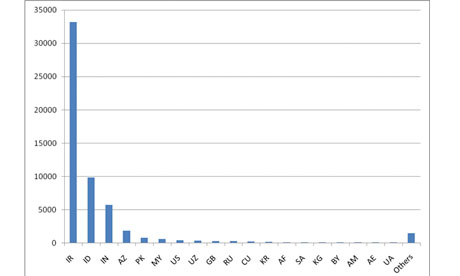
The worm was discovered in June, and researchers found about 45,000 infected computers in various countries, including Indonesia and India. But the vast majority were in Iran, leading analysts to conclude that a system in Iran was the likely target.
Iranian officials said Saturday that they had been hit by "electronic warfare" and acknowledged that the worm had infected more than 30,000 computers, including personal computers owned by employees of the nuclear power plant near Bushehr.
But although the officials said over the weekend that the facility itself was not in danger and that the virus was under control, Monday's remarks suggest otherwise.
Because of the worm's reach and complexity and the huge investment required to write the code, Alipour said he thinks the virus was designed by a foreign organization or country. "The writer has had access to industrial information which is not available to IT experts," he said, stressing that an ordinary group of hackers could not have designed the virus.
An Iranian computer expert said the nuclear power plant must also be infected if employees' personal computers were hit by Stuxnet. "This could either be done by Israel, intending to steal nuclear secrets or disrupt power plants, or by India, which has the biggest private programming capacity worldwide," said the expert, speaking on the condition of anonymity because of the sensitivity of the subject.
A low-level cyberwar between Iran and the West intensified after President Mahmoud Ahmadinejad's disputed election victory last year. Several groups of Iranian hackers, some of them alleged to have ties to the intelligence ministry, have been attacking opposition Web sites. In December, they temporarily disrupted the Twitter network, which they accuse of assisting the grass-roots opposition movement.
Hacker groups such as the Iranian Cyber Army and Ashiyaneh have been saying they disrupted thousands of Western sites in the past year. In return, hundreds of Iranian Web sites have also been under attack.
Tehran-based engineers specializing in repairing personal computers said they had not noticed any upsurge in demands of repairs because of the virus. Computers are widely used in Iranian society, with the Internet playing an important role in distributing opposition news that is censored by state media outlets.
Alipour said the worm had become active about a year ago. "It is different from any other virus," he said. "Stuxnet is extremely dangerous, and serious measures should be taken to clean it up."
Enhanced by Zemanta

Are We Secretly Fighting a Cyberwar Against Iran?

Stuxnet, a virus affecting Iran's nuclear facilities, appears to be a case of sabotage. If the United States is behind it, then Obama is already at war with Iran. READ MORE
By Robert Dreyfuss / The Nation

Enhanced by Zemanta

Monday, September 27, 2010

Who Launched A Cyber Attack Against Iran?


Graph shows concentration of Stuxnet-infected computers in Iran as of August.
Photograph:
Symantec

Web Virus Aimed At Nuclear Work, Says Tehran -- Financial Times

An internet virus that has damaged computer systems in Iran was designed by foreign governments to undermine the country’s nuclear ambitions, according to Tehran.

As western governments continued to analyse the origins and impact of the Stuxnet malware, which has affected at least 30,000 IP addresses in Iran, an official stressed the sophisticated nature of the virus.

Read more ....
lhttp://www.ft.com/cms/s/0/e4c82cea-ca5d-11df-a860-00144feab49a.html
More News On The Stuxnet Malware Attack Against Iran

Worm affects Iran nuclear plant -- BBC
Stuxnet worm rampaging through Iran: IT official -- AFP
Stuxnet Compromise at Iranian Nuclear Plant May Be By Design -- PC World
Report: Stuxnet Worm Attacks Iran, Who is Behind It? -- PC Magazine
Iran admits Stuxnet worm infected PCs at nuclear reactor -- Computer World
Pentagon Silent on Iranian Nuke Virus -- FOX News
Stuxnet worm mystery: What's the cyber weapon after? -- Christian Science Monitor
Could Iran Retaliate for Apparent Cyber Attack? -- FOX News/Reuters
Implications of Iran cyber attack affect all -- Globe And Mail/Reuters
Enhanced by Zemanta

Hostage crisis: French nuclear boss heads to Africa

Hostage crisis: French nuclear boss heads to Africa

The open pit Uranium Mine at Arlit.
by Staff Writers Paris (AFP) Sept 27, 2010http://www.nuclearpowerdaily.com/reports/Hostage_crisis_French_nuclear_boss_heads_to_Africa_999.html The chairwoman of French state-owned nuclear giant Areva is to visit the firm's operation in Niger, the company said Monday, after Al-Qaeda militants kidnapped several of her employees there. "Anne Lauvergeon plans to visit Niger soon," a spokesman said, declining to confirm a report that she would travel on Thursday. The purpose of her visit is to visit Areva employees in the region, the spokesman said.
Areva has been criticised for failing to heed warnings of a kidnap threat that an armed group was seeking to abduct foreign workers in the desert area where seven Areva expatriates were kidnapped on September 16.
The warning said the security situation in the Arlit region -- where Areva runs uranium mines and where the five French nationals, a Togolese and a Madagascan were kidnapped by Al-Qaeda linked militants -- was deteriorating.
Lauvergeon, who normally enjoys appearing in the media, has been keeping a low public profile since the kidnapping.
Enhanced by Zemanta

US hopes to resolve nuclear liabilities with India


The United States said Monday that it hoped to reach a solution with India on a law regulating its nuclear energy market after business leaders charged that it would deter investment. The issue arose during talks in New York between US Secretary of State Hillary Clinton and Indian Foreign Minister S.M. Krishna, which were meant to lay the groundwork for President Barack Obama's visit to New Delhi.
The United States and India in 2008 signed an agreement to open the way for cooperation in nuclear energy, a landmark step for the world's two largest democracies, which had prickly relations during the Cold War.
In hopes of meeting companies' concerns, India's parliament recently approved legislation to spell out their liabilities in the event of an accident, but some critics say the bill will instead discourage investment.
"We've taken note of some of the concerns that industry representatives have raised about some of the provisions of the liability bill and that the bill may possibly be inconsistent with international standards," said Robert Blake, the US assistant secretary of state for South Asia.
"We look forward to working with the Indian government to work our way through this and arrive at a solution where American industry can contribute to India's ambitious civil nuclear energy needs," Blake told reporters.
A clause in the legislation allows nuclear power plant operators to pursue suppliers of equipment, raw materials and services for 80 years after the construction of any plant in the event of an accident.
Opponents of weaker versions of the bill wanted to avoid a repeat of problems following the 1984 industrial disaster in Bhopal, central India, which involved US firm Union Carbide.
Obama plans in November to pay his first presidential visit to India, where many policymakers remain fond of his predecessor George W. Bush.
The Obama administration has vowed to build a broad global partnership with India, but some in New Delhi have been uneasy by Obama's early focus on China and Pakistan.
Blake said that Clinton and Krishna "agreed that the president's visit will be a defining moment in the history of our bilateral relations."

Russia to Begin Tianwan Nuclear Power Reactors Construction Next Year

Russia will begin construction of two addtional reactors at the Tianwan nuclear power plant in China next year, the head of the Rosatom state-controlled nuclear corporation said.Tianwan Nuclear Power Plant
Russia's nuclear power equipment and service export monopoly Atomstroyexport and its Chinese partner, the Jiangsu nuclear power corporation, signed a framework agreement this March on construction of two VVER-1000 reactors with a power output of 1000MW.
"The work must begin next year," Rosatom head Sergei Kiriyenko said.
The first two VVER-1000 reactors at the Tianwan nuclear power plant were started in 2007.
Atomstroyexport and the Jiangsu nuclear power corporation signed a general contract to build the plant, the largest project in Russian-Chinese economic cooperation, in 1997. The Russian company was charged with design work, equipment and material supplies, construction and assembly work, as well as training Chinese personnel.
Russia and China agreed that Moscow would receive $1.8 billion to build the second stage of the Tianwan nuclear power plant.http://nuclearstreet.com/nuclear_power_industry_news/b/nuclear_power_news/archive/2010/09/27/Russia-to-Begin-Tianwan-Nuclear-Power-Reactors-Construction-Next-Year-092703.aspx
Enhanced by Zemanta

Blog Post: TVEL Wins Contract for Nuclear Fuel Plant in the Ukraine from Nuclear Power Industry News

According to news reports, Ukraine's cabinet approved the Ministry of Fuel and Energy's proposal to construct the nuclear fuel plant at a meeting on 22 September, the country's national news agency Ukrinform reported.
TVEL was said to have won the tender as, unlike the other bidder Westinghouse, it had expressed willingness to invest its own money in the construction of the plant. The cost of constructing the fuel plant is put at some $212 million.
Vitaliy Lukianenko, the prime minister's press secretary, noted, "TVEL was unanimously supported during a competition for choosing the company to build the plant."
A condition of the tender is that Ukraine holds a controlling stake in the joint venture company that is to be established to manage the plant, despite TVEL likely to provide the majority of the funds to construct it. Another condition is the requirement for the transfer of technology for the manufacture of fuel assemblies under a non-exclusive licence by 2020 for reactors both in Ukraine and abroad.
According to Yuriy Nedashkovsky, president of national electricity generator Energoatom, nuclear fuel fabrication could start at the new plant in 2013. Initial production capacity of the plant will be 200 tonnes of uranium equivalent (tUe) per year of fuel rods and assemblies. In 2017, capacity to manufacture fuel pellets is set to increase to 400 tUe, while in 2020 the plant will be able to produce 400 tUe of fuel rods and assemblies.
Ukraine has 15 nuclear power reactors at four nuclear power plants (Khmelnitski, Rovno, South Ukraine and Zaporozhe), all operated by Energoatom. All the units are Russian VVER types, two being 440 MWe V-312 models and the rest the larger 1000 MWe units - two early models and the others V-320s. In 2009, almost half of Ukraine's electricity was produced by its nuclear plants.
In common with other VVER reactors, all of Ukraine's are routinely supplied with fuel by TVEL, although trials of 42 Westinghouse fuel assemblies are ongoing at the three South Ukraine units. This is taking place on an experimental basis, with final regulatory approval for the use of Westinghouse-supplied fuel outstanding.
Efforts to establish fuel manufacturing in Ukraine are an extension of this bid to break TVEL's technological monopoly on nuclear fuel supply. In addition to nuclear services, Ukraine also depends on Russia for much oil and gas, supplies of which have twice been cut off in a long-running payment dispute. Ukraine is able to mitigate this by supplying about 30% of the uranium that goes as the raw material for nuclear fuel. It also produces the zirconium alloys needed for fuel elements, but uranium enrichment and manufacture of finished fuel assemblies takes place in Russia.
Enhanced by Zemanta

Blog Post: Bloomberg: Constellation, EDF in Negotiations to Save Nuclear Venture

Electricite de France SA  and Constellation Energy Group Inc. are in talks to avoid the collapse of their U.S. nuclear venture, Bloomberg News reported on Friday, citing two people with knowledge of the discussions.
The Baltimore-based Constellation is due by December to decide whether or not to exercise a put option to sell non-nuclear plants to EDF for up to $2 billion -- a move that EDF would view as likely to jeopardize their relationship and a venture to develop new nuclear projects.
The talks began in the past two to three weeks and the companies expect to come to an agreement within the next month, one of the people told Bloomberg.
Constellation spokesman Larry McDonnell declined to comment on the put option with Europe's biggest utility, while Carole Trivi, an EDF spokeswoman, also declined to comment.
Full story at http://www.bloomberg.com/news/2010-09-24/edf-constellation-are-said-to-be-in-talks-on-saving-u-s-nuclear-venture.html
Enhanced by Zemanta

Iran Could Limit Uranium Enrichment, Ahmadinejad Says

Iranian President Mahmoud Ahmadinejad on Friday said his country could stop enriching uranium to 20 percent if it received fuel for a medical isotope production reactor in Tehran, the Associated Press reported (see GSN, Sept. 24).
Iran in February began refining low-enriched uranium from its stockpile to 20 percent. Although the move was ostensibly intended to produce isotopes for the medical research reactor, the United States and other Western powers have feared the process could help Iran produce nuclear-weapon material, which has an enrichment level around 90 percent. Tehran has denied harboring any military ambitions for its nuclear program.
"We were not interested to carry out 20 percent enrichment. They (the U.S. and its allies) politicized the issue. We were forced to do it to support the (medical) patients," Ahmadinejad told AP (Dareini/Heilprin, Associated Press I/Washington Post, Sept. 25).
"Whenever they give us the fuel and we are in possession of it, we can examine a halt" in production of higher-enriched material, Agence France-Presse quoted him as saying (Agence France-Presse I/Google News, Sept. 25).
Ahmadinejad blasted countries for imposing economic penalties on Iran over its nuclear program while offering incentives for atomic cooperation, AP reported. The U.N. Security Council in June adopted its fourth sanctions resolution aimed at pressuring the Middle Eastern nation to abandon its disputed nuclear efforts.
"The era of following a policy of carrot and stick is over. Even such words are insulting to nations. It's only good for cowboys and those of retarded people. Definitely it has no effect," the Iranian leader said. "They issued resolutions as talks were under way. Still, we are ready for talks."
An Iranian delegate is likely to meet next month with representatives of the five permanent Security Council member nations and Germany, Ahmadinejad said (Dareini/Heilprin, AP I).
European Union foreign policy chief Catherine Ashton unsuccessfully attempted this year to schedule new talks with Iran, AFP quoted U.S. National Security Council Chief of Staff Denis McDonough as saying.
"When she hears back, we will know whether they are serious or not," McDonough said (Agence France-Presse II/Yahoo!News, Sept. 24).
Russia called Saturday for the talks to take place in the near future, Interfax reported.
"I hope that this meeting, which we held at the level of the six countries' foreign ministers, and during which we adopted a very clear statement strongly confirming our readiness to resume talks, will have an impact, and these talks will not be a remote prospect," Russian Foreign Minister Sergei Lavrov said in a television interview, referring to a meeting last week between top diplomats from China, France, Germany, Russia, the United Kingdom and the United States (see GSN, Sept. 22).
"Our Iranian friends could offer their reaction to this situation more promptly," Lavrov said, adding that Iran "is quite a difficult partner in negotiations."
"As for the contents (of the Iranian nuclear dossier prepared by the International Atomic Energy Agency), Iranian partners could be much more constructive, and, I am confident, could respond to IAEA inquiries more rapidly. Certainly, they should have done what they promised us to do," he said (see GSN, Sept. 7; Interfax, Sept. 25).
No evidence exists that Iran is developing a nuclear bomb, but the nation must still prove that its atomic program has no military component, RIA Novosti quoted Lavrov as saying last week (RIA Novosti, Sept. 23).
At last week's International Atomic Energy Agency General Conference meeting, IAEA Director General Yukiya Amano only briefly alluded to the Iranian nuclear dispute while Beijing and Moscow expressed little interest in the matter, Islamic Republic of Iran Broadcasting on Friday quoted Iranian Atomic Energy Organization head Ali Akbar Salehi as saying. The meeting's lack of focus on Iran represented one of the event's accomplishments, Salehi said (Islamic Republic of Iran Broadcasting, Sept. 24).
"Mr. Amano must be careful not to lose his legitimacy due to his partisanship for certain policies," Salehi told Der Spiegel in an interview published today.
"We are asking ourselves: Is Mr. Amano interested in providing a pretext for an attack against us?" he asked, referring to U.S. and Israeli threats of military action against Iran's nuclear facilities (Dieter Bednarz, Der Spiegel, Sept. 27).
Meanwhile, U.S. President Barack Obama said Friday "there are no guarantees" that international economic pressure would prompt Iran to alter its atomic policies, AFP reported.
"This regime has shown itself to be very resistant to observing basic international norms and being willing to engage in serious negotiations around a nuclear program that has generated great fear and mistrust in the region and around the world," he said.
"But we do think that the sanctions raise the costs for the government," Obama said. "Most of these sanctions are targeted at the regime, at its military and we think that over time hopefully there's enough reflection within the Iranian government that they say to themselves, you know, this is not the best course for our people, this is not the best course for Iran" (Agence France-Presse III/Spacewar.com, Sept. 24).
Meanwhile, Iranian state media yesterday said a sophisticated computer worm has infected staff computers at the nation's Bushehr nuclear power plant, AP reported.
The worm "has not caused any damage to major systems of the plant," and workers were attempting to wipe the software from multiple infected systems, Iranian media quoted plant project manager Mahmoud Jafari as saying. The isolated infections would not delay the plant's scheduled opening next month, he said.
Iranian Atomic Energy Organization specialists held a meeting last week on possible methods to combat the "Stuxnet" worm (Associated Press II/Google News, Sept. 26).
"The attack is still ongoing and new versions of this virus are spreading," state media today quoted Iranian Information Technology Company deputy head Hamid Alipour as saying, according to AFP (Agence France-Presse IV/Google News, Sept. 27).
The worm appeared to have been designed by a government or well-financed independent group, Symantec Corp. security response operations head Liam Murchu told AP, adding that the worm was intended to hit multiple "high-value targets" (Lolita Baldor, Associated Press III/Google News, Sept. 27).
The United States indicated Friday it was unsure of the worm's origin, AFP reported.
"One of our hardest jobs is attribution and intent," National Cybersecurity and Communications Integration Center head Sean McGurk said.
"We've conducted analysis on the software itself," he said of the worm. "It's very difficult to say 'This is what it was targeted to do.'"
"We haven't seen any impacts or effects of what it does," McGurk added. "We know that it's not doing anything specifically malicious right now."
"It would be premature to speculate at this time" what entity produced the worm, he said (Agence France-Presse V/Google News, Sept. 25).
Elsewhere, Moscow today argued on behalf of its decision not to export an advanced air defense system to Iran. Some experts expressed concern that Iran could use the S-300 defenses to help protect its nuclear sites from potential airstrikes.
"These supplies fall under an embargo that the (U.N.) Security Council has introduced and force majeure applies here," Lavrov said, referring to contract language ruling out responsibility for an unforeseeable event (Agence France-Presse VI/Zawya, Sept. 27).
Enhanced by Zemanta

Russia Formally Invited to NATO Conference

Russia announced over the weekend that it had been formally invited to participate in the November NATO summit in Lisbon, Portugal, RIA Novosti reported (see GSN, Sept. 22).
"We have received an invitation for Russian top leaders to visit the alliance's summit in Lisbon," Foreign Minister Sergei Lavrov said in an interview with Russia 1 television. "(We) are preparing a report to" President Dmitry Medvedev.
Lavrov said the alliance stressed key items including the importance of boosting collaboration on missile defense, terrorism and Afghanistan (RIA Novosti, Sept. 25).
The Kremlin's chief diplomat said Moscow would base its decision on attending the event on "several major questions," Russia Today reported.
"The first is: what attitude will be chosen towards Russia? The second is: how will NATO regard itself in relation to international law, and the prerogatives of the U.N. Security Council?" he said.
Anticipated to be voted on at the November summit is a proposal to establish a NATO missile shield. Russia has been wary of U.S. and alliance plans to field missile defenses in Europe. Moscow contends that too strong a system would negatively impact its own nuclear deterrent.
Both U.S. Secretary of State Hillary Clinton and NATO chief Anders Fogh Rasmussen in recent days have called on the Kremlin to pursue joint missile defense with the alliance.
Lavrov criticized what he views as NATO's vague stance on Russia.
"On one hand, we are a partner but, on the other ... NATO's new members should be protected from us," he said (Russia Today, Sept. 27).
Enhanced by Zemanta

Medvedev to push modernization, energy goals on China visit

Medvedev to push modernization, energy goals on China visit

by Staff Writers Moscow (AFP) Sept 24, 2010 Russian President Dmitry Medvedev will travel to China on Sunday to expand economic ties with the world's largest energy consumer and try to engage Beijing in a range of business and trade projects. With a large business delegation in tow, Medvedev will travel to China at the invitation of Chinese President Hu Jintao, his second trip to the country since assuming office in 2008.
The packed agenda of his three-day trip will include visits to Beijing, Shanghai and Dalian, a port in northeast China which was under Russian control at the turn of the 20th century.
Relations between Moscow and Beijing -- once bitter foes during the Cold War -- have a turbulent history.
The two nations position themselves as counterweights to US global dominance and the Kremlin likes to call its ties with Beijing a "strategic partnership." But Moscow has been watching China's formidable economic might with a mixture of awe and uneasiness.
A key sticking point in ties is that Russian energy supplies still account for the bulk of economic cooperation, analysts say.
The Kremlin, on a mission to modernize Russia's hydrocarbon-dependent economy, wants more Chinese investments and know-how, while Beijing is in no rush to commit, they say.
"Russia has been increasing its energy and materials supply but China bought little else," said Chris Weafer, chief strategist at UralSib investment bank.
"Medvedev will undoubtedly push for Chinese support for his modernization programme and will try to get a commitment from the government to encourage its major corporations to increase investment in the Russian economy and especially outside of extractive industries."
Russia and China jointly run only three industrial parks, said Sergei Luzyanin, deputy director of the Far East Institute at the Russian Academy of Sciences.
"That's a drop in the ocean, of course. It's clear that you need hundreds of them."
"Russia, of course, is trying to entice large investment capital but it is not coming so far."
Energy is also expected to be a major focus of the talks.
"A whole set of documents (to be signed) is related to expanding cooperation in the oil and gas sphere," Medvedev's top foreign policy aide Sergei Prikhodko told reporters.
Russia is keen to diversify its energy supplies and has been in talks with China, the world's largest energy consumer, over gas deliveries.
With pricing remaining a major issue, those talks have dragged on for several years and Russia's powerful prime minister Vladimir Putin travelled to Beijing last October to try to push the talks forward.
Russia's energy czar and Putin's deputy, Igor Sechin, travelled to China earlier this month to lay the groundwork for Medvedev's trip.
During Sechin's visit, Russia and China announced plans to jointly build a 5-billion-dollar oil refinery in the port city of Tianjin and a network of at least 500 petrol stations in the country.
Last year, Moscow and Beijing agreed a 20-year deal to pump Russian oil to China in return for 25 billion dollars in loans.
After talks with top officials in Beijing, Medvedev will travel to Shanghai for Russia Day at World Expo.
Medvedev will kick off his China trip with a visit to Dalian, where he will visit a memorial to Soviet Union war dead.
Known in Russian as "Dalny" (remote), Dalian came under Moscow's control at the turn of the century and was the scene of a major clash between Russian and Japanese forces in the 1904-05 war known as the battle of Port Arthur.
Medvedev will visit the city at a time when China is entangled in a bitter territorial dispute with Japan. Some analysts have said Beijing may try to secure Russia's support in the diplomatic conflict.
Prikhodko said the Dalian trip had been in the works for a year and was intended as a "pro-Russian and not an anti-Japanese gesture."
Top billionaires including Viktor Vekselberg and Oleg Deripaska are set to follow Medvedev to China.
Enhanced by Zemanta